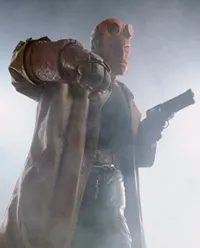
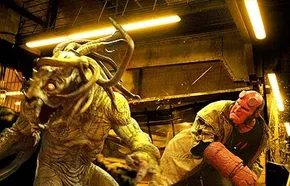
The character of Hellboy is huge. He’s loud, he’s red, and he moves with a fluidity that makes you forget you’re watching a man in a suit. He fights, jumps, runs, and trash-talks like a real person. But look closer. Most of that “flesh” is actually latex.
It’s a prosthetic masterpiece. Rick Baker’s Cinovation Studio designed the suit. It’s a marvel of modern creature makeup.
Ron Perlman knew it needed the right hands on set. He picked Jake Garber as his personal makeup artist. Every single day, Garber’s job was simple but grueling. Transform Perlman into the surly demon.
Garber isn’t new to this. He’s got over 20 years in the game. Ninety film and television productions under his belt. You’ve seen his work if you’ve ever watched a big-budget movie.
“Garber has been involved in over 90 film and television productions in his twenty-year career.”
He worked on Kill Bill Vol. 1. Kill Bill Vol. 2. The Hulk. Austin Powers in Goldmember. The Nutty Professor.
But makeup isn’t his only trick. He does animatronics. Puppetry. Stunts. Art direction. He’s even been in front of the lens. He played one of the alien invaders in Independence Day. He was the Spider Puppeteer on Special Unit 2.
We sat down with him. We talked about the demon. Here is what he had to say.
Life on the Set of Hellboy
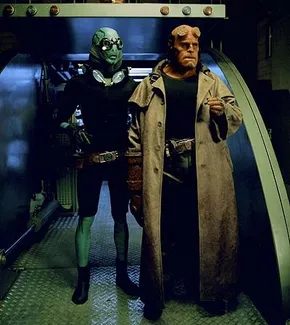
It wasn’t just waking up at dawn. That’s the myth people have about being a makeup artist on a big genre film. But in Prague, we worked Hellboy splits.
That’s industry speak for a schedule that starts in the middle of the day and runs until midnight. So, if you’re Ron Perlman, you don’t show up at noon. You show up much, much earlier. I’d be there about four hours before his official crew call.
The clock started ticking the moment he sat down. We were given a strict four-hour window to transform him. But let’s be real, he wasn’t in the chair for four hours straight. That would have been insane. The actual application and touch-up time hovered around two and a half hours.
Why the buffer? Because sitting under layers of prosthetic foam and latex for that long is brutal. I needed him to have space to stretch his legs. Grab a coffee. Maybe eat a little breakfast if he could manage it. It wasn’t just about getting the look right; it was about keeping a human being comfortable while they turned into a demon.
The Teletubby Stage
People always ask about the set of Hellboy. It’s easy to picture a gritty, dark warehouse. But the main stages we used were massive, bright, and oddly cheerful.
We shot on the Teletubby Stage. Yes, that Teletubby Stage. The same studio that gave the world those colorful, bobbing creatures. The contrast was jarring. You’d have Ron, fully transformed into the red-skinned, horned son of Hades, standing amidst the bright primary colors and clean lines of a set designed for preschool entertainment.
It creates a strange dissonance. One minute you’re thinking about the lore of the B.P.R.D. and ancient demons. The next, you’re looking at a backdrop that feels like it belongs on a children’s television network.
“It creates a strange dissonance. One minute you’re thinking about the lore of the B.P.R.D. and ancient demons. The next, you’re looking at a backdrop that feels like it belongs on a children’s television network.”
That environment demands a different kind of focus. You can’t get lost in the darkness of your character when you’re standing in a room designed to be inviting. You have to carry that weight internally.
The lighting on that stage was bright. Almost too bright for the textures we were working with. Foam latex doesn’t always play nice with high-key lighting. It can flatten things out. But we made it work. We adjusted the gels. We used negative fill to create shadows where the character needed depth.
It wasn’t just about hiding Ron’s face. It was about integrating him into that world. Making sure the red skin didn’t get washed out by the studio lights. Making sure the horns cast the right shadows on his neck.
And then, the breaks. When the cameras stopped rolling, the magic would slip away. Just a little. I’d check for peeling edges. I’d make sure the makeup didn’t shift during the move to the next setup.
There’s a rhythm to it. Apply, shoot, check, adjust. Over and over. For weeks. Months. The splits meant the nights were long. The days
Breaking in the Foam
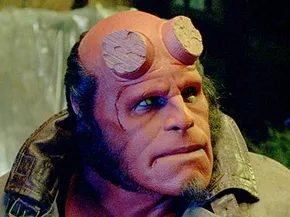
The process started with a heavy lift. We didn’t just slap on some cream; we built Ron up. The core of it was foam prosthetic pieces. The first thing we got him into was a monolithic unit. It covered his back and chest, flipped up over his head, traced his jawline, and settled hard against his pectorals. That’s the chest muscle. It was a structural foundation.
Then came the headgear. We started with a plastic cap to kill his hair. Think of it like a tiny helmet. Over that, we layered a foam piece. It blended right over his eyebrows and ran down the back of his skull. That’s where it locked into the neck and chest piece we’d already fitted. The ears weren’t separate appliances. They were molded right into the foam, attached to that plastic cap underneath.
Once that assembly was secure, we took a break. We let him walk around. Guillermo, who was directing, had a name for this phase. He called it the Teletubby stage.
It was a weird, surreal pause. Ron would stomp around set in that half-finished state. A giant foam head with no face, just ears and a jaw. It looked ridiculous. But it was necessary. You have to let the materials settle. You have to let the actor get used to the weight. You have to let the director see if the silhouette works from every angle before we start painting on the skin tones and scars.
The Final Touches
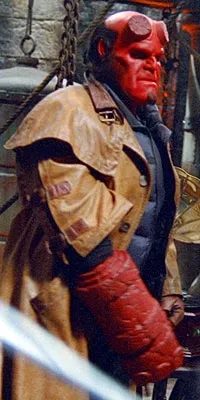
When Perlman returned to the chair after his Teletubby stint, the process shifted into high gear. The final two pieces were full-facial prosthetics that covered everything except his lower lip. I usually held off on that last piece until the very end. It gave Ron a window to grab a coffee or snag a snack without ruining the application.
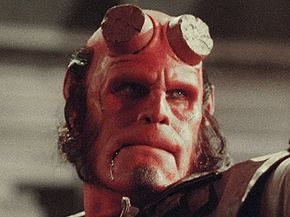
Once those main pieces were locked in, the painting began. People think Hellboy is just “red,” but that’s a myth. There were about four or five additional colors layered in to break up the flatness. We needed shading so he didn’t look like a plastic toy. Then came the hair. Four separate pieces went on: the samurai-style wig, the sideburns, and later, a little goatee. I’d slap the lower lip on right around then. Depending on the day, I’d also have to paint his hands to match the rest of the red suit. After that, in he went with dentures and contact lenses that covered his entire eye. Then the prosthetic hand went on. That was the typical day.
Not every day was the same. About half a dozen times, we did him from the waist up. That was a completely different beast. It took five hours to get him in the suit. We needed three or four assistants helping with different phases of that massive application.
The Anatomy of a Monster
So in the final Hellboy costume, how much of Ron Perlman is actually visible? His eyelids. That’s it.
The team at Rick Baker’s shop did the heavy lifting on sculpting. They carved out a piece designed to carry Ron’s actual facial features through the makeup. It wasn’t just paint on rubber. It was engineering.
Getting the Job
Learning the trade
I didn’t come into this with a formal degree in creature work. I came in knowing Ron Perlman. We had bounced around together on Star Trek: Nemesis. It’s a specific kind of chemistry you build when you’re stuck in a trailer for hours at a time. He mentioned this project while we were wrapping up that Star Trek gig. I was interested, obviously, but the industry is full of “maybe later” conversations. You say you’re interested. You hope something sticks.
This time, it stuck.
The plan was to run my standard Baker shop process. I’ve done the heavy lifting on projects like The Nutty Professor before, so I knew the drill. Ron pulled some strings. He asked for me specifically. I wasn’t just an option; I was the request.
The schedule was brutal. I did a test makeup for Ron in October. Right after that, I was gone. Four months in Europe. I flew to Prague to start work on a different film. But I didn’t stay there long. I got back from Europe literally one day after leaving the previous shoot. No rest. No decompression. I went straight to a second makeup test for Hellboy. Two days later, we started shooting.
It’s not a resume line you can prepare for. It’s just showing up when the phone rings, usually at 3 a.m., with your kit packed and your coffee cold.
The Accidental Path to Prosthetics
Jake Garber didn’t start with a degree. He started with a library card and a horror obsession. Originally from Minnesota, Garber studied theatre at the University of Minnesota but never finished. There were no formal makeup classes on the menu. Just him, old theatre books, and a growing fascination with practical effects.
It was essentially a Halloween hobby that spiraled out of control.
“Go to the library and read any kind of article on it; studying old theatre books… It was always a fan of horror movies.”
Most pros in the prosthetic world share this scrappy background. Garber sculpted and drew cartoons as a kid. The Midwest didn’t offer many outlets for that kind of thing, so he made his own. By his late teens, he was earning a living in Minnesota. The early 80s were kind to a multi-hyphenate kid. He shot corporate training films. He did photo shoots. He worked on theatre productions.
It wasn’t glamorous. It was survival.
The California Gamble
That grueling period taught him everything. He wasn’t just painting faces. He was building hair pieces. He was crafting prosthetics. He was learning the entire pipeline.
In 1989 or 1990, he packed up and moved to California. The plan was simple: show his portfolio around and see what happened. He didn’t expect much. Hollywood is a gatekept city. You don’t just walk in.
He walked in. And on day one, he landed a job.
The shop was making walk-around masks for Universal Studios. Frankenstein. The Creature from the Black Lagoon. Big IP. Big sets. He stuck it out. He kept going. He’s tracked every single job since that first day in Los Angeles.
The Grind of Practical Effects
Moving to Hollywood wasn’t the end of the struggle. It was just the beginning of a different kind of grind. The work at Universal was steady, but it wasn’t the creative freedom he eventually sought. It was manufacturing. It was volume.
But it was entry. It was proof he could do the job.
From there, the trajectory shifted. He started getting calls for indie films. Then bigger projects. The horror genre became his natural home. Why? Because he understood the mechanics. He knew how to make something look terrifyingly real on camera. He knew how to make it work under tight deadlines.
The training wasn’t in a classroom. It was in the glue and latex. It was in the late nights. It was in the mistakes.
Garber’s career is a testament to the idea that you don’t need a stamp of approval to break in. You just need to be able to do the work. And you need to be willing to do it badly at first. Then better. Then consistently.
The industry changes. Digital effects take over. Budgets shrink. But the hand-sculpted prosthetic? It still holds weight. It still has texture. It still breathes.
Garber didn’t ask for permission. He just kept sculpting. And kept working.
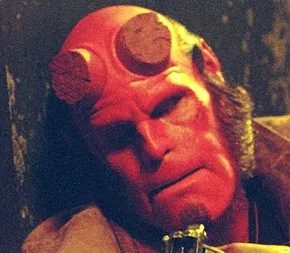
Doing prosthetics for Hellboy wasn’t just a job. It was an endurance test. Jake Garber didn’t just apply makeup once or twice. He did it 86 times for Ron Perlman’s iconic role. That number alone should make your head spin. Most makeup artists barely touch a character a dozen times in their entire career.
The duration was the real killer. Usually, you’re on set for one or two days. Or maybe the character doesn’t show up for most of the film. But Ron Perlman’s character was there. Every day. Garber kept asking himself if he could actually hang on that long. The pressure was constant. The repetition was brutal.
The Curse of the Critical Eye
You’d think making magic happen in person would make you better at watching it. It doesn’t. For Garber, going to the cinema is a pain. He can’t switch off. He’s scanning for flaws. If the makeup effects look off, the whole movie breaks for him. It pulls him right out of the story.
So when it works? It’s a treat. A rare, genuine treat. When the illusion holds, he’s in. But when it fails? Game over. It’s a tough way to live. He admits watching Hellboy at its premiere was messy. He was too busy analyzing the application to enjoy the premiere.
Final Thoughts
He knows he needs to watch the film again. Just once. Without the critic’s microscope. Maybe then he can actually see the movie. Not the prosthetics. Not the seams. The story. Until then, the Hellboy makeup remains a masterpiece he helped build, and a reminder of why he might never fully relax in a dark theater again.
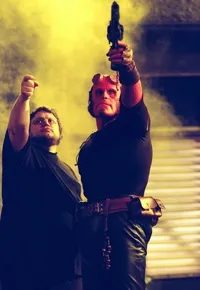
The Real Title Behind the Prosthetics
You spend years mastering prosthetics, animatronics, puppetry, and SFX makeup. It is a chaotic, messy, highly technical field. So what do you actually call yourself?
Technically? A makeup artist.
Jake Garber made the shift away from the shop environment specifically to focus on the application side. He stopped building the world and started inhabiting it with actors. It is a distinction that matters.
Why Chemistry and Psychology Matter More Than You Think
Being a special-effects makeup artist is not just about gluing foam latex to skin. It is a broad term for a skill set that requires a strange mix of chemistry and psychology.
You need to understand materials. But more importantly, you need to read the room.
Garber says you have to figure out quickly what an actor wants when they sit in the chair. Do they want to chat? Do they need silence to prepare for the day? Are they running lines? You are not just applying makeup. You are managing the actor’s headspace while transforming their face.
“Special-effects makeup artist is a broad term. There’s a broad range of stuff you have to understand to even get into it.”
The “Hellboy” Anecdote That Defines the Industry
Speaking of Hellboy, the stories from the set are the stuff of legend. But the funniest one involves John Hurt.
Hurt was sitting in the chair. He was smoking a cigarette. Talking to a crew member.
This was someone who had worked with him on Alien. They hadn’t seen each other in years.
Here is the kicker. The last time they were in the same room, this crew member was stuffing entrails into John Hurt for the film.
You meet a lot of interesting people in this business. The line between horror and reality blurs faster than you think.
Where to Dig Deeper
If you want more on how this industry functions, or just want to geek out over the lore, there are paths to follow.
The official site for Hellboy still holds the archives. Ron Perlman’s legacy in the franchise is well documented. You can find reviews and figures on E! Online.
For the tech side, check out RevolutionSF. It is a great spot for practical effects enthusiasts.
The comics-to-film pipeline is where the magic happens. Comics2Film breaks down the adaptation process. It is worth reading if you want to understand how a character like Hellboy survives the jump from page to screen.
The Bigger Picture
This work does not exist in a vacuum. It ties into broader questions about movie screens, distribution, and even the cultural fascination with monsters.
How do vampires work in modern cinema? How do mummies become relevant again? It is all connected.
Superhero quizzes might seem like fluff, but they reveal how audiences engage with these characters. Illustration techniques inform the visual language of the films.
It is a ecosystem. You watch the movie. You see the prosthetics. You read the article. You ask how it was made.
That is the cycle.