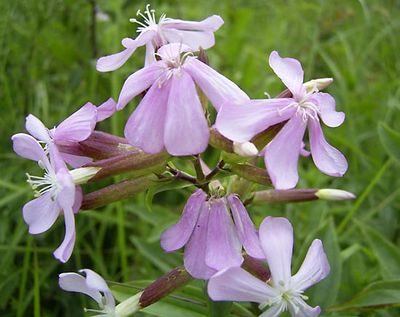
If you have ever seen a patch of pink or white flowers growing wildly near a fence line in eastern North America, you might have stumbled across common soapwort. This plant, known by its more colorful nickname “bouncing bet,” is part of a genus called Saponaria. There are about 40 species in this group, all members of the pink family, technically known as Caryophyllaceae.
While they look delicate, these plants are tough survivors. They are native to Eurasia but have spread far beyond their original homes. Many have become weedy, naturalizing in places they were not planted. A few varieties are kept in gardens specifically because their blooms are pretty. But the real story of soapwort lies in its name and its history.
What a Soapwort Plant Looks Like
These plants can be annuals or perennials. They grow from underground rhizomes, which are horizontal stems that send out roots and shoots. You can find them standing upright or spreading out low to the ground.
The leaves are simple. They are roughly oval or taper to a point. Depending on the species, the stems and leaves might feel waxy to the touch or covered in fine, soft hairs.
The flowers are distinct. Each has five petals. The colors range from stark white to various shades of pink, pale purple, and red. When the flower dies back, it produces a fruit called a capsule. Inside are numerous dark brown seeds, ready to scatter and start the cycle over again.
Specific Species and Uses
Not all soapworts are created equal. Some are niche garden plants. Others are common weeds with a big history.
Rock soapwort, also called tumbling Ted (S. ocymoides ), is a trailing species. It has several cultivated varieties. These produce clusters of flowers that range from soft pink to deep red. It is often used in rock gardens or hanging baskets because it spills over edges nicely.
Then there is pygmy pink (S. pumilio ). As the name suggests, this is a very small alpine plant. You might find it grown in rock gardens by enthusiasts who appreciate its compact size and hardiness in cold climates.
The most significant species for humans is common soapwort (S. officinalis ). It can reach up to a meter high, which is about three feet. It has become widely naturalized in eastern North America.
Why does this matter? Historically, this plant was useful. Its roots were used for medicinal purposes. But the sap is the real draw. It creates a lather when mixed with water. People used it as a substitute for soap. The name Saponaria comes from the Latin word for soap. The plant literally gave its name to the cleaning product we still use today.
The sap of common soapwort acts as a natural detergent, linking the plant’s identity directly to human hygiene practices for centuries.
Today, you are more likely to see it as a garden escapee than a source of laundry detergent. But the connection between the flower and the soap remains. It is a reminder that many of our modern products have roots in the wild plants that grow just off the roadside.
The plant’s ability to spread so easily makes it a resilient survivor. It thrives where other things might struggle. For gardeners