The Universe is vast. Terrifyingly so. Yet the most intriguing mysteries might just be hiding in our solar neighborhood. A NASA probe is currently speeding toward one of those mysteries. It’s an asteroid unlike any other object we have ever explored.
“For the first time ever, we are exploringa world made not of rock or ice. But metal,” astronomers say. This isn’t hyperbole. It’s a scientific declaration of intent.
The Mars Flyby: A Gravity Assist Masterclass
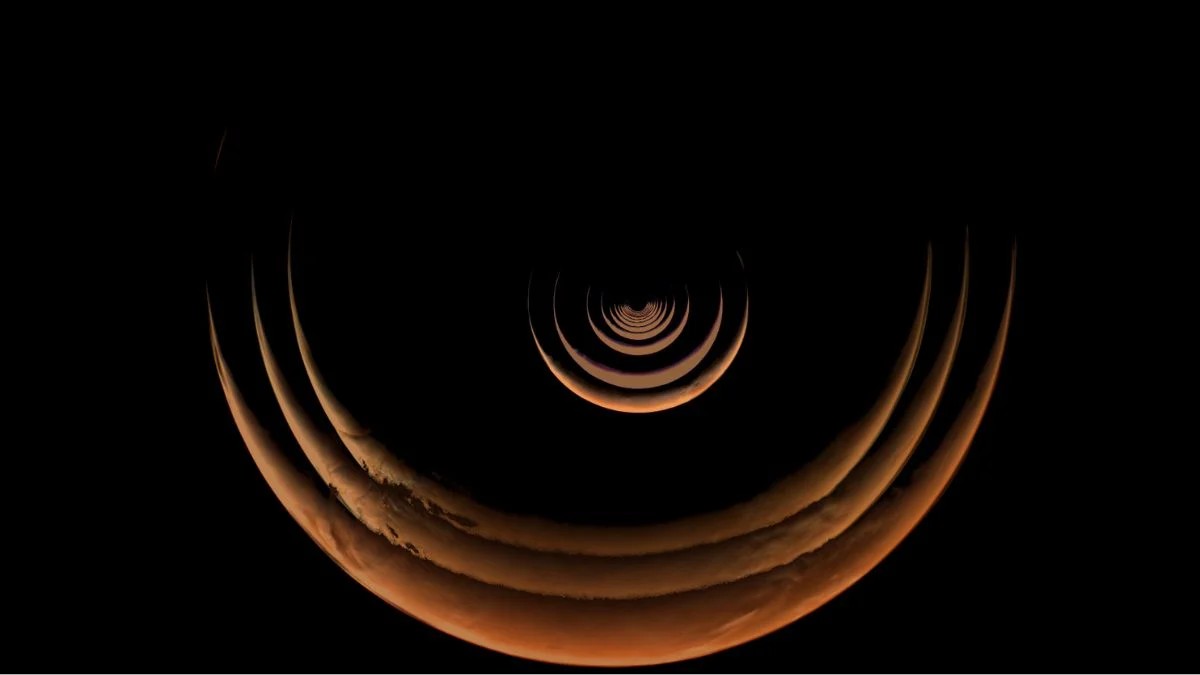
On May 15. The Psyche spacecraft skimmed past Mars. It came within just 2,800 miles (4,600 km) of the red planet’s surface. It was moving fast. More than 12,000 mph (19,848 km/h).
The result? A trippy, breathtaking timelapse of Earth’s neighbor. But the visual poetry was secondary. This flyby served a critical mechanical purpose.
First, it acted as a dress rehearsal. The probe’s sensors needed calibration before tackling the asteroid. They looked at Mars’ “bow shock.” This is the boundary where solar wind particles are diverted around the planet. Like a ship cutting through waves.
They imaged the south polar cap. Rich in water ice. They also captured images of Huygens crater, which features a double-ring structure. These details help refine the navigation algorithms for the main event.
But the real reason for the maneuver? Speed.
Mars acted as a planetary slingshot. A gravity assist. The spacecraft gained approximately 1,000 mph without burning a drop of its xenon propellant. It “stole” a tiny fraction of Mars’ orbital energy. Mars slowed down by an imperceptible amount. Psyche sped up.
“We’ve confirmed that Mars gave the spacecraft a boost,” says Don Han, Navigation Lead at NASA’s Jet Propulsion Laboratory (JPL). “And shifted its orbital plane by about 1degree.”
This wasn’t luck. It was calculated years in advance. Bob Mase, the Psyche project manager at JPL, notes that the team nailed the trajectory. It set the course for a rendezvous with the asteroid in 2029.
“This gravity assist was years in the making. And the navigation team nailed it.”
Destination: The Metal Asteroid
Psyche is named after the Greek goddess of the soul. Italian astronomer Annibale De Gasparis discovered it in 1852. It orbits in the main asteroid belt. Three times farther from the Sun than Earth. Between Mars and Jupiter.
Why does this asteroid matter?
Astronomers hypothesize that Psyche might be the exposed iron core of a protoplanet. A “planetesimal.” Imagine a embryonic planet that formed early in the solar system’s history. Then collided. Shattered. Stripped of its rocky mantle.
We are looking at bare bones. The Solar System’s ribcage.
“Psyche is approximately280 kilometers across… its overall composition is contentiously uncertain.”
The asteroid is roughly the size of Massachusetts. But we don’t know what it’s truly made of. Some argue it’s a solid metallic core. Others suggest it’s a rubble pile of metal fragments held together by gravity. We won’t know for sure until August 2029.
The Hardware on Board
Launched in 2023 on a SpaceX Falcon Heavy rocket. The Psyche spacecraft is about the size of a singles tennis courts. Solar-powered. Equipped with a suite of sophisticated instruments.
Here is what it carries:
- Multispectral imager: Captures data in different wavelengths of light.
- Gamma-ray and neutron spectrometer: Determines surface chemical composition.
- Magnetometer: Measures the remnant magnetic field.
- X-band radio system: Maps the gravitational field and inner structure.
The mission is also testing something new. Deep Space Optical Communication (DSOC). Instead of traditional radio waves, it uses near-infrared lasers. This system beams data back to Earth. It even transmitted the first interplanetary video of a cat.
Lindy Elkins-Tanton. Principal Investigator of the Psyche Mission. Says the instrument teams “worked overtime” during the Mars flyby. All instruments delivered excellent results.
What’s Next?
The spacecraft is in great health. NASA plans to resume sustained thrusting with its solar-electric propulsion system this fall. They need to fine-tune the orbit for the final approach.
Whether Psyche is a pristine ancient core or a chaotic pile of debris. It will be revealed soon. Or at least. Before the decade is out.
We are going to a metal world. One we barely understand. To find out if it’s the heart of a dead planet or just space junk.
The wait is long. The science is new. And the Universe is still waiting to tell its secrets.