Ancient builders loved a good reprieve. Or, more accurately, a good reuse. That’s the likely story behind a massive sandstone slab featuring an Egyptian pharaoh stomping on foreign invaders. For a long time, this block was buried. Literally. It formed part of the foundation for the unfinished mortuary temple of Ramesses II’s descendant, Ramesses IV. Ramesses IV reigned from 1153 to 1147 B.C. during the 20th Dynasty. But the stone itself? Much older. It likely dates to the reign of Amenhotep II. That puts it between 1427 and 1153 B.C., squarely in the 18th Dynasty.
Herbert E. Winlock found it in Luxor. He was an Egyptologist, and later director of the Metropolitan Museum of Art. That discovery happened in 1912. Winlock initially thought the scene showed the pharaoh slaying enemies with a bow. He called the piece one of the “best preserved specimens of the great imperial pictorial relief yet discovered.” The colors are still vibrant. The paint is intact. Why? Probably because it was tucked away in those temple foundations, shielded from the sun and weather.
A Chariot, Horses, and Trampled Enemies
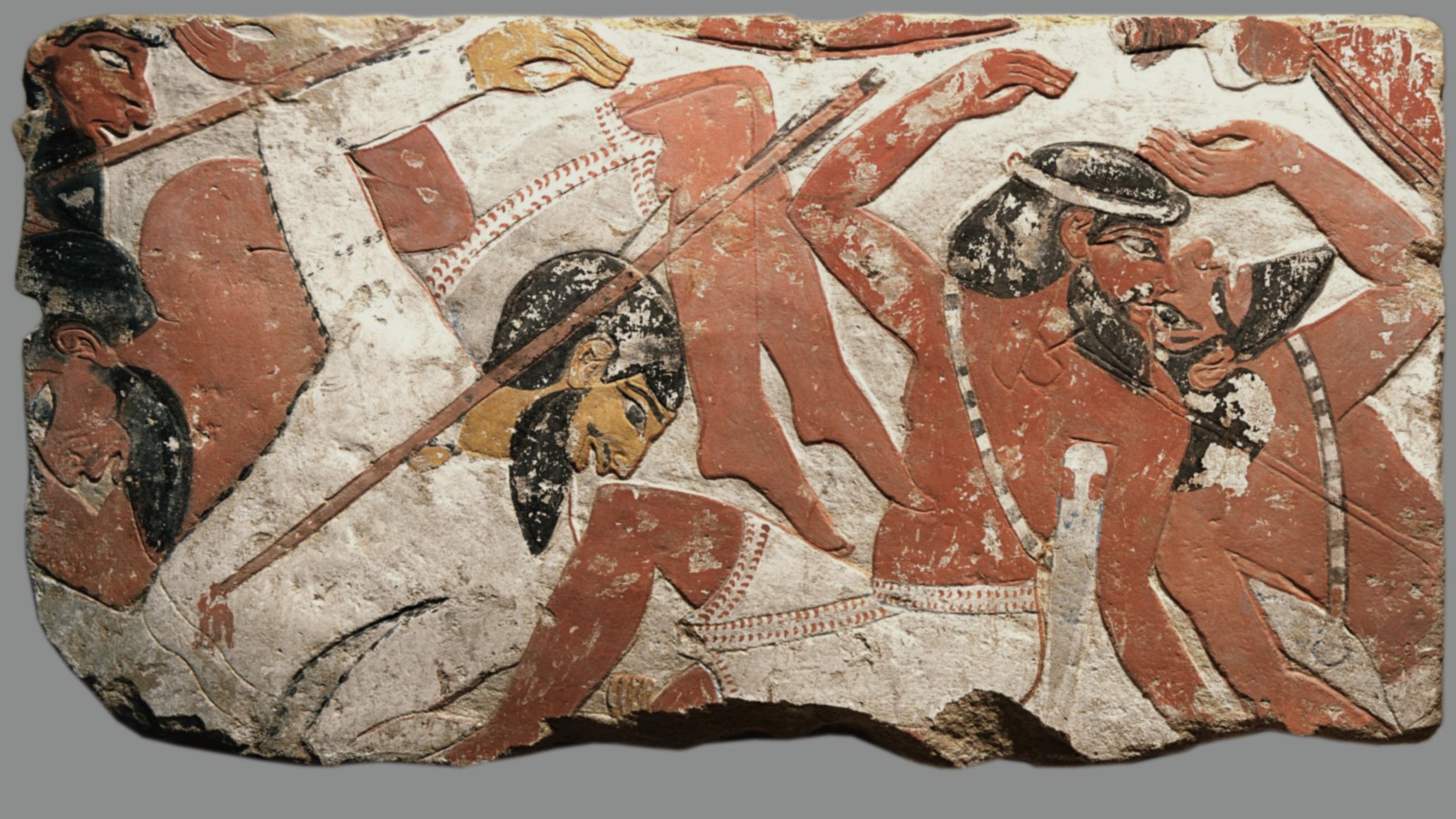
The fragment is big. Roughly 24 by 45 inches. That’s about 61 by 115 cm of painted sandstone. According to Catharine Roehrig, a curator emerita at the Met, this slab was part of a larger narrative. It depicted an Egyptian pharaoh vanquishing a foreign army. You can see the royal chariot in the upper right. The horses are there. The pharaoh is there. Below them, chaos.
Three enemies have been pierced by arrows. Another soldier is trying desperately to avoid being trampled. His body language screams panic. The scene isn’t just violence; it’s dominance. The pharaoh isn’t just winning. He is crushing.
Who Were the Enemies?
The visual clues point north. Or east. The defeated soldiers have pointed beards. They wear distinctive clothing. James P. Allen, another Met curator, suggests these figures were ancient Syrians. Or possibly the Hyksos. The Hyksos were a Semitic-speaking dynasty. They ruled Egypt from about 1640 to 1570 B.C. during the Second Intermediate Period. By Amenhotep II’s time, they were gone. So why depict them? Or Syrians, for that matter?
The battle scene likely reflects historical conflicts. 18th Dynasty pharaohs like Amenhotep II fought against Asiatic rulers. The relief serves as a reminder. A permanent, stone reminder of Egyptian power over Western Asia.
The Real Purpose: Propaganda, Not History
Here’s the twist. The relief probably wasn’t a documentary of one specific battle. Roehrig notes that its primary purpose was different. It was to portray the pharaoh as the victorious defender of Egypt. This role was essential. It justified rule. It secured divine favor. The specific enemies mattered less than the act of vanquishing.
“Their primary purpose was to portray the pharaoh in his role as the victorious defender of Egypt “
The stone was reused. It was buried. It survived millennia. It ended up in New York City. Today, it hangs in the Metropolitan Museum of Art. The paint is still bright. The arrows still fly. The chariot still rolls.
Did Amenhotep II actually fight this exact battle? Maybe. Maybe not. Does it matter? Not really. The message was clear. And it’s been echoing for 3,400 years.
For more on these kinds of discoveries, check the Astonishing Artifacts archives. Can you put together last week’s Astonishing Artifact?