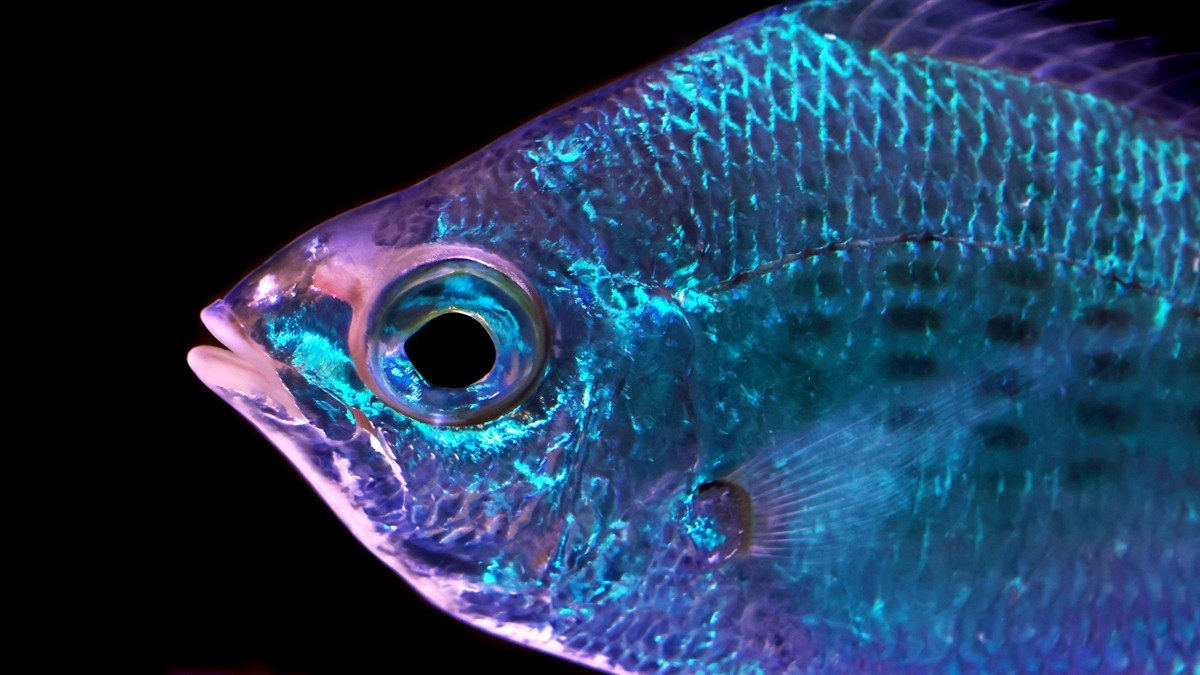
Glittering schools of fish look like living disco balls. Tiny mirrors flashing in unison. We assume they are just bouncing light off their scales. A passive reflection. A trick of the eye.
That assumption is likely wrong.
Masakazu Iwasaka, an interdisciplinary engineer at Hiroshima University, has spent decades watching light hit fish. Now he has evidence that suggests these creatures do far more than reflect. They might actually sense it.
In a preprint paper—still awaiting peer review—Iwasaka argues that specialized pores in fish skin react to light. Not just bounce it back.
He focused on the cobalt silverside fish (Hypoatherina tsurugae ). These guys hang out in the shallow waters near Japan and Korea. Their skin is packed with something called iridophore cells. Inside those cells? Crystals of guanine.
Here is the thing about guanine. It doesn’t use pigment like our melanin does. It uses structure. The crystals bend and reflect light at different angles. Structural color. It’s why opals shine and peacocks strut.
How Iridophore Cells Change State Without Muscle Movement
Iwasaka wasn’t the first to notice something odd about these fish. Earlier work showed that iridophore spots on their dorsal trunks flashed at frequencies of several hertz. Rapid. Repetitive.
And here is the kicker. It happened independently of body motion. The fish weren’t moving. The skin was.
He categorized the flashes into three states. Poetic names, but precise data.
* Static bright
* Dynamically twinkling
* Dark
He suspected environmental light levels triggered these shifts. So he tested it.
Twenty-two wild-caught silversides ended up in a standard lab aquarium. To get a microscopic view, some were briefly anesthetized, filmed with a microscope-lens camera, then returned to the water.
First, he hit them with a white LED. Standard room light. The iridophores stayed in ‘static bright’ mode.
Then he turned the direct light off.
The shift was instant. The iridophores flipped to ‘dark’. Think of it like your pupils constricting in the dark. The guanine crystals stopped reflecting with the same intensity. As if they had physically shifted position.
But it wasn’t permanent. Soon, they adjusted back to the ambient room light. Back to ‘static bright’.
Which Wavelengths Trigger the Strongest Reaction in Fish Skin?
Iwasaka didn’t stop at white light. He needed to know if the skin could distinguish color.
He cycled through blue, green, and red LEDs. He even used blue lasers and two types of green lasers.
The results were clear.
“Spectral analysis revealed that this quenching response,” Iwasaka writes, “was most sensitive to blue light compared with green and red illumination.”
When the blue light hit, the reaction was sharpest. After cutting the direct light source, the iridophores returned to their twinkling state in about 10 seconds.
Ten seconds is fast. Really fast.
Iwasaka suggests that slow cellular restructuring can’t explain it. He proposes neural modulation. The fish’s brain might be telling the skin what to do.
The speed and reversibility of this response… raise the possibility of neural modulation in addition of intrinsic photoreceptive processes.
He suspects opsins. You know those proteins in your retina that help you see? Iwasaka thinks similar proteins might be hiding in the fish’s skin.
But he admits he doesn’t have the proof yet. The current study stops at observation. It doesn’t probe the molecular mechanics. It hasn’t even passed peer review. There could be errors. Omissions.
Still.
If fish skin can sense blue light as quickly as it reflects it, we have to rethink how these animals perceive their world. They aren’t just hiding from predators. They are feeling the light.
Is that a sensory system or a defense mechanism?
Maybe it’s both.
Maybe we’re just looking at the wrong end of the equation.