We forget our earliest days. Completely. New research suggests it’s not that those moments were never recorded, but that the hardware for remembering them was too noisy, too messy, too overconnected.
The idea that the brain is a tabula rasa, a blank slate waiting for experience to write upon it, has lingered for a century. Science is starting to scrap it. At least, for the hippocampus.
The messy architecture
Published in April in Nature Communications, the study looks at mice. Mice have brains, memories, and hippocampi that work somewhat like ours do. Specifically, the CA3 region. This part of the brain handles storage. And retrieval.
Researchers examined brain tissue at three stages: newborn. Adolescent. Adult.
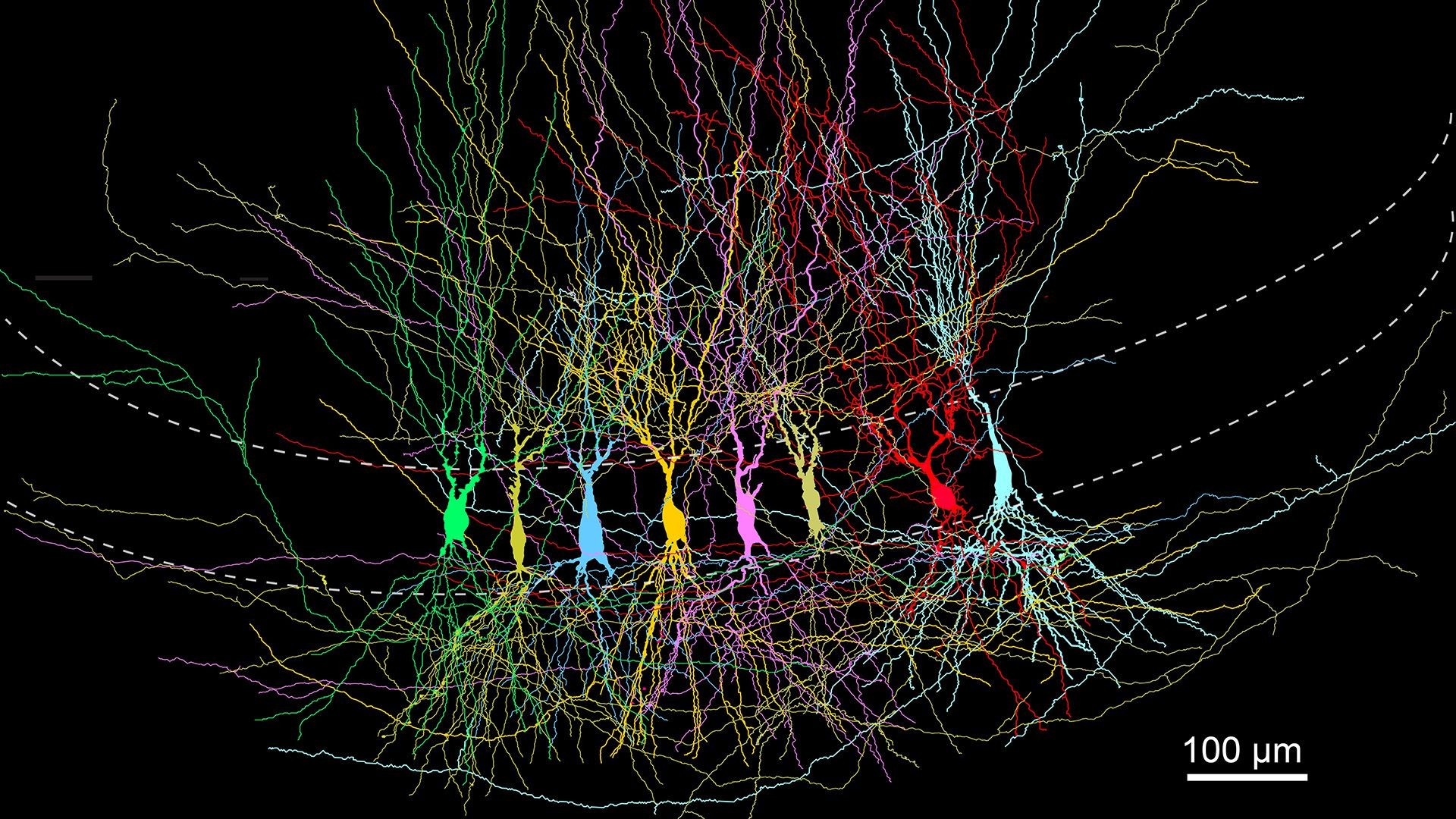
Here is what they saw. Newborn networks were dense. Chaos, essentially. Neurons fired off wildly, linked by hyper-connections that looked random, almost accidental. As the mouse aged, that noise didn’t just fade, it got carved out. Pruning. A massive decluttering project started shortly after birth and ramped up by adolescence.
The mature brain wasn’t built from nothing, piece by piece. It was edited down.
“It starts out as a tabula plena, a full slate, and then becomes more sparse,” says Peter Jonas, co-author of the study at IST Austria. He didn’t say this gently. The brain arrives pre-filled. Then it deletes the excess.
Why the fog?
So why do we remember nothing of being an infant?
Precision. Or lack thereof.
In a mature brain, a neuron usually needs multiple inputs to fire. It’s picky. Specific. But in a young mouse (or human) brain, one little spark is enough. A single input triggers a fire sale of electrical activity.
It sounds efficient. It isn’t.
When everything is connected to everything, memories blur. Input A looks like Input B because they both set the whole room on fire. The resulting memory is a vague, broad smear, not a distinct event.
“The system is very active but not precise.”
This isn’t just theoretical. In experiments, young mice learn to fear a shock. But they don’t just freeze at the spot where they were shocked; they freeze in any similar corner of the cage. They know “danger” is near. They don’t know where.
Adult mice freeze exactly where it happened. Specificity returns with pruning. As the unnecessary connections are cut away, the remaining pathways become clear lines. Stable memories replace fog.
Nature writes the first draft
Does this mean pre-birth experiences count? Probably not as memories.
Hauður Freyja Ólafsdótter, an independent expert at Radboud University, notes the finding aligns with developmental psychology. We get sharper with age, both psychologically and physically, at the circuit level.
But why be so chaotic to begin with? Why the noise?
Jonas theorizes it’s about speed. A blank slate is a slow start. Neurons might be too isolated to talk to each other. By starting over-connected, the brain ensures that sights, sounds, and smells can immediately link up. It’s a genetic head start.
Pre-birth experiences might leave traces. Subtle, maybe psychological. But those aren’t the detailed autobiographical memories we construct later. They’re shadows, Jonas says.
The slate wasn’t empty. It was overflowing. We only remember clearly once the brain learned what to forget.