New data suggests the Earth was already decaying long before Chicxulub hit.
Sixty-six million years ago, the asteroid slammed into Mexico’s Yucatán Peninsula. It ended the reign of nonavian dinosaurs. It cleared the board. In the chaos that followed, small, adaptable mammals rushed into empty niches. They evolved faster diets. Larger bodies. Diverse lifestyles. Within a few million years, they dominated the land.
But new evidence published May 12 in PNAS complicates that narrative.
A team led by Dr. Arturo Casadevall of Johns Hopkins University found microscopic evidence of environmental fungal blooms both before and after the Cretaceous-Palaeogene (K-Pg) extinction event. The spikes aren’t just post-apocalyptic cleanup crews. There was a fungal surge roughly 30,00 to 1000,00 years before the asteroid struck. This early bloom coincides with intense volcanic activity in the Deccan Trap in India. Cooling. Stress. Decay.
This finding breathes new life into the Fungal Infection Mammalian Selection hypothesis, or FIMS hypothesis.
For two decades, this controversial idea has argued that fungi gave mammals an evolutionary edge. Not by killing dinosaurs directly, but by creating a hostile environment where mammals’ biology held a distinct advantage. Egg-laying reptiles and dinosaurs couldn’t handle the rot. Mammals could.
Is this the missing link in mammalian dominance? Or is it a chain of plausible arguments holding together by sheer force of will?
The Rot Before the Impact
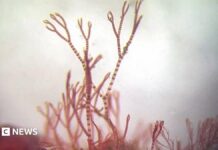
Casadevall and researcher Rosanna Baker analyzed palynomorphs from the Denver Basin in Colorado. These are tiny fossilized organic remains—fungal spores, hyphae, pollen—preserved in ancient sediment.
They looked at layers spanning roughly 60,000 years of the K-Pg event. Most samples were plant-heavy. Some layers? 50% fungal spores.
High fungal proportions signal ecological disturbance. More dead stuff means more fungi eating it. After the asteroid, this made perfect sense. Dead plants and animals littered devastated ecosystems.
But the earlier spike? That was surprising.
“What surprised us was the proliferation in association withDeccan volcanism,” Casadevall told Live Science. This implies ecological disruption prior to the meteor impact. Ecosystems were already stressed. Already facing fungal overgrowth. The asteroid just delivered the final blow to a world that was already sick.
This mirrors findings in New Zealand, suggesting the bloom wasn’t local. It was global.
Why Mammals Survived the Fungal World
The core of the FIMS hypothesis rests on mammalian biology. Specifically, immunity and temperature.
Fungi are major pathogens for plants, insects, amphibians, and reptiles. Systemic fungal infections that kill mammals are relatively rare. Why? Sophisticated immune systems.
Mammals have first-line defenses. Neutrophils recognize fungal cell walls. They engulf spores. They attack invasive filaments. The adaptive arm builds custom antibodies. It creates immune memory.
Temperature played a role too. Mammals maintain high, stable body temperatures—97 to 104°F (36-40°C). Many environmental fungi can’t survive those internal conditions.
When the asteroid hit, it triggered “impact winter.” Ash and dust blocked the sun. Forests burned. Darkness fell. Dead matter piled up.
Mammals could forage in the cold. Dinosaurs, often thought of as “cold-blooded,” struggled to stay active. Weakness made them susceptible to disease.
Gestation mattered too. Mammals protected embryos inside the womb. Warmth. Immunity. Shielding.
Dinosaurs laid eggs in nests. Soil. Decaying plant matter. Perfect fungal habitats. Fossilized hyphae (fungal threads) have been found in dinosaur eggshells. Did fungi invade living eggs? Or colonize them after death? We don’t know. But it’s a clue.
The Case Against: It’s Complicated
Not everyone buys it.
Mary O’Connell, Chair of Zoology at the University of Manchester, says the hypothesis doesn’t fit all evidence. It emerges from a chain of plausity arguments rather than direct proof.
“Links in the chain are weaker than the framing suggests,” she noted.
Consider body temperature. When Casadevall first proposed this in 2005, dinosaurs were viewed as cold-blooded. Mammals were warm-blooded. That distinction offered a clear advantage.
But we know better now. Many nonavian dinosaurs—T. rex, Velociraptor, Brachiosaurus —were likely warm-blooded too. If dinosaurs were warm, why couldn’t they handle the fungus?
Birds are living dinosaurs. They survive fungal pressures regularly. They often have higher body temperatures than mammals. The FIMS hypothesis struggles to account for this.
Andrew Flynn, paleobotany assistant professor at New Mexico State University, points out that cold-blooded creatures like turtles and crocs survived the asteroid impact with less severity than mammals. If fungi were the key filter, why did these cold-blooded survivors fare okay?
“The fungal thing is not probably what’s causing mammals to rise up and dominate,” Flynn said.
Jingmai O’Connor of the Field Museum calls the hypothesis “out of favor.” If modern dinosaurs (birds) survive fungal infections, does that undermine the theory entirely?
The Respiratory Weakness
Casadevall and his colleague Dr. Isabel Jimenez are refining the theory. They published an updated version in 2026.
The new focus? Respiration.
Mammals breathe with flexible lungs. Blood-rich alveoli. Gas exchange happens easily.
Birds—and likely many dinosaurs—have rigid lungs ventilated by air sacs. Air sacs act like bellows. They maintain one-way airflow. But they perform little gas exchange. Poor blood supply.
This system might carry inhaled fungal spores deep into the tract. Into the air sacs. Immune cells struggle to reach and clear those areas.
Fungal infections can spread beyond the respiratory system, into the bones.
Jimenez argues this makes air-sac-bearing dinosaurs uniquely vulnerable. Combined with soot and sulfur pollution from the asteroid, secondary fungal infections became likely. Nutritional stress weakened them further.
Some small-bodied, feathered theropods might have survived. Feathers insulate. Generalist diets help. But the major lineages? They may have choked on their own lungs.
A Squeaky Clean Bone?
Evidence from dinosaur fossils adds texture to the debate.
In 2022, Cary Woodruff at the Miami museum described a Late Jurassic sauropod from Montana. MOR 7029. Lived 150 million years ago. Long before the asteroid.
The sauropod’s neck vertebrae showed unusual lesions. Air-filled neck bones usually have smooth, glass-like sockets where air-sac tissue meets bone.
This specimen? Rough. Irregular.
“Like fossilized heads of broccoli florets,” Woodruff said.
Other paleontologists confirmed: respiratory infection. Airsacculitis. Inflammation that spread to the bone (osteomyelitis).
Could it be fungal? Maybe. In modern birds, aspergillosis causes similar issues. Bacteria could do it too. Without soft tissue, they couldn’t confirm the pathogen.
But Woodruff suspects the infection killed the sauropod. Too weak to hunt. Too sick to drink.
It shows dinosaurs could get serious fungal infections. It doesn’t prove fungi wiped them out at the K-Pg boundary. Just that the susceptibility existed.
The Bottom Line
The FIMS hypothesis offers a provocative angle on mammalian dominance. It suggests fungi weren’t just scavengers. They were selective pressures.
Mammals had the immunity. The temperature. The protection.
Dinosaurs had the respiratory vulnerability. The exposed eggs.
But skeptics remain. The asteroid caused tsunamis. Earthquakes. Global food-web collapse. Large dinosaurs at the top of food chains would die regardless of fungal susceptibility.
We need more evidence. Elevated fungal disease in dinosaur fossils post-asteroid. Pathogenic fungal spores identified in the sedimentary record at the boundary.
Until then, the fungal world remains a hypothesis. A compelling one. But still a hypothesis.
Did fungi give mammals the edge? Or did mammals just survive because they were small, hidden, and lucky? The rot tells a story, but the ending is still being written.