Half of the world’s 634 primate species are teetering on the edge of extinction. The math is stark. Humans are thriving. The rest of the primate family, from tiny tarsiers to massive gorillas, is not.
The IUCN paints a grim picture. Ninety percent of these animals live in tropical forests. Those forests are shrinking. Conservationists are scrambling, but time is a luxury they don’t have.
Take the orangutan.
Native to the dense canopies of Indonesia and Malaysia, their numbers are collapsing. In the eastern lowlands of Malaysia alone, the population dropped by 30 percent between 2002 and 2017. Bornean orangutans (Pongo pygmaeus ) are critically endangered. Fewer than 60,000 remain. The decline is accelerating as rainforests are bulldozed for palm oil plantations, mining operations, and human settlements.
When habitat disappears, conflict follows.
Displaced orangutans wander into farmland. They are viewed as pests. They are hunted for bushmeat. Or they are poached for the illegal pet trade. The result is often the same: orphaned infants.
It is a tragic cycle. But in Borneo, a different approach is emerging.
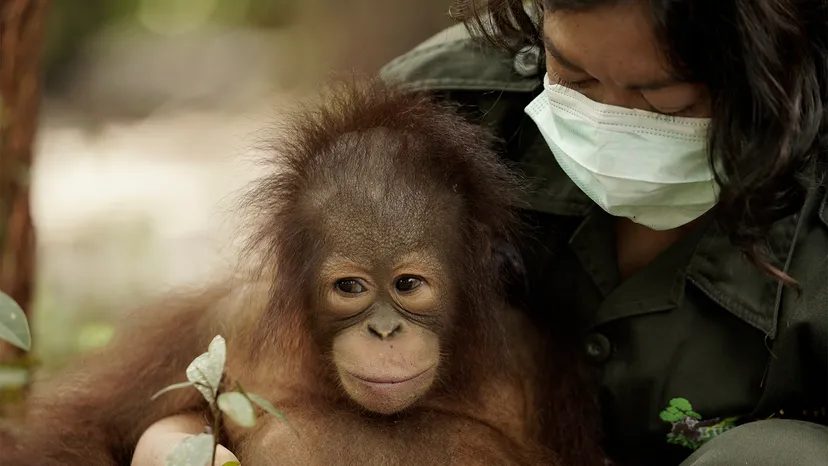
The Borneo Orangutan Survival Foundation (BOS) is doing more than just preserving habitat. They are running a sanctuary for orphans. And they are doing something unusual. They are running a school.
“To survive in the harsh conditions present in Bornean rainforests, young orangutans must learn countless survival skills from their mothers… In the case of our orphaned orangutans, they must learn how to be ‘wild’ from human surrogate mothers.”
Jamartin Sihite, CEO of the BOS, explains the logic.
In the wild, baby orangutans stay with their mothers for years. They learn everything from which fruits are safe to how to navigate the canopy. Adolescents don’t range independently until they are about eight years old. That’s a long apprenticeship.
Orphans have no mother to teach them.
So, humans step in.
These surrogate mothers don’t just feed the babies. They teach them how to be wild. It’s not enough to be healthy. They need to know how to survive the harshness of Borneo’s rainforests. Without this education, reintroduction to the wild is impossible. The forest is unforgiving.
This “forest school” program is a direct response to the collapse of their natural education system. It’s an attempt to reverse the damage caused by human encroachment. One orphan at a time.
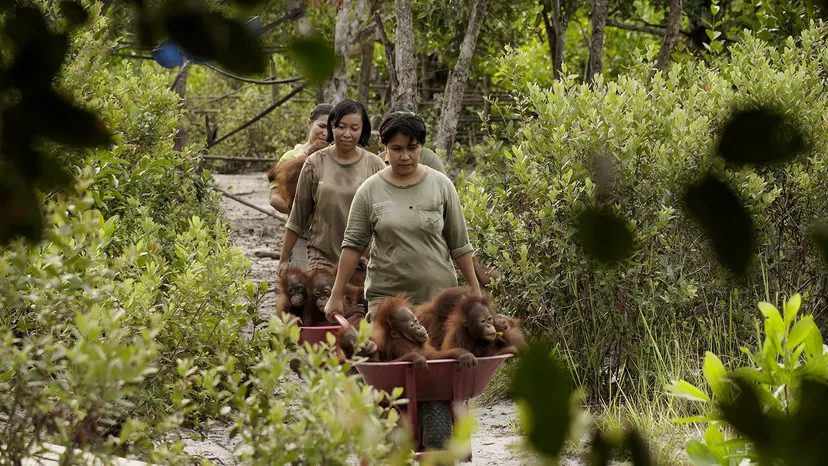
Wild orangutans don’t just inherit survival skills. They learn them. For decades, researchers have tracked wild populations to figure out exactly what a juvenile needs to know to stay alive without human help. The Borneo Orangutan Survival (BOS) Foundation took that data and built something unprecedented: a forest school.
Sihite, a lead researcher, explains that these aren’t just playdates. The orphaned pupils are grouped by age. Each group gets a curriculum. The main focus? Food. Specifically, foraging and processing.
It sounds simple. It isn’t.
Young orangutans spend roughly 50 percent of their waking hours just trying to eat. Depending on their age and sex, that number can shift, but the time investment is massive. In class, they learn to suck termites out of rotten logs. They practice peeling rattan vines with their teeth. This isn’t a party trick. It’s survival. If they can’t process the food, they don’t eat.
Beyond the Basics: Climbing, Nesting, and Socializing
The curriculum doesn’t stop at eating.
Other “classes” cover the physical demands of life in the canopy. Climbing. Navigating the forest floor. Building nests for the night. These aren’t optional extras. They are daily necessities.
Then there’s the social side.
Orangutans are solitary, but they aren’t antisocial. The school teaches them how to interact with others. How to read body language. How to avoid conflict. Crucially, they learn to identify threats. Predators. Hazards. The goal is to create an adult who can spot danger before it becomes a problem.
And, of course, there is the future.
They learn how to care for offspring. It seems odd to teach an orphaned child how to parent. But without that knowledge, the cycle of survival breaks.
The Long Road to Independence
Why does it take so long?
“Orangutans have the longest interbirth interval of any mammal,” Sihite notes. “And an incredibly long period of offspring-mother dependence.”
That dependence lasts eight years.
In the wild, a mother teaches her young everything. From the Mawas Conservation Area, researchers studied these mother-offspring pairs. They watched how the mothers demonstrated techniques. They timed how long it took for the young to master skills.
The BOS school uses human surrogate mothers to replicate that eight-year lesson plan. It’s intensive. It’s slow. It’s necessary.
Before release, the juveniles undergo quarantine. Health checks. Stress tests. Then, they move to pre-release islands. These islands act as a final exam. Can they survive on their own? Without humans feeding them? Without humans protecting them?
If they pass, they go into the wild.
It’s a lot of work. But it’s the only way to ensure these orphans don’t just survive. They thrive.
Watching the Masters at Work
Visiting the school is difficult. Strict protocols apply. Anyone arriving in Indonesia must wait seven days before visiting. The goal is to minimize stress for the animals.
But you don’t need a plane ticket to see the process in action.
The Smithsonian Channel’s Orangutan Jungle School brings the classroom to your screen. The series focuses on the orangutans, not the humans.
“In most television and media programs, the stars are humans, but in ‘Orangutan Jungle School,’ the orangutans are the stars,” Sihite says.
The series highlights their quirks. Their struggles. Their joy. It’s a reminder that despite the species difference, the drive to learn and grow is shared.
All ten episodes are available on Smithsonian Channel Plus. The first two are free. No subscription required. It’s a glimpse into the rigorous training that prepares these animals for a life they would otherwise never have.
Note: In Malay, “orangutan” translates to “forest person.”
A fitting name for creatures who spend their entire lives navigating the canopy, learning the forest’s secrets one skill at a time. The school is closed to the public. But the lessons continue. In the wild. In the classroom. And, for now, on your screen.