Think about how hard it is to connect a painting to its painter when that painter died five thousand years ago. Archaeology has struggled with this gap forever. We have the artifacts, we have the bones, but linking the two is messy. Rock art, specifically, has always been out of reach for geneticists. No body associated with the canvas, usually. So how do we know who held the pigment?
Maybe now we can.
First Contact
Researchers pulled ancient human DNA straight off cave walls. Directly from the surface. It is the first time anyone has managed this feat.
Does this prove who painted the walls? No. Not yet. But it proves something else. Human genetic material sticks around on rock surfaces for millennia.
“We know that some of the art was created by blowing pigment or rubbing it directly onto the wall. With current DNA sensitivity, we thought, why not try?”
Dr. Hipólito Collado Gidaldo and his team from Spain, Portugal, and Germany weren’t looking for ghosts. They were looking for contact traces. Handprints, smudges, the physical act of making art. If the technique is right, the DNA stays.
The Search for Signal
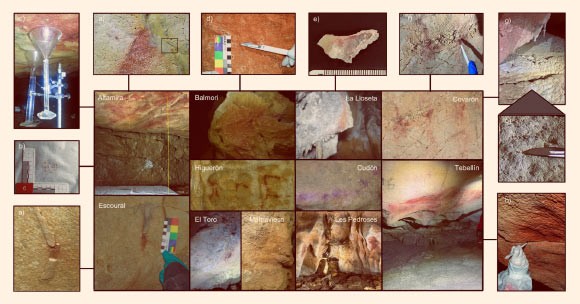
The team scanned twenty-four panels across eleven caves. Mostly red ochre marks. Some dots, some hand stencils, a few recognizable figures. They also tested unpainted walls, dirt, animal bones, and a bird-bone “airbrush” from Altamira Cave.
The odds were stacked against them. Preservation is tricky. Dirt carries noise, a jumble of animal DNA from mice and birds and things we can’t even name. They needed pure signal.
Escoural Cave in Portugal delivered it.
A sample from a pigmented crust yielded human DNA. Pure. No animal noise. An unpainted patch nearby showed the same. That ruled out simple contamination from the cave floor. Someone touched those walls. Recently enough in evolutionary time that the strands survived.
Other spots were murkier. Samples from Escoural and Covarón Cave held mixed signals. Human and animal DNA tangled together. Probably from muddy feet carrying sediment into the dark.
At Covarón, the genetics told a clearer story. Western hunter-gatherers, dating between 5,2000 and 16,000 BC. The DNA came from women. At Escoural? A male.
Limits and Leaps
Here is the rub. They only found usable human DNA in one painted panel. Zero from the Altamira bird-bone tool.
It means success is rare. Time destroys. The study can’t claim to identify the actual artists yet. Maybe the people whose DNA showed up were just walking through. Tourists from 5,000 BCE.
Alba Bossoms Mesa sees it as a new door, not an answer.
“It’s exciting. This is a new way to map prehistoric presence. We’re looking at genetic archives on stone.”
Dr. Matthias Meyer agrees. Cave walls aren’t just stone. They are biological storage drives, if the conditions hold up. The variability is high. Sometimes nothing survives. Sometimes a little does. And when it does?
It tells a story.
The Next Step
The method is rough. The success rate is low. The next phase involves refining the extraction, targeting caves with better molecular preservation, and focusing on hand stencils or figurative art where skin contact was inevitable.
Will we finally put names to the painters?
Maybe not names. But perhaps identities. Perhaps genders, or at least a genetic fingerprint that places a specific population right where the ochre meets the wall.
It’s a start. The walls are silent, but they remember. We just have to listen closer. 🧬🏺
A. Bossoms Mesa et. al. (2026) Investigating ancient human DNA preservation, Nat Commun.