You want to check your blood glucose without the prick. You want to know if the milk in your fridge has gone bad, right now. Most of the time, you need a laboratory. A big one.
That might be about to change.
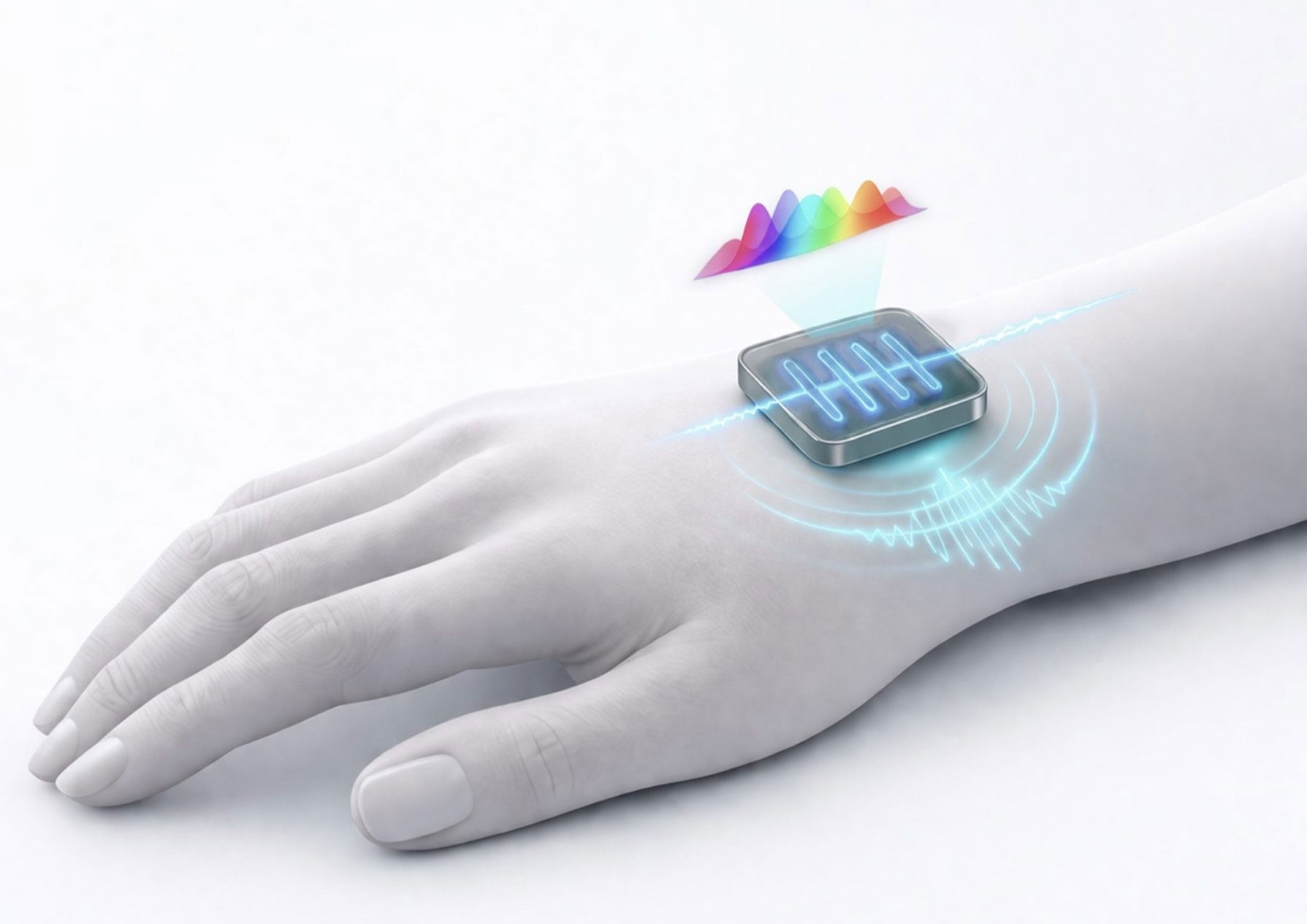
Researchers at the University of Cambridge have built something tiny. A spectrometer. It costs around $10 to make. It fits on a chip no bigger than a postage stamp, maybe even smaller, essentially a smartwatch component in size. It does the heavy lifting of a benchtop lab machine that usually weighs hundreds of pounds.
This is not science fiction. It is published in Nature Photonics. It is called a “convolutional spectrometer.” The name sounds academic, dry. The technology underneath is a radical break from how we’ve done spectroscopy for decades.
The Problem with Shrinkage
Here is the issue with sensors. You make them small, they get stupid. That is the trade-off. As instruments shrink, resolution dies. Bandwidth narrows. Accuracy evaporates.
Standard miniaturized spectrometers are useful for basic things, maybe checking color or simple compounds. They fail at complex tasks. They lose data in noise.
This team worked with a startup, GlitterinTech. They didn’t try to miniaturize an existing design. They threw out the playbook. They looked at the mathematics. Specifically, the convolution theorem.
They moved the math from the computer processor directly into the light path.
Instead of dispersing light and trying to reconstruct a spectrum later (a computationally expensive guess), they used optical components to perform the convolution physically. Think unbalanced Mach-Zehnder interferometers. Think microring resonators. These components interact with the light in periodic, predictable ways. The result is a direct readout that requires very little computing power to decode.
“We avoid many of the limitations that held miniaturized spectrometers,” Dr. Chunhui Yao said. “High precision, strong noise tolerance.”
The device sits on silicon nitride. It looks at near-infrared light, specifically 1200 to 1700 nanometers. That range matters. Water shows up there. Glucose shows up there. Lipids. Alcohol.
It Works, and It Is Robust
Numbers can be boring. These are not.
They tested plastics. Coffee. Flour. Tea. Pharmaceuticals. The success rate for identifying materials? 100%.
Then they looked at concentrations. Aqueous solutions. Organic liquids. The error margin was 0.01%. Commercial benchtop machines—the ones sitting on lab desks for thousands of dollars—couldn’t touch that level of consistency in a device this size.
The real test, however, is the human body.
The device monitored skin moisture. It tracked blood alcohol levels. It measured lactate. Most importantly, it tracked glucose over time, in one person, without needles. Continuous. Noninvasive.
Did they keep it warm and clean? No.
The researchers subjected the sensor to temperature swings. Down to –20°C. Up to 80°F (that is 176° Fahrenheit). It stayed stable. It did not drift. That kind of durability is rare in miniaturized optics. Most would fry or lose calibration in that heat.
Why It Matters
Computing power is expensive in wearable tech. Batteries are not. The convolutional approach is linear. Simple. It processes data in under a second with almost negligible CPU overhead.
This is not just about making small sensors. It is about making sensors that don’t drain your watch battery every ten minutes to calculate a spectrum.
Prof. Richard Penty, who helped with the photonic integration, called it “beautiful.” He noted the architecture is scalable. Manufacturable. You can mass-produce this.
So, where does this go?
Factories can monitor material quality in real time. Farmers can check produce on the line. You? You might have a watch that tells you exactly how hydrated you are. Or how drunk. Or how sick.
The researchers want spectrometry to be as common as a motion sensor. Every smartphone has a motion sensor. Maybe soon, every wearable has a lab-grade chemical analyzer.
It does not have to fit on a desktop. It can go into the things you wear. The invisible chemistry of life, captured by a ten-dollar chip.
Reference: “Optical convolutional spectrometer,” Nature Photonics, April 15, 2026.