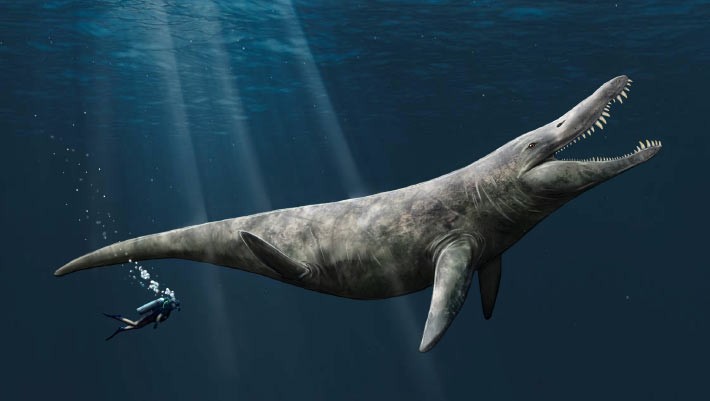
Forget the 25-meter monster from Walking with Dinosaurs. It didn’t exist.
Liopleurodon ferox was a real beast, sure. But for decades, pop culture and rough estimates painted it as a leviathan of impossible scale. A short-necked marine reptile patrolling the shallow seas of England and France during the Middle Jurassic, it earned a fearsome reputation. Some older reconstructions put it at 25 meters long. That is longer than a basketball court. It is absurd.
New research changes the story. Paleontologists at the University of Portsmouth, led by Dr. Edward Bartlett, re-examined every known specimen. They wanted the truth, not the TV drama. The result? Liopleurodon ferox was significantly shorter. Far more manageable. Yet still deadly.
The confusion started early. The original holotype, described in 1873 was just an isolated tooth. A single caniniform tooth. That small piece of bone became the anchor for a messy taxonomic history. Over the years, scientists slapped the Liopleurodon label onto dozens of fragmentary fossils from the Callovian and Tithonian periods. Some were tiny. Some were huge. The range of size estimates ballooned from a modest 6.39 meters to that wild 25-meter claim.
It was a mess.
To fix it, the team gathered 37 specimens linked to Liopleurodon ferox. They measured. They compared. They calculated. The data tells a different story. Total body length likely ranges from about 2.46 meters to 8.09 meters. But here is the nuance. The most complete skeletons cluster between 4.8 and 6 meters. The average animal? Probably close to 5 meters.
“Although it was smaller than some famous reconceptions, it was still the dominant marine predator on the Jurassic Oxford Clay seas.”
Five meters. Still huge. Still the apex predator. But nowhere near the mythical 25-meter figure.
The researchers built their model using two well-preserved skeletons—one from Tübingen, Germany, another from the Natural History Museum in London. They calibrated the proportions using a separate, complete skull. What did they find?
The skull is massive. It makes up about 24% of skeletal length. That is a notably larger share than previous estimates suggested. A bigger head means bigger bite. It hints that Liopleurodon could tackle prey significantly larger than other pliosaurs of the time. Even scaled down, it remains the largest known animal in the Oxford Clay Formation ecosystem.
But here is the twist that makes it interesting. While L. ferox might be smaller than we thought, it wasn’t alone.
Several fragmentary fossils from the same formation point to pliosaurs that were giants. Estimates for these unknown relatives reach up to 12.2 meters. They lack the specific diagnostic features to name them. They are mystery giants swimming alongside the 5-meter Liopleurodon.
This suggests something crucial about evolutionary history. Gigantism in pliosaurs, specifically animals over 10 meters long, evolved during the late Middle Jurassic. Liopleurodon shared its world with these true giants, even if it wasn’t one of them.
So, who was the biggest predator? Probably the unnamed giant. But Liopleurodon still held its own. It was the benchmark. The standard. And now, thanks to this reappraisal, we know exactly what it looked like.
Not a 25-meter dragon. A 5-meter powerhouse. With a head nearly a meter long.
The findings appear in the Journal of Vertebrate Palaeontology. The debate on size is over. The mystery of the other giants remains. And honestly, that is better. It keeps the ocean mysterious.