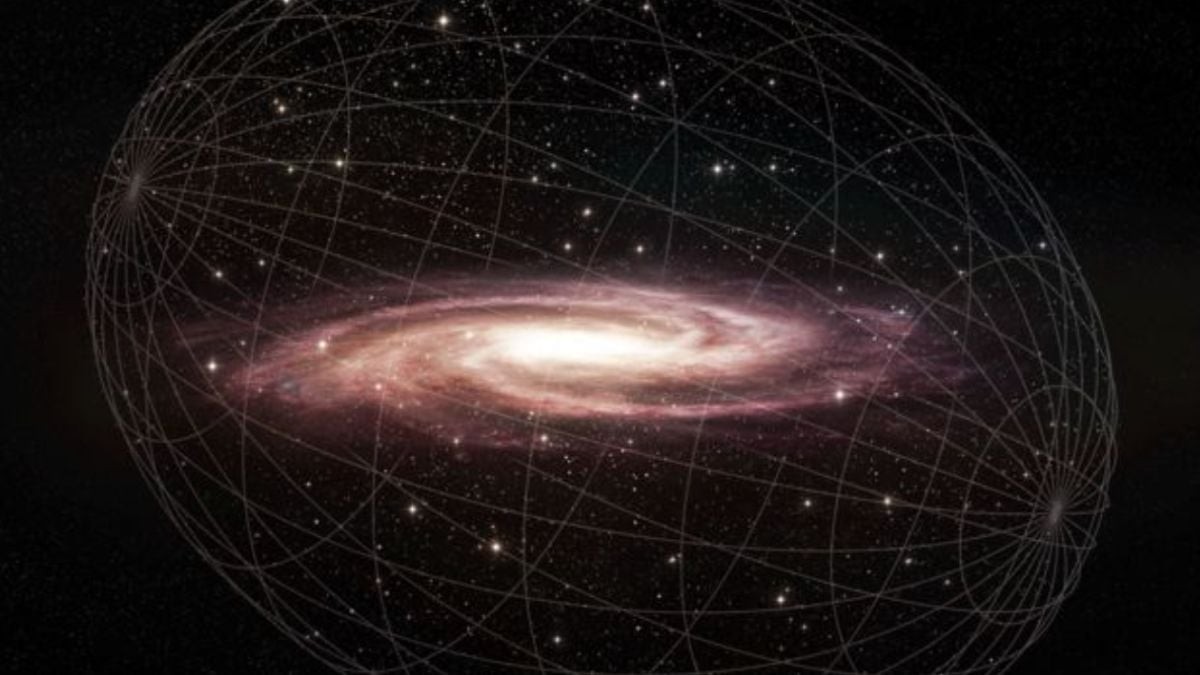
The Milky Way looks tidy. A flat disk spinning gently through the void. It’s stable. Or so we think.
New simulation data suggests otherwise. Our galaxy didn’t just drift into its current shape. It may have flipped. Completely. Over billions of years.
This isn’t a glitch in the matrix. It’s physics, violent and slow, reshaping our cosmic home. The disk reoriented itself inside its dark matter halo. The result? A galaxy that is far more turbulent than it appears to be.
The Slow Spin Anomaly
To understand the tilt, you first need to understand the weirdness in the outer edges. For the last decade, the Gaia satellite has mapped star positions. What it found didn’t add up.
Stars in the stellar halo—the sparse, ancient outskirts—were moving too slow. They orbited the galactic center at speeds far below what the Milky Way’s mass should allow.
Most astronomers assumed this meant we had overestimated the galaxy’s mass. Simple math error. But Kirill Batrakov at Durham University had a different hypothesis. He didn’t want to tweak the mass. He wanted to tweak the orientation.
“It was a little unexpected for me to find this connection between the rotation of the stellar halo flips in the disk,” Batrakov noted.
The project started by checking rotational velocity. It ended with a theory that challenges how we view galactic evolution.
Collisions That Changed Everything
The Milky Way is about 13.6 billion years old. That’s a long time for things to settle down. But mergers don’t allow for settling. They cause upheaval.
Researchers used the Auriga simulation suite to model galaxies that formed early in the Universe’s history. The data showed a clear pattern. Galaxies that underwent major mergers ended up with stellar halos that rotated significantly slower.
Sound familiar?
We have physical evidence of these crashes. Stellar streams with foreign chemistry. A warp in the disk that makes it wobble. One major event occurred roughly 10 billion years ago. It involved a smaller galaxy. Astronomers nicknamed it the Gaia Sausage. Probably because it was long and thin before it got shredded.
This collision wasn’t just a merge. It applied torque. Gravitational torque.
That torque didn’t snap the galaxy. It tilted it. Gradually. Over eons, the Milky Way’s disk shifted its axis relative to the surrounding dark matter halo.
What is a Disk Flip?
If the galaxy tipped over, what does that mean for us?
The researchers defined a “disk flip” as an orientation change of more than 90 degrees. Not a full 180. Not upside down. More like the disk rotated until it was sideways relative to its previous path.
Imagine living long enough to watch the night sky change. The constellations you know today would drift out of shape. New patterns would emerge as the stars realigned. We’re standing on a planet orbiting a star that is slowly drifting through a sky that used to look completely different.
Independent Evidence Supports the Tilt
Batrakov’s team isn’t shouting into the void. Another group reached the same conclusion.
Earlier this year, astronomers from the Chinese Academy of Sciences published findings in Astronomy & Astrophysics. They analyzed the Milky Way’s dark matter halo. They found it oriented almost perpendicular to the stellar disk.
In other words, the invisible mass surrounding us is facing a different direction than the visible matter. The most logical explanation? The disk reoriented itself after a heavy impact. The dark matter halo didn’t move. The disk did.
Why This Matters
Disk flips appear often in cosmological simulations. But simulations are idealized. Reality is messy.
If the theory holds, it solves the mystery of the slow-spinning halo without requiring us to rewrite the laws of gravity or invent invisible mass we can’t detect. It also explains other “puzzling peccadilloes” of the Milky Way.
Is it confirmed? No. Batrakov warns it’s too early for 100% certainty.
“Ideally, we should try to identify alternative signature of past disk flips to make that claim fully.”
We need more data. More signatures. But the pieces are aligning. The Milky Way might be a flipped coin in a vast, dark coin toss.
The Royal Astronomical Society’s National Astronomy Meeting in 2026 saw these findings presented. The debate is just starting.
Our galaxy isn’t just a frisbee. It’s a top that spun itself over. And the question isn’t just how it got there. It’s what else it took to knock us sideways.