Astronomers found it. It wasn’t supposed to be there. Or at least it shouldn’t be visible.
This ancient galaxy is glowing through the cosmic fog. That’s the impossible part. The universe was murky back then. Thick with neutral hydrogen. A haze that usually eats light. Not this time.
“This was thought to be impossible,”
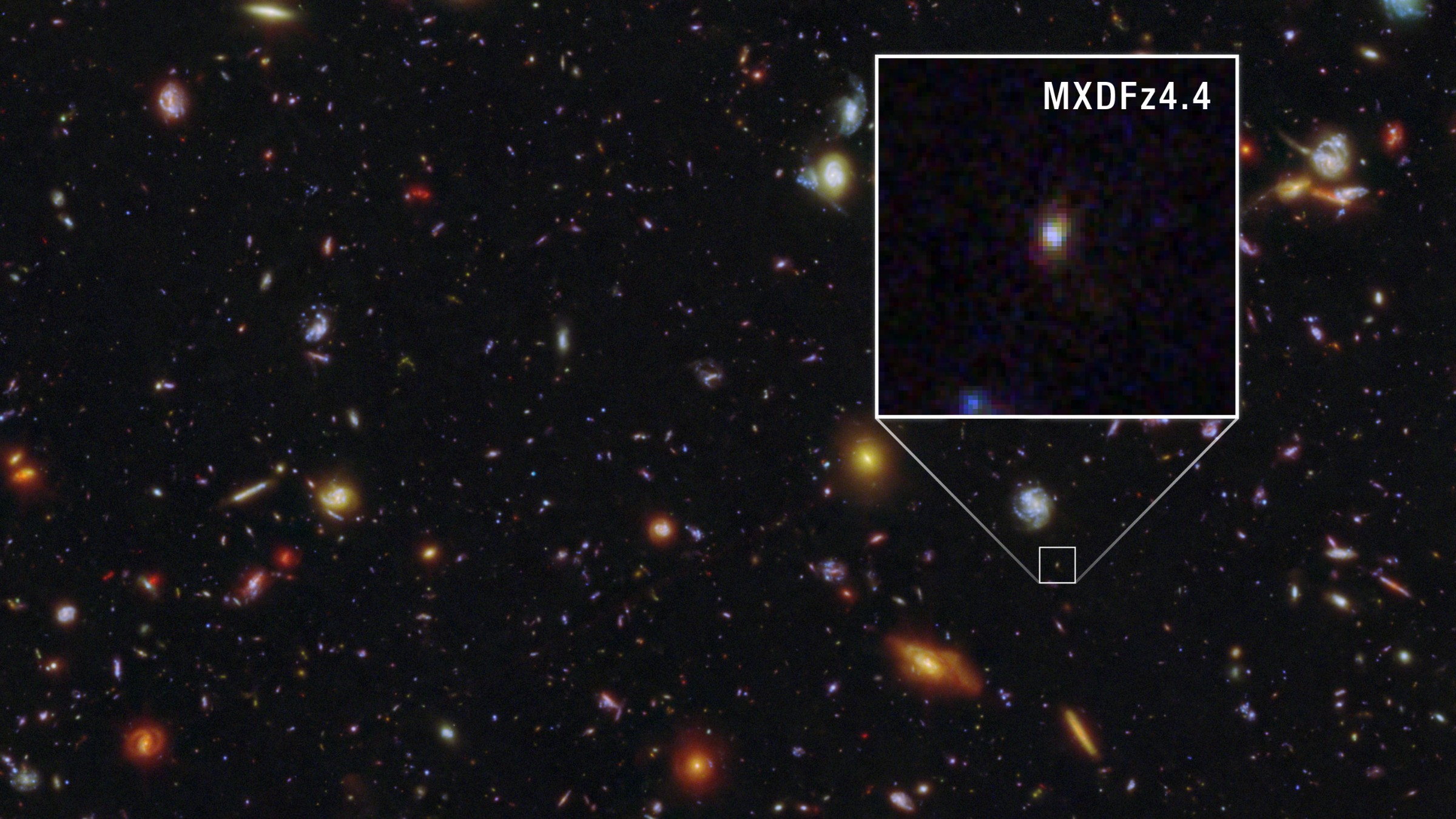
That’s what lead researcher Ilias Goovaerts said. He’s at the Space Telescope Science Institute. The galaxy is called MXDFz44. We caught its signal just 250 million years after the Epoch of Reionization wrapped up. That’s early. Shockingly early. The data landed in The Astrophysical Journal in June.
The team didn’t use just one telescope. That would’ve been risky. They used Hubble. James Webb was there too. Plus the European Southern Observatory’s Very Large Telescope. VLT, for short.
Together they saw ionizing ultraviolet photons. Energetic little buggers. They strip electrons right off hydrogen atoms. Before this? No other galaxy from that era showed these specific signals. We were blind to them. MXDFz4.4 broke that streak.
Small but Loud
Here is the trick. The galaxy isn’t huge. In fact, it’s tiny compared to home. One-hundredth the area of the Milky Way. Roughly.
But the stars? They form ten times faster than we do here. It’s a crowded mess of massive, young stars. Pack them tight and the pressure builds. The radiation punches holes in the surrounding gas. Clear channels.
That’s how the light gets out. The light escapes the galaxy. Then it escapes the intergalactic medium. Goovaerts estimates between half and all of those ionizing photons make the journey.
Think about the distance. The signal has to cross all that plasma. It’s the most intergalactic material any signal has ever had to survive. And yet it arrived.
Found By Accident
The discovery was an accident. Or close to it.
Goovaerts was rushing. Funding deadline looming. Just days away. He was looking at an old, deep Hubble image for an unrelated proposal. Wanted to see if anyone had already checked the spot.
Took him hours. Two, maybe three. He saw something.
Excitement hits fast. Then the hard work starts. Extracting the data. Pinning down the properties. It took months to let the discovery mature. But that first look? That was immediate.
They needed serious data to prove it wasn’t noise. Forty hours on Hubble. Webb imaging across the spectrum. And then the VLT. Six days of observation with the Multi-Unit Spectroscopic Explorer. It grabbed a deep spectrum.
Confirmed the distance. Used the Lyman-alpha emission. That’s the hydrogen fingerprint. A glow from excited gas. It tells us when and where.
Fog Lifting
Why does this matter? Well. The early universe was dark. Not black, just dimmed. Hydrogen fog blocking the way. Stars and galaxies eventually ionized it. Cleared the path.
We’re still trying to understand the process. The timeline is fuzzy. But this galaxy? It suggests vigorous starbursts did the heavy lifting. Maybe more galaxies like this are hiding there. Waiting.
Marc Rafelski from STScI called it unique. So far. There’s a lot of sky left to check.
Bursts like this might have been key.
Maybe they were the engines that turned the lights on. For everyone else.