Astronomers found evidence that young red dwarf stars might be eating rocky planets.
They spotted a clue that feels like checking a teenager’s breath. Did they smoke? Did they drink? Here. It’s the lithium count. The stars have too much of it. Lithium is a light chemical that gets burned away fast. Hot interiors destroy it early. By the time a star is a mere 50 million years old—barely an adolescent in cosmic terms—there shouldn’t be any trace left.
But six stars broke the rules.
Robin Jeffries from Keele University led the study, published in the Monthly Notices of the Royal Astronomical S ociety. They scanned thousands of stars. Found these six outliers. They held onto their lithium while everyone else around them lost theirs. Jeffries called it obvious.
“Even a small amount of lithium stands Out clearly… like throwing paint onto a blank.”
It isn’t a fluke. It’s about 2% to 3% of stars in that specific temperature range. Rare, but consistent.
What gives?
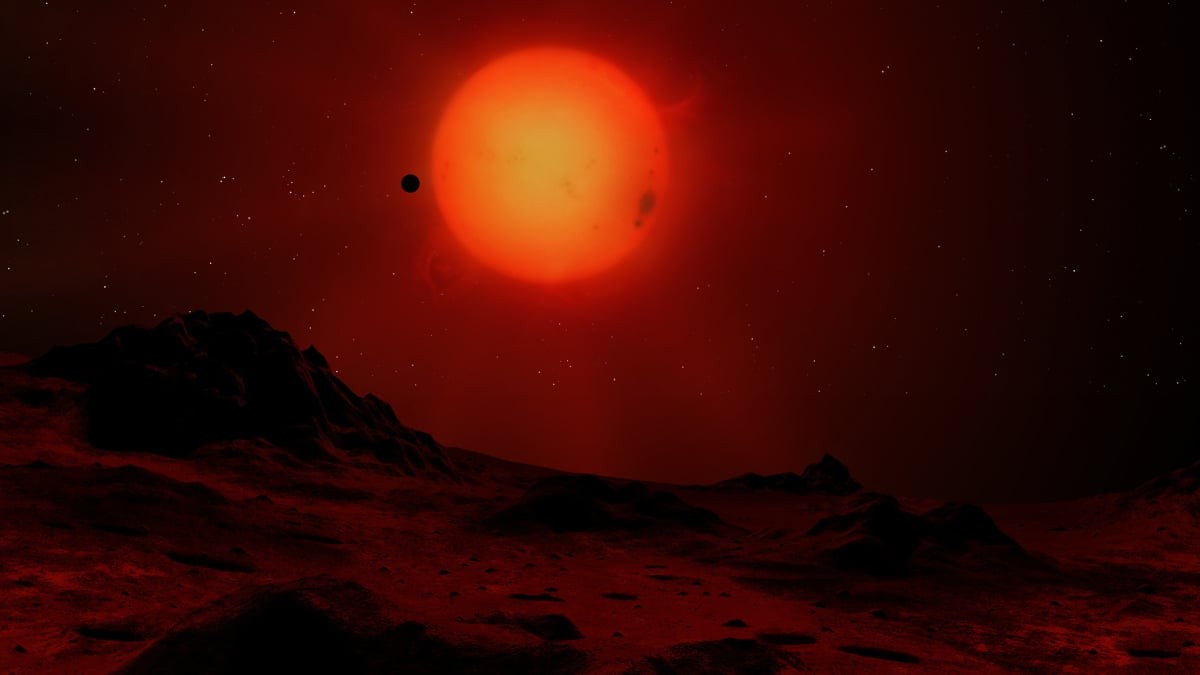
Stars eating planets is old news. But the evidence has always been shaky. Faint whispers of chemicals in a spectrum. This looks different. This is loud. The theory? These young red dwarfs swallowed several Earth-mass worlds. Rocky bodies rich in lithium. A massive snack that dumped fresh chemical inventory onto the star’s outer layer.
Think about what that implies for planetary systems. We like to think they form nicely and stay put. Neat little orbits.
This suggests chaos.
Red dwarfs are the most common star in the galaxy. They host tons of Earth-sized planets. Many sit in habitable zones. Not too hot. Not too cold. Perfect for water. But if the star eats the planet before life starts… well. You can’t have biology without a body to live on.
The team didn’t just guess. They looked at other possibilities. Maybe magnetic fields are protecting the lithium? No. Magnetic activity needs fast spin. These stars spin slowly. So much for the magnet theory. Maybe they kept feeding off their birth clouds of gas and dust for too long? Unlikely. The data says no. The disks would be gone.
So back to the buffet. The star ate the food.
How much food? Roughly three to ten Earths per star. That sounds impossible. Until you look at simulations. Young planetary systems are messy. Gravity slingshots planets inward. They collide. They spiral. They end up as fuel.
The lithium signature won’t last forever. It will eventually be mixed down or destroyed again. But right now? It’s sitting there. Visible. Proving that even before a world has a chance to become complex. Before cells form. Before oceans turn blue… the universe can simply snatch it away.
We keep looking for signs of life in stable orbits.
We might need to look closer at the aftermath of the chaos.