


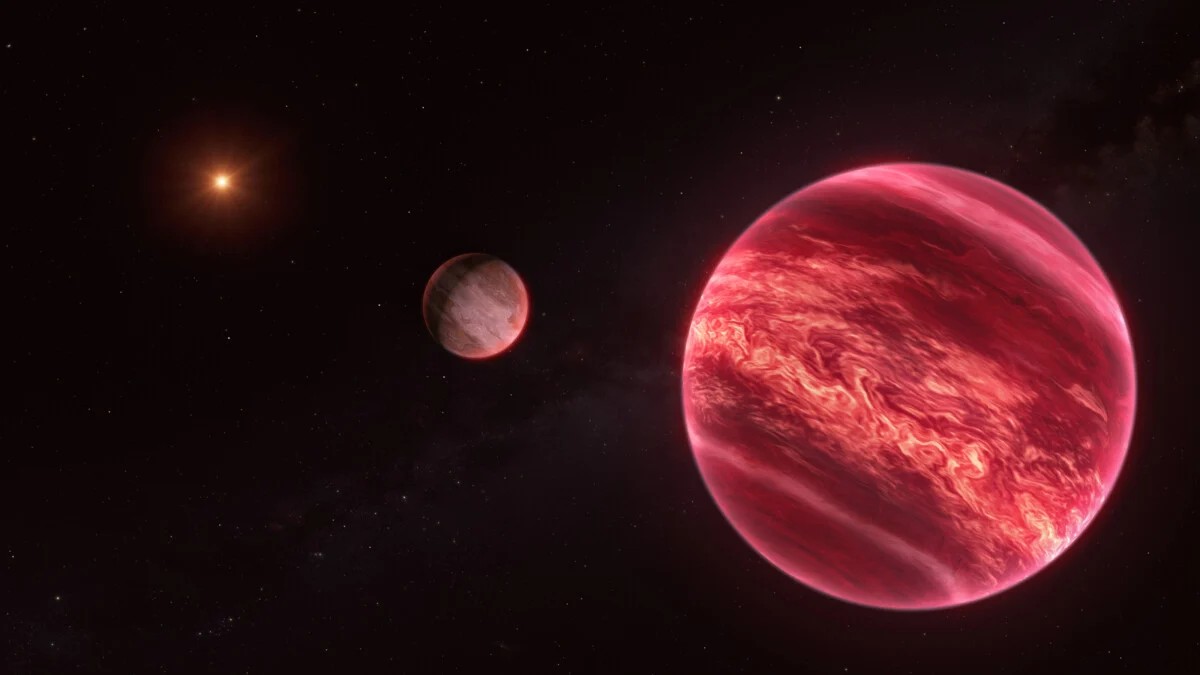
It’s not a star. It’s not quite a planet. It’s definitely not from around here.
Astronomers are staring at something weird in the CD-35 22 system, located a comfortable 73 light-years away. The object defies standard classification. It’s an exosatellite orbiting a brown dwarf that itself is circling a main-sequence star. This is the holy grail of celestial mechanics: a confirmed exomoon. If the data holds up, it’s the first documented one.
Why “Moon” Is Tricky to Define Here
Brown dwarfs are the cosmic misfits of the galaxy. They’re too massive to be planets. Too small to ignite true hydrogen fusion. They’re often called “failed stars,” sitting in that awkward gravitational limbo. So, what do you call a satellite orbiting a failed star?
The team, led by Kevin Hoy and published in Nature, calls it an exomoon by virtue of being the “third wheel” in a hierarchical system. It orbits an object that orbits another object. Simple enough, right? Wrong.
“This exosatellite is clearly massive enough to
be a planet, but it does not
orbit a star,” Hoy explained. “Though it orbits an object that
orbits a star.”
It’s a gas giant, likely. Roughly the mass of Jupiter. The brown dwarf it circles—CD-35 2722B—is 30 times heavier. In our solar system, moons are usually rocky or icy chunks relative to their primary. This thing is heavyweight. But mass isn’t the only deciding factor. Orbit is.
How We Found It Without Seeing It
You can’t just snap a picture of an exomoon that far away. The resolution isn’t there. Instead, researchers used the European Southern Observatory’s Very Large Telescope in Chile. They employed the radial velocity technique.
They didn’t look for the moon. They looked for the wobble.
A massive companion tugging on its primary creates a gravitational dance. The brown dwarf jiggles slightly as the satellite pulls it back and forth. Over two years, the team collected 27 observations. A signal popped up, repeating every 170 days. That periodicity suggests a consistent gravitational tug.
Previous attempts to find moons around brown dwarfs involved objects widely separated. Were those moons? Planets? Hard to say. This companion hugs the brown dwarf tightly. Close enough to complete an orbit in just under half a year.
Why This Beats Previous Candidates
Astronomers have chased this ghost for years. The search for a first confirmed exomoon has produced several high-profile candidates, but none have stuck.
Take 2024. A team spotted potential sodium gas clouds around WASP-49b, suggesting a volcanic moon like Io. It was compelling. It was based on spectroscopic data. But it wasn’t a direct detection. Just an inference.
Or look back to 2018. Kepler-1625b showed a transit dip suggestive of a Neptune-sized satellite. It made waves. Then other data cast doubt. The scientific consensus on “candidates” remains elusive.
This new detection feels different because the method is direct and the orbit is tight. The wobble is undeniable. Alice Zurlo, co-author and astrophysicist at Universidad Diego
Portales, isn’t hesitating.
“As exotic as it is, this system is truly unique and
represents a breakthrough.”
The Road to Confirmation
Don’t pop the champagne just yet.
Astronomers are cautious by trade. One dataset, however robust, rarely seals the deal. More observations are needed. They need to rule out stellar activity or instrumental error. The team acknowledges this. They’re waiting for independent verification.
But the implications are staggering. If this is indeed a moon, it changes the math of planetary formation. Gas giants forming around brown dwarfs? That’s a scenario most models didn’t prioritize. It suggests moons can form in systems we previously considered barren or chaotic.
It also raises questions about habitability, if we’re being bold. A moon the size of Jupiter? Probably not a beach vacation destination. But it proves that satellite systems can exist in the most bizarre corners of the universe. Not just around friendly Sun-like stars, but around the failed ones. The ones we barely understand.
The lines between star, planet, and moon have always been fuzzy. This discovery blurs them further. We might be living in a universe where moons aren’t just accessories to planets. They’re the main event in their own right.
What other failed stars are hiding moons around them? The data suggests they’re out there. Waiting to wiggle.


