


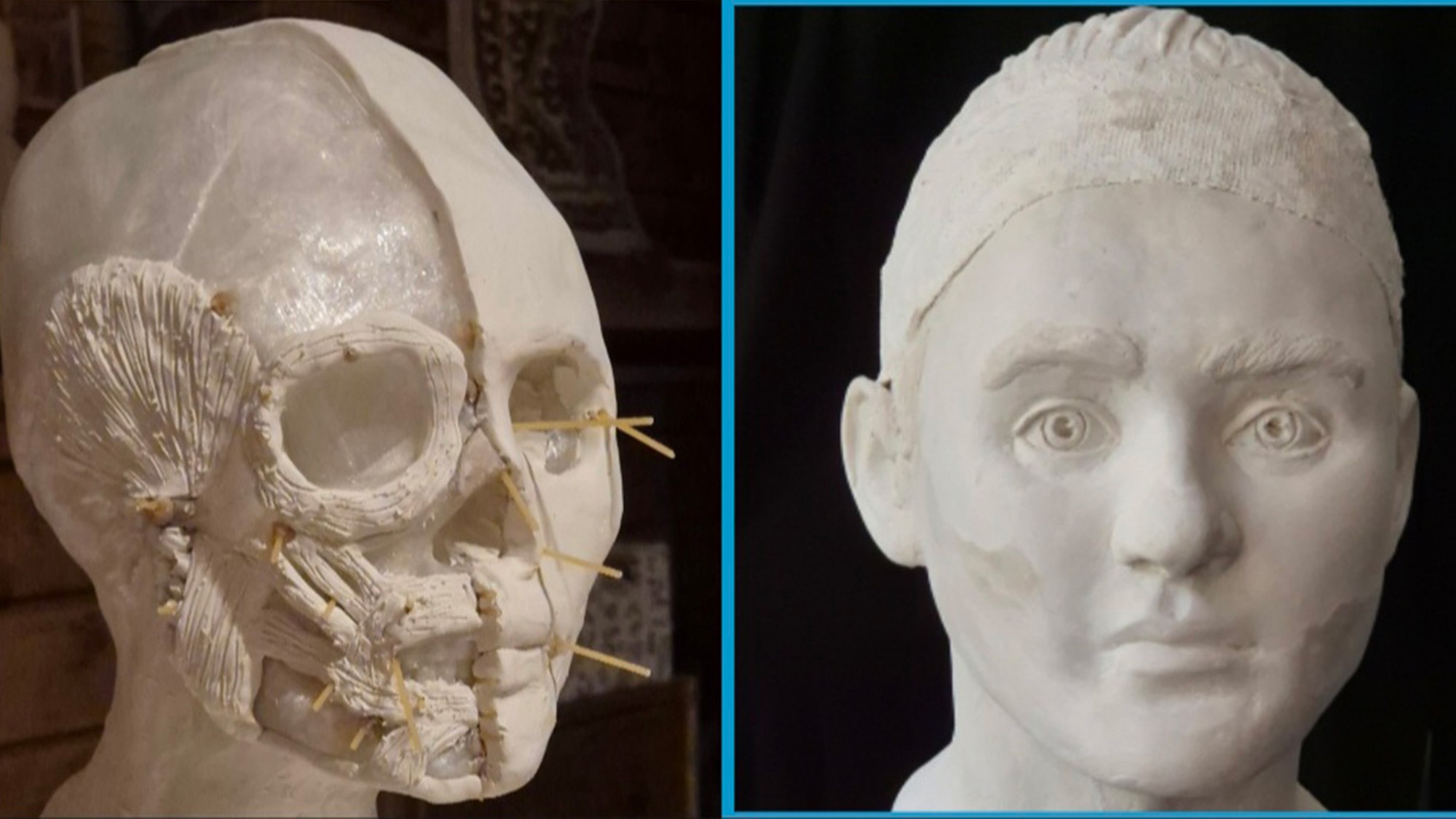
The face of a young woman wearing a laurel wreath has returned to life. Not literally, of course. But nearly 1,700 years in the ground, her skull has been translated into a silicone likeness. She wears elaborate clothing and those bizarre cork sandals shaped like birds. Now, visitors can see what she might have looked like.
She is just one of 16 individuals from Aquincum. That was the Roman city sitting on the Danube frontier—modern-day Budapest, Hungary. Their faces appear in a new show: Once We Were Like You. It runs at the Aquincum Museum through Oct. 31.
The exhibit pairs excavated skulls with scientific approximations of life. These aren’t guesses. They are forensic reconstructions. Six are hyperrealistic. They have real hair, eyes, and eyelashes. Some have beards. Men, women, a child. All lived during the Roman rule of the region.
“The face is the most important feature for recognizing people.”
— Emese Gábor, Forensic Facial Reconstruction Specialist
This approach changes how we see the dead. Skulls are just bone. But these models? They are humans again.
How These Roman Faces Were Reconstructed
You don’t just sculpt over a skull. Not when you want accuracy. And not when the bones are precious.
It starts with a high-resolution 3D CT scan. Specialists make an exact 3D-printed copy of the original skull. This protects the ancient remains. No handling. No damage. Emese Gábor does her work on the replica.
“If a hyper-realistic reconstruction is required… I create a mould and cast the face from silicone.”
This workflow uses modern science. CT imaging helps. Archaeogenetics (ancient DNA) helps too. Facial approximation research adds another layer. When DNA yields clues about skin or eye color, the sculptors use that. It isn’t perfect. Hair texture? Speculative. Facial expression? Guesswork. But it gets closer.
The woman with the wreath remains difficult to shake. Known as the Jablonka Road mummy, her face had decomposed. Only the skull survived. But her grave told a story. Laurel wreath. Fine clothes. Spindle. Bird-shaped cork sandals. And a painted male portrait near her feet. Maybe her husband? Maybe her father? Who knows.
Who Were the 16 People of Aquincum?
Aquincum was a frontier town. Population diverse. Times from the first through fourth centuries. DNA and archaeology show connections to Italy, Scotland, Syria. Also Sarmatian groups. Celtic communities living there before the Romans came.
The 16 faces in the exhibit represent different slices of that life.
A young girl who didn’t make it to adulthood. A woman possibly a nurse or healer, buried among children. A construction worker. A military officer. A blacksmith.
Not all died peacefully.
Two women appear to have met violent ends. Buried face down. Legs tied together. The exhibition suggests one was accused of witchcraft. The other of poisons. Take that as historical interpretation, not hard evidence. No one knows for sure why they were buried that way. Just that they were.
“Every reconstruction is a journey.”
Gábor shapes each face. Again and again. She reflects on their lives. By the end, they aren’t anonymous. They are people.
Why This Exhibition Matters
Most of these people weren’t famous. They weren’t generals. They weren’t emperors. They were the less wealthy. People whose names rarely appear in written histories. Skeletons suggest strenuous labor. Hunger. Chronic inflammation.
You don’t see that in a textbook. You see it when you stand next to a life-size silicone model. Walk around it. Study it from different angles. A digital image on a screen doesn’t hit the same.
Gábor wants visitors to think beyond the data. Beyond the bones.
“You see a person… someone who was born… who loved… who struggled… who raised children.”
They got sick. Not all died of illness. Accidents happened. Violence existed. Death was the end for everyone.
But seeing the face sparks empathy. Real empathy. Not the detached kind you feel reading about “deceased individuals.” This is human.
They were like you. Once.
Now they are back. Just for a few more weeks.


