


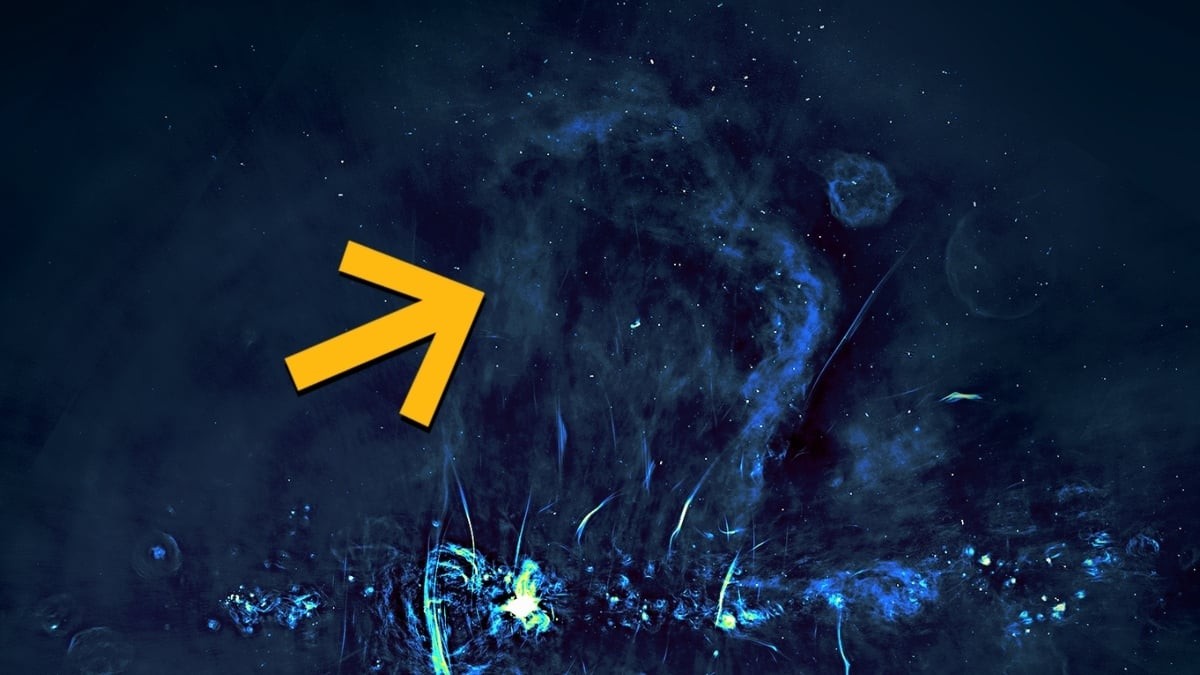
It’s not a black hole tantrum.
For forty years, astronomers thought they were staring at a massive lobe erupting from our galaxy’s center. They called it the Galactic Center Lobe. It looked like a giant bubble ballooning out from the core of the Milky Way, towering thousands of light-years high. It was confusing. It was prominent. And it was entirely misunderstood.
A new study has finally pulled the curtain back. The structure isn’t where we thought it was. It isn’t even what we thought it was.
According to astrophysicist Kathryn K reckel of Heidelberg University and her team, the so-called Galactic Center Lobe is actually a closed loop. It sits much closer to us. Roughly 6,520 light-years away in fact. This reclassification is huge for Galactic center lobe studies because it changes everything about how we interpret the data.
The team proposes renaming the structure. Call it the “Greatly Confused Loop “. It fits.
Why We Mistook the Foreground for the Background
Distance in space is notoriously tricky. Add in the dense chaos of the galactic core—stars, gas, dust—all overlapping in our line of sight, and you get a perfect visual trap.
The bottom half of this loop sits directly against the background of the galactic plane. When viewed in radio waves, that lower section blends right into the surrounding glow. To our eyes (or our instruments), an open arc looks exactly like part of a massive central structure.
Untangling this mystery required a “40-year struggle to separate genuine nuclear features from the foreground galactic disk.”
So how do we tell the difference between something deep in the center and something right out front?
How Ionized Sulfur Solved the Case
Radio data lied to us, or rather, it told an incomplete story. The key to the Galactic center lobe mystery was looking at light differently.
Kreckel’s team used data from the SDSS-V Local Volume Mapper. Instead of radio waves, they looked at optical and infrared spectra. Specifically, they tracked ionized sulfur.
This matters. Sulfur emits light at longer, redder wavelengths. Red light punches through dense molecular gas and dust better than blue light does. This allowed the scientists to see through the clutter that was hiding the bottom of the loop.
Once they saw the full circle, the geometry made sense. It wasn’t a one-sided lobe. It was a bubble.
To nail down the distance, they compared the dimming of the sulfur’s glow with existing 3D maps of galactic dust. The dust dims the light in a predictable way. Based on how faint the light appeared, the bubble had to be nearby. 6,520 light-years away.
The Origin of the Bubble
It’s smaller than we thought too.
At around 115 light-years across, this bubble is a significant chunk of space, but it’s tiny compared to the massive scale originally estimated if it were near the galactic center.
What created it?
The bubble is a cloud of hydrogen gas. It’s glowing because of intense ultraviolet radiation. But from what source?
The researchers didn’t find a specific star cluster powering it right now. They think it’s an orphan bubble. Carved out by an earlier generation of massive stars. These stars lived fast, died young in supernova explosions, and blasted cavities into their nurseries.
When those stars blew up, they pushed material away. Then, new stars formed. Their radiation ionized the remaining gas, making it glow. Because we see the edge of this hollowed-out shell brightest, it looks like a ring or loop.
Sound familiar? It’s almost identical to Barnard’s Loop in Orion. Same process. Different location.
Why This Classification Shifts Astronomical Perspectives
We have a tendency to assume the big, dramatic structures we see must be connected to the galactic engine. The supermassive black hole. The core eruptions. The Galactic Center Lobe name implied a direct link to the center’s activity.
This new finding suggests otherwise. It was just foreground noise. A local stellar nursery doing its thing.
The findings were published in Astronomy & Astrophysics. It’s a reminder that looking is easy. Understanding is hard. And sometimes, the things staring back at us are much closer than we dare to admit.
Which other famous sky features are just foreground illusions waiting to be decoded? Maybe nothing changes our maps overnight. But the next time you look at the galactic plane, keep that in mind. What you see isn’t always where you think it is.


