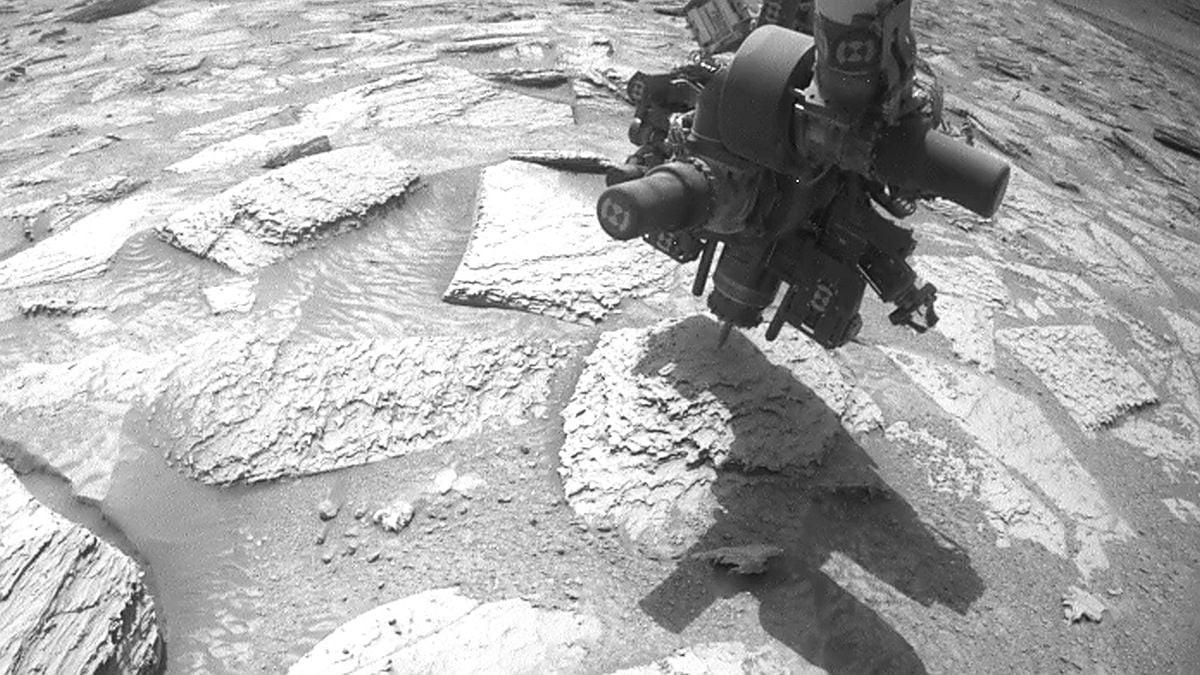
The Mars rover Curiosity has encountered a mechanical anomaly never before seen in its 13.5-year mission: the accidental extraction of an entire rock slab. While the rover is designed to drill into Martian bedrock to collect powder for chemical analysis, a recent operation resulted in the 13-kilogram (28.6-pound) rock remaining attached to the drill sleeve and being lifted off the surface.
This incident highlights the unpredictable nature of extraterrestrial geology and the ongoing resilience of NASA’s engineering teams, who continue to adapt hardware originally designed for a two-year mission to survive over a decade on the Red Planet.
An Unprecedented Mechanical Glitch
The event began on April 25, 2026, when Curiosity targeted a rock named “Atacama” for routine sampling. The rover’s rotary-percussive drill is engineered to hammer and rotate simultaneously, pulverizing hard rock into a fine powder that is then vacuumed into onboard instruments for mineralogical and chemical analysis.
However, instead of breaking down the rock, the drill penetrated a structural weakness that caused the entire upper layer of the slab to detach. When the drill was retracted, the 13-kg chunk of Martian stone came with it.
“Drilling has fractured or separated the upper layers of rocks in the past, but a rock has never remained attached to the drill sleeve,” NASA stated in a blog post regarding the incident.
This marks the first time in Curiosity ’s operational history that a sample has been lifted entirely from the ground rather than pulverized in place. The incident underscores a fundamental challenge of remote planetary exploration: engineers on Earth cannot fully predict how specific local variations in rock hardness, layering, or micro-fractures will react to mechanical stress until the tool makes contact.
A History of Drilling Challenges
The Curiosity drill has faced significant technical hurdles throughout its mission, reflecting the harsh environment of Mars and the limitations of testing equipment solely on Earth.
- 2015: Electrical shorts emerged in the percussive mechanism, compromising the drill’s ability to hammer effectively.
- Late 2015: A suspected piece of debris jammed the drill’s brake system.
- November 2016: The drill feed stalled completely due to brake degradation, leading NASA to suspend all drilling operations indefinitely.
Through extensive diagnostic testing and software workarounds, engineers restored functionality by 2018. Since resuming operations, the drill has provided critical data, including the detection of long-chain alkanes in Martian mudstone—organic compounds that are difficult to explain through known non-biological processes alone.
Recovering the Stuck Sample
Once the rock was discovered attached to the drill, the team on Earth initiated a series of maneuvers to dislodge it without damaging the rover’s arm or instruments.
- Initial Attempts: The team first attempted to vibrate the drill to shake the rock loose. This failed.
- Secondary Attempt (April 29): Further vibrations were applied. While some sand and debris fell away, the main rock mass remained firmly attached.
- Final Resolution (May 1): Engineers executed a complex sequence involving tilting the drill arm, rotating the sleeve, vibrating the mechanism, and spinning the drill bit.
The rock finally detached on the first attempt of this final sequence, fracturing as it hit the Martian surface. The successful recovery allowed Curiosity to resume normal operations.
Why This Matters for Mars Exploration
This incident is more than a mechanical curiosity; it illustrates the evolving relationship between human engineering and alien geology. Curiosity was originally designed for a primary mission of roughly two years, yet it has operated for over 13 years, climbing Mount Sharp and analyzing ancient lakebed sediments in Gale Crater.
The rover’s longevity is a testament to the adaptability of its ground control team. As the rover shows signs of wear, its ability to overcome unexpected physical challenges—such as lifting an entire rock—ensures that scientific operations can continue. These discoveries, ranging from water history evidence to potential biosignatures, continue to revolutionize our understanding of whether Mars could have once supported microbial life.
The incident serves as a reminder that even after more than a decade of exploration, Mars retains the capacity to surprise us, demanding constant innovation and problem-solving from the scientists and engineers who guide its journey.