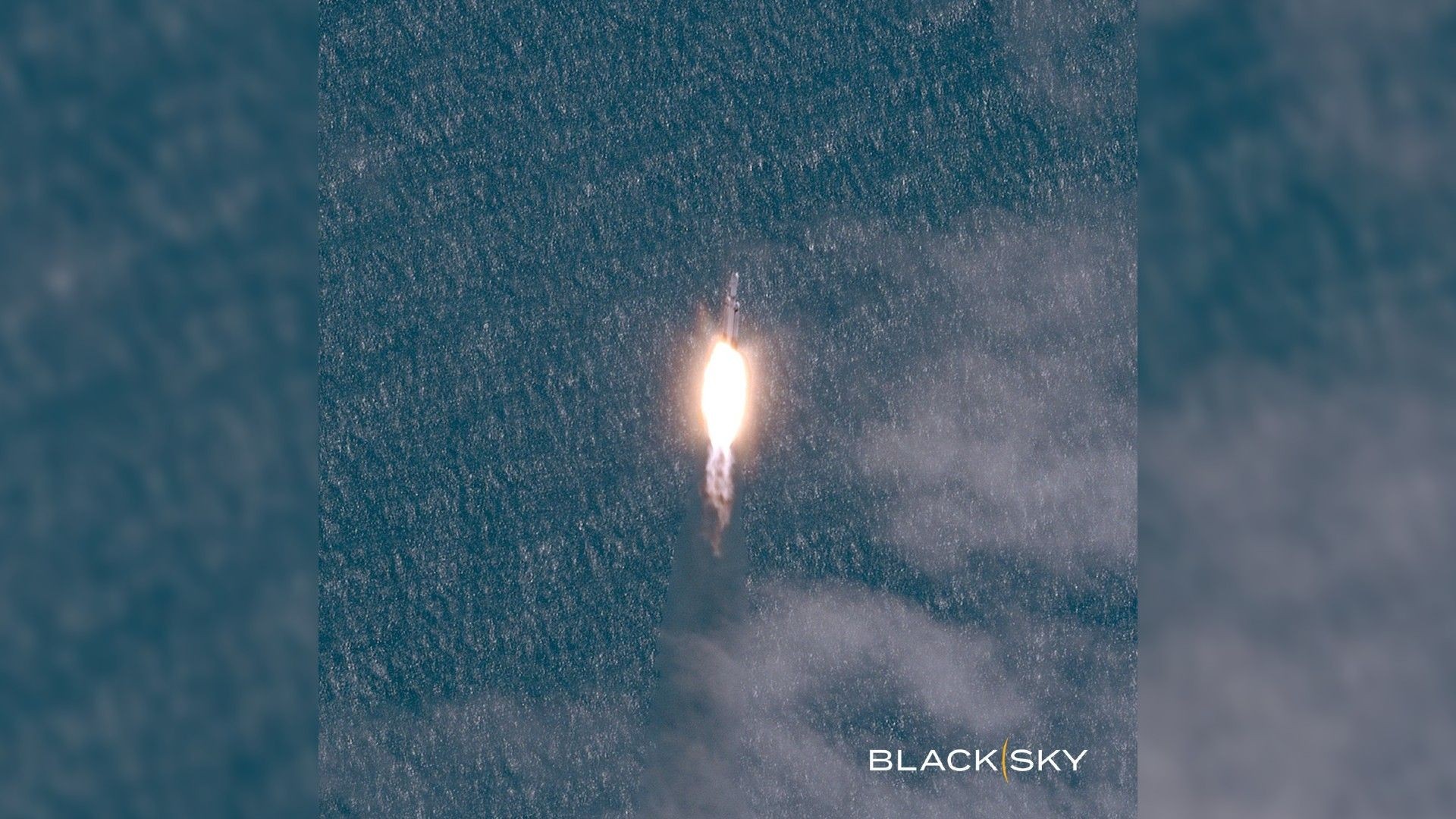
A high-resolution satellite recently provided a rare, orbital perspective of a major SpaceX milestone. On Wednesday, April 29, the Falcon Heavy rocket completed its first launch in 18 months, successfully delivering the ViaSat-3 F3 communications satellite toward its destination in geosynchronous transfer orbit.
A View from Low Earth Orbit
The liftoff was documented by one of BlackSky’s Gen-3 Earth-observing spacecraft. Unlike traditional ground-based cameras that view launches from a fixed position on Earth, this satellite captured the event from an “off-nadir” angle—essentially looking down from space at a sharp angle during twilight.
The satellite provided two distinct perspectives:
– On the pad: A sharp image of the massive rocket prepared for ignition at NASA’s Kennedy Space Center in Florida.
– In flight: A second shot taken just 38 seconds after liftoff, capturing the vehicle as it ascended through cloudy skies at speeds exceeding 400 miles per hour.
The Technology Behind the Lens
The ability to capture such high-quality imagery from space is a testament to the advancing capabilities of small satellite constellations. BlackSky is currently expanding its Gen-3 constellation in low Earth orbit (LEO).
While only four of these specific spacecraft have been launched to date, their technical specifications are impressive:
– High Resolution: The satellites can resolve objects on the ground as small as 13.8 inches (35 centimeters).
– Versatility: The Gen-3 models feature “time-diverse imaging,” allowing them to capture high-quality data at various hours of the day and night.
This capability is part of a broader trend in the space industry where “constellations” of smaller, highly capable satellites are being used to provide near real-time monitoring of Earth, offering much more frequent data than the massive, singular satellites of the past.
Context: The Power of Falcon Heavy
The Falcon Heavy remains a critical asset in the global launch market. It currently stands as the second-most-powerful operational launcher in existence, surpassed only by NASA’s Space Launch System (SLS).
While SpaceX is developing the Starship —a vehicle intended to far exceed the lifting capacity of both the Falcon Heavy and the SLS—Starship is still in the developmental and testing phases. For now, the Falcon Heavy remains the heavy-duty workhorse for transporting large, complex payloads like the ViaSat-3 communications satellite into orbit.
The successful launch and the high-resolution satellite capture highlight the growing synergy between heavy-lift launch capabilities and the sophisticated orbital sensors used to monitor them.