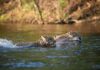
In the natural world, physical perfection is often seen as the prerequisite for leadership. However, a remarkable case study involving a kea parrot named Bruce is challenging long-held assumptions about how disability affects social standing in animal hierarchies.
Living at New Zealand’s Willowbank Wildlife Reserve, Bruce is a kea—a highly intelligent, playful parrot—who is missing half of his beak. Despite this significant physical disadvantage, researchers have discovered that he is not just a survivor, but the undisputed leader of his flock.
Breaking the Rules of Dominance
In many animal societies, a physical injury often leads to a loss of status. A notable example is Faben, an alpha chimpanzee in Tanzania, who lost his top rank after contracting polio. While Faben managed to maintain a “beta” status through new tactics and alliances, he could not reclaim his throne.
Bruce’s situation is different. According to a study published in Current Biology, Bruce achieved alpha status without the help of an able-bodied ally. His dominance is purely a result of his own behavioral adaptations.
The Power of Innovation
The research, led by behavioral ecologist Alex Grabham from the University of Canterbury, tracked 162 physical dominance interactions among nine males in Bruce’s “circus” (the collective noun for a group of keas). The results were striking:
– Bruce won 100% of his physical confrontations.
– To compensate for his missing beak, Bruce developed a specialized combat style. While typical keas rely on kicking, Bruce utilizes a “jousting” technique that leverages his exposed lower beak.
– This innovation is highly effective: his jousting repels opponents 73% of the time, compared to only 48% when he relies on kicking alone.
The Perks of the Throne
Being the “top bird” provides Bruce with significant social and survival advantages that go beyond mere combat victories. His status has fundamentally altered the social dynamics of the group:
- Hierarchical Grooming: In a rare departure from typical kea behavior—where birds usually only preen their mates—other males actively clean Bruce’s beak, reaching the areas he cannot. Interestingly, the lower a bird’s rank, the more likely they are to perform this grooming, a pattern similar to that seen in chimpanzees.
- Priority Access to Resources: Bruce enjoys “first dibs” on food. During the study, he was able to eat at the central feeders 83% of the time. On several occasions, lower-ranking birds even allowed him 15 minutes of uninterrupted, solitary access to all food sources before they began eating his leftovers.
A “Chill” Leader
In many species, being the alpha is a high-stress job. For example, alpha male baboons often show elevated levels of stress hormones (glucocorticoids) because they must constantly defend their position from challengers.
However, Bruce appears to be the exception. Analysis of his droppings revealed that he is actually the most relaxed member of the group. Researchers suggest this may be because his dominance is so absolute that other birds do not even attempt to challenge him. Because he is rarely bullied or chased, he enjoys the benefits of leadership without the typical physiological costs of constant conflict.
The Big Picture
While Bruce’s success is a triumph of behavioral flexibility, scientists note that his environment plays a role. In the controlled setting of a wildlife reserve, his hierarchy is stable. In the wild, where groups are constantly shifting and food sources can be much harder to process, a damaged beak could present significant survival hurdles during harsh winters.
Conclusion: Bruce’s story demonstrates that intelligence and innovative behavior can effectively bypass physical limitations, allowing an individual to not only survive but thrive at the top of a social hierarchy.