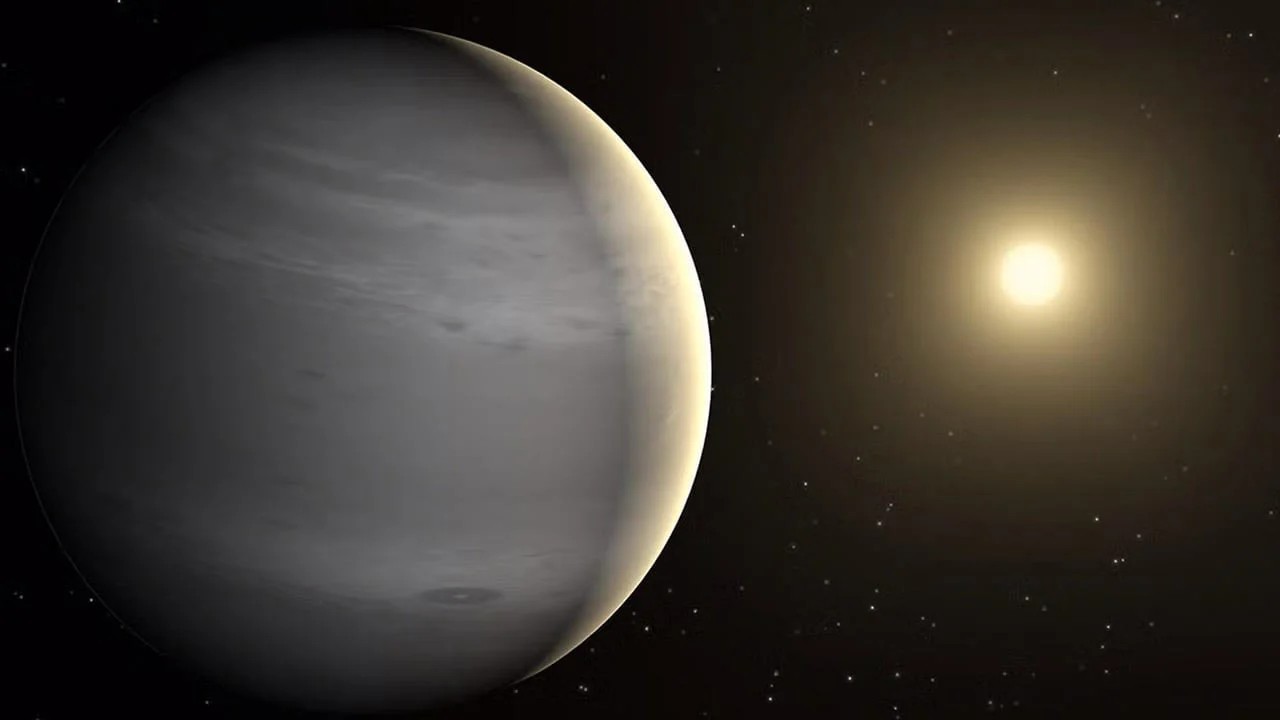
A Planet in the Middle
Most giant planets are extremes. They’re either scorching hot Jupiters roasting near their stars. Or they’re frozen gas giants, far away and icy cold like Jupiter or Saturn.
TOI-199b isn’t like those. It sits in the middle.
Astronomers using the James Webb Space Telescope just peeked at its atmosphere. This is Saturn-sized world is rare. It’s temperate. Actually Earth-like temperature wise.
That is surprising.
175 Degrees, Please
The planet orbits a star over 330 light-years away. It takes about 100 days to make one lap. Its temperature sits around 175 Fahrenheit.
Still too hot to step on? Yes. But for a giant gas planet, it’s mild. Think about it. A car parked in direct summer sun hits temperatures close to this. Hot Jupiters, by comparison, can hit thousands of degrees. TOI-199b is nothing like them. It is also nothing like the freezing giants in our own solar system. It occupies a narrow gap in between. A Goldilocks zone for size and heat, but not necessarily habitability.
“This is the first time we’ve been able to study the atmosphere” of one of these planets in detail, Renyu Hu from Penn State said.
Only a handful of temperate giants are known. We have seen thousands of exoplanets since 1992. But few fit this specific mold. Hu led this team alongside researchers from NASA’s Jet Propulsion Laboratory.
Catching the Fingerprint
How do you sniff a planet from light-years away? Transmission spectroscopy.
As the planet passes in front of its star — a transit — some starlight filters through its atmosphere. The rest goes by. The atmosphere acts like a filter. Molecules grab specific colors of light.
JWST splits the starlight like a prism. It looks at what’s missing.
“Specific elements will absorb specific wavelengths… creating a fingerprint,” Aaron Bello-Arufe explained. He is the lead author of the paper, published in the Astronomical Journal on May 20.
The transit was long. About seven hours. Hot Jupiters usually zip by much faster. The team recorded twenty straight hours to get a good baseline. Then they watched the dip.
The result? Methane. Definitely there.
Models, Then Reality
Scientists expected methane. Models predicted it would be in the mix. So seeing it confirmed their theories weren’t wrong. Nice validation. But they saw more than that. Hints of ammonia and carbon dioxide also appeared in the data.
Are those definitely there? Probably. More observations are needed to measure exactly how much.
Does it matter?
Yes. Computer models struggle to explain how atmospheres form and evolve over billions of years. Adding data points like this helps tweak the dials. It makes the simulations sharper. If we can understand how a temperate gas giant keeps its methane and ammonia balanced, we might learn more about our own atmosphere too. Earth shares the same cosmic neighborhood. Same chemistry basics.
“This more complete picture… can be used to improve our models,” Hu said.
It also proves we can do this. The success gives researchers confidence to aim telescopes at other temperate giants. Maybe this planet is unique. Or maybe this class of world is common. We do not know yet.
Who and Why
Penn State and JPL led the charge. Help came from Arizona State University. Johns Hopkins. Carnegie Institution for Science. Caltech. UC Santa Cruz.
NASA funded it. The Space Telescope Science Institute provided the grant.
The paper, titled “Methane on the Temple Exo-Saturn TOI.199 b,” lists a dozen authors including Bello. Arufe. Hu. And others. DOI 10.38.47/1.53.8.3.8.81./ae.4. fb.a
There is always more sky out there. TOI-1. 9. 9. b is just the first detailed look. The question isn’t if we find more. It is what they tell us next.