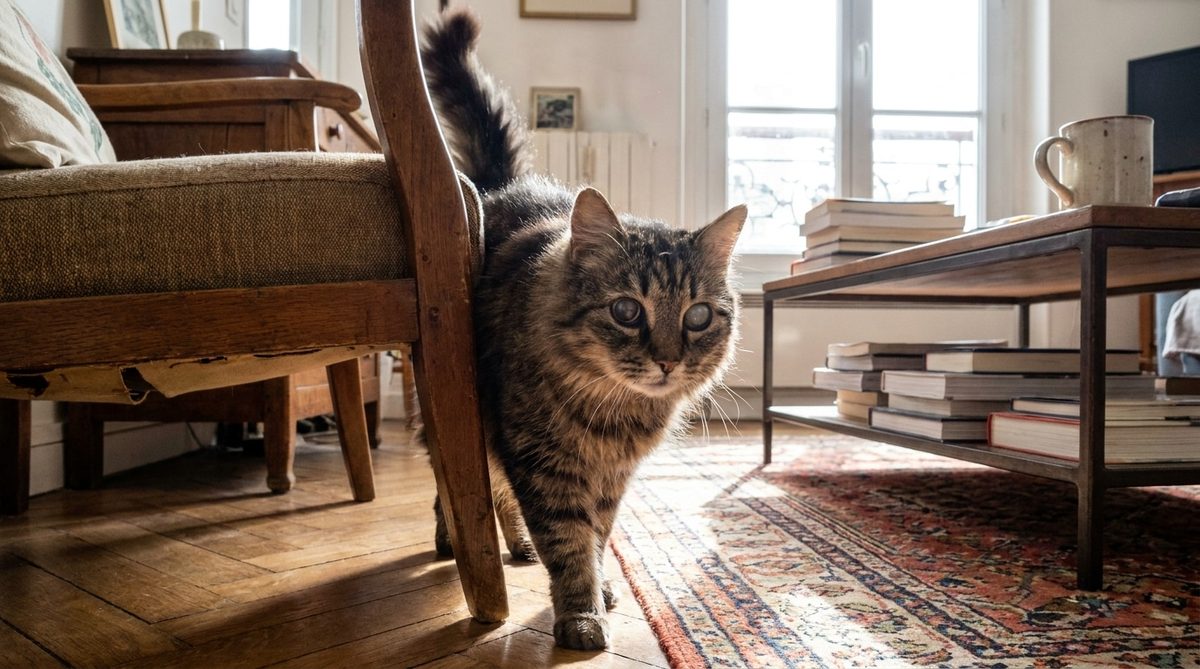
Your cat is sitting in the corner. Refuses to play. Ignore your voice in a way that looks like arrogance. In the middle of summer, when cats are usually full of energy, this attitude seems peevish. Or maybe just in a bad mood.
But behind this apparent cynicism lies a harsh medical reality: irreversible blindness.
Before labeling your whiskered companion as chronically sulky, you need to learn how to interpret the true signs of poor eyesight. Close observation will help you guide them through the difficult transition. It’s not about diagnosing yourself, it’s about knowing when to get help and how to adapt your home.
How to confirm possible blindness at home
You don’t need high-tech equipment to detect vision loss. Methodical observation in the living room is enough. Here’s how to confirm potential blindness using three instinctive vision tests.
1. Pupillary light reflex
Take a small flashlight. Carefully aim the beam at the cat’s eyes. Look carefully. Pupils should contract immediately and symmetrically. If there is no response or the response is slow and uneven, vision may deteriorate.
2. Blink Reflex
Quickly approach your cat’s face. Do not cause wind gusts. Just bring your hand close. A sighted cat will blink or backs away. If there is no movement or warning sign, their immediate spatial awareness is likely impaired.
3. Navigation Test
Add a small obstacle to a familiar route. Move the chair slightly from its usual position. Does the cat steer around it instinctively? Or does it hit an object? Failure to avoid new obstacles is a strong sign of vision loss.
When to visit the vet within 48 hours
Slow degeneration allows cats to sharpen their hearing to compensate. They adapt. But sudden changes allow no delay.
You need to see your vet within 24-48 hours if you notice any of the following:
- Unexplained falls (eg falling off a scratching post).
- Pupils that remain abnormally dilated even in natural light.
- Red, sore or swollen eye.
- Frequent crying or frantic rubbing of the eyes.
These are not signs of bad behavior. They indicate possible eye pressure problems or retinal detachment. Immediate medical examination is required to prevent suffering. Ignoring these acute symptoms can lead to permanent damage or loss of the eye.
Creating a safe environment for a blind cat
A veterinarian’s diagnosis of blindness is not the end. It’s a change in routine. With stable signals, a blind cat can live a happy and confident life.
The most important thing is to anchor their world. Always store the following products in exactly the same place:
- Food and water bowls.
- The litter box in a low-traffic area.
- Their resting cushion and low-base cat tree.
If you respect the mental map your cat has created, they will navigate surprisingly easily. They will rely on the stability you provide.
People often interpret detachment as coldness. It’s a reflex. But you ensure their safety with simple tactile and light checks and identifying urgent eye problems. You help them age with dignity.
Is your cat’s unusual stillness a sign of vision loss? Or is it something else entirely? The difference is important.