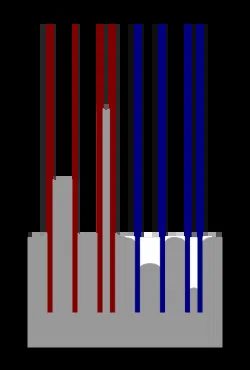
Water does not always follow the rules learned in school. It just doesn’t stand still. It’s on the rise.
This is capillary action. A physical phenomenon in which a liquid moves up or down through a narrow tube without any external force pressing on it. You can see this in plants. You can see it in paper towels. You might not notice it in a thin glass tube, but the physics is the same.
The driving force isn’t magic. It is molecular. More precisely, it is a tug of war between two types of attraction: adhesion and cohesion.
Adhesion is the attraction between the liquid and the solid wall of the container. Imagine the water molecules hugging the glass. Cohesion is the attraction between the liquid molecules themselves. They want to stay together as a close group.
The outcome depends on who wins this tug of war.
If adhesion is stronger than cohesion, the liquid will rise. The molecules pull up the sides and drag the rest of the liquid with them. This creates a concave meniscus – the curved surface you see when water sits in a clear glass. The water rises.
If cohesion prevails, the liquid is pushed away from the walls. It doesn’t climb. It will fall. The mercury in the old thermometer ensures this. It forms a convex meniscus. It curves in the middle and stays low.
Surface tension also plays an important role here. It is the elastic nature of a liquid’s surface that allows it to resist external forces. It works with adhesion and cohesion to determine how high or low the liquid go.
It’s not just about the tubes. It’s about how trees absorb water from their roots to their leaves. It’s all about how your skin absorbs the lotion. It’s all about how the ink flows into the pen.
Without capillary action, many everyday things wouldn’t work. Plants would wilt. The cleaning products would accumulate instead of spreading. The world would be much less wet in the places that need it most.
Why do some liquids rise while others fall? It depends on molecular preference. Do they like the wall more than each other? Or vice versa?
The answer changes everything.
It sounds contradictory, but the surface tension of a liquid often works against itself. To minimize energy, it tries to keep its surface area small. But when you confine it to a small space, that same tension becomes a motor that pushes the liquid up or down. This behavior is not random. It is caused by the tug of war between two specific types of intermolecular forces.
Adhesion vs Cohesion
If you see liquid rising in the thin tube, it is due to adhesion. This force of attraction between the liquid molecules and the solid walls of the container. When this adhesive force is stronger than cohesion – the force that holds the molecules of a liquid together – the liquid rises.
The result is a concave curve on the surface. We call this the meniscus. In this scenario, the liquid “wets” the surface. Water in a glass is a classic example. The water molecules are more attracted to the glass than to each other, so they spread out and climb the walls, pulling the rest of the column up with them. They continue until the weight of the water balances the surface tension and the rising pressure of adhesion.
But what happens when cohesion wins?
The Convex Meniscus
When the liquid molecules are attracted to each other more strongly than to the pipe material, the liquid actually sinks below the surrounding level. The surface curves upwards from the middle, forming a convex shape.
Mercury is a good example of this. Its internal cohesion is incredibly strong. It will not spread on most surfaces. When mercury is placed in a capillary tube, it pushes downwards, creating an inverted, dome-shaped curve. It’s a stark visual reminder that not all liquids act like water.
How pipe diameter makes all the difference
You can test this yourself with simple glass tubes. Take a narrow capillary and immerse it in water. The water rises up. Now take a wider tube and do the same. The water is still rising, but not as high.
The narrower the tube, the higher the liquid rises. Why? This is because the adhesion force acts along the circumference of the pipe. In a thin tube, the ratio of wall surface area to liquid volume is much higher. The “pull” of the walls has a greater effect on the total mass of the liquid column. In a wide pipe, the same adhesive force must lift a much heavier column of water, so the balance point is lower.
The height of the liquid column is inversely proportional to the radius of the capillary tube.
Capillary action in nature
This is not just a physics lab trick. It is a biological necessity. Plants rely on capillary action to survive.
Roots absorb water from the soil, but getting water to the leaves—sometimes hundreds of feet into the air—requires more than osmosis. Plants are basically bundles of microscopic capillary tubes known as xylem. The narrow diameter of these vessels allows the water to rise against gravity and carry dissolved nutrients with it.
It’s an ongoing process. When water evaporates from the leaves (transpiration), it draws more water from the bottom up. Capillary action helps maintain this flow by working with cohesion to create a continuous water column. Without it, trees would not be able to transport natural resources from the ground to their highest branches.
So