


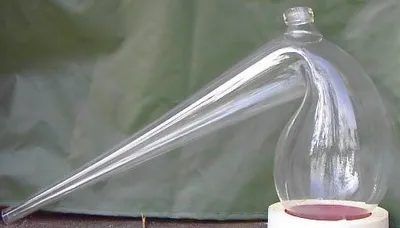
You can still spot the basic shape in modern chemistry labs, but the retort is really an ancient piece of tech that never quite died out. It is a vessel designed for distillation. You put substances inside. You apply heat. The result is a separation process driven by vapor and condensation.
The classic lab version is straightforward. It looks like a glass or metal bulb with a long, curved spout. The spout guides the distillate out of the vessel and into a receiving container. This design has been around for centuries. It traces its lineage back to the cucurbit, a flask used by medieval alchemists who were trying to understand the nature of matter long before modern chemistry existed.
Industrial Scale Separation
While the lab version is simple, industrial retorts are massive machines. They perform critical tasks in mining and energy production. One major use is separating gold from mercury in amalgams. This is essential for recovering precious metals after they have been extracted using mercury. Another key application involves zinc. Industrial retorts separate zinc metal vapor from smelted ore mixtures. The heat drives off the vapor, leaving behind other materials.
Coal processing also relies heavily on these vessels. Retorts obtain coke or gas from coal. By heating coal in a sealed environment without oxygen, manufacturers can produce these valuable byproducts. The design of these industrial units varies. Some are tall and thin. Others are short and wide. The materials differ too. Some are made of clay. Others are constructed from iron, depending on the specific chemical demands of the process.
The retort is not just a relic. It remains a practical tool for separating substances through heat-induced phase changes.
Why does this matter today? Because separation is often the hardest part of processing raw materials. Whether it is refining gold or producing fuel, the ability to isolate specific components using heat is foundational to industry. The retort does this simply. No complex machinery. Just heat, vapor, and a curved path to catch what is needed. The principle remains the same as it was for the alchemists. Change the state of matter, then capture what you want. The rest falls away.


