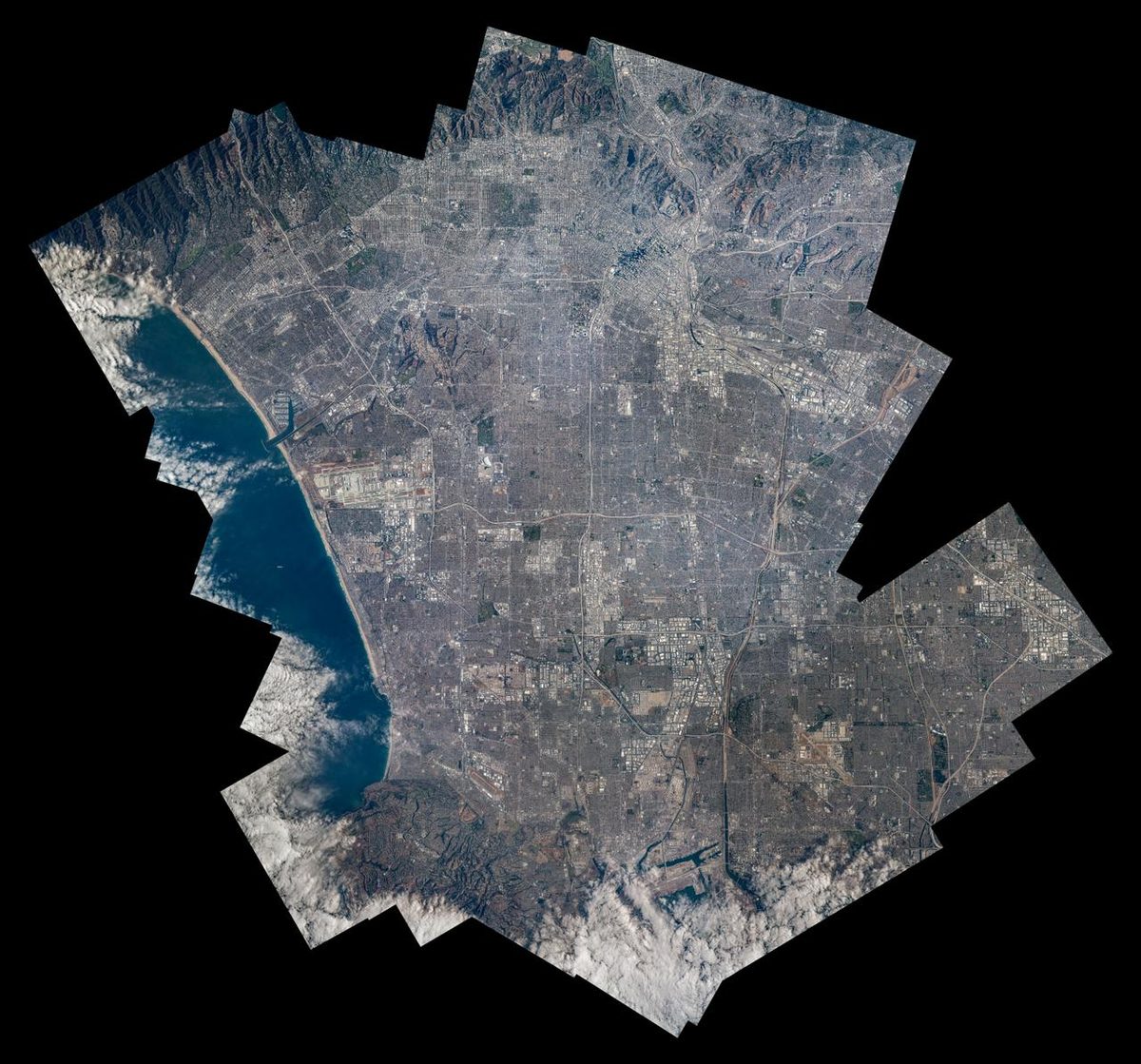
Los Angeles was built on a grid. That’s the defining architectural fact. The city follows a Hippodamian plan. You know the type. Straight lines. Perfect squares. Rectangular blocks. It is the standard American urban layout.
But seeing it on a map is one thing. Seeing it from orbit is another.
Thomas Pesquet did the heavy lifting. The European Space Agency astronaut captured the city. He took about a hundred photographs. The date was May 21. The view was from space.
The result? A 430-megapixel map. It is massive. It is high resolution. You can see the streets clearly. They are straight. They run true.
This isn’t just a cool picture. It is a record of urban geometry. The grid is not just aesthetic. It is functional. It shapes how people move. How traffic flows. How the city breathes.
Pesquet’s images prove it. The lines are rigid. They stretch across the landscape. There is no ambiguity. No winding paths. Just order.
This precision matters. It shows how humans impose structure on land. How we cut the earth into pieces. Then fill them with life.
The grid is everywhere in the United States. But Los Angeles makes it obvious. The scale is huge. The pattern is relentless.
Pesquet captured it all. One hundred shots. stitched into one giant image. The resolution is stunning. You can almost see the cars. You can trace the avenues.
It’s a reminder of how we build our world. In straight lines. In right angles. In grids.


If you’re waiting for the next big wave in science and tech, you might be looking in the wrong places. The algorithms push what’s popular. They don’t always push what’s necessary.
We’ve already covered the surface. Now let’s look at the friction. The part where theory meets the messy reality of implementation.
Why the hype cycle keeps failing us
It’s easy to get lost in the noise. One day it’s quantum computing. The next, it’s neural interfaces. Then the metaverse. The cycle repeats. But beneath the marketing gloss, something quieter is happening.
Real progress isn’t always loud. It’s incremental. It’s boring until it isn’t.
Consider the recent shifts in battery technology. We aren’t seeing a sudden breakthrough that solves all energy crises overnight. We’re seeing small, stubborn improvements in solid-state electrolytes. Engineers are tweaking viscosity. Adjusting temperature tolerances. It’s not sexy. It’s essential.
“Progress is rarely a single moment of genius. It’s a thousand small corrections made in isolation.”
This is why following niche science channels matters more than chasing headlines. The details live in the pre-print papers. The peer reviews. The failed experiments that never make it to the newsfeed.
The hidden infrastructure of AI
Everyone talks about the models. The large language models. The image generators. But what runs them?
The infrastructure is straining. Power grids are hitting limits. Data centers are consuming water at unsustainable rates. The environmental cost isn’t a side effect. It’s a core component of the technology.
This leads to a critical question: How do we scale intelligence without collapsing the local ecosystem?
Researchers are exploring liquid cooling systems. Using waste heat to warm residential areas. Recycling water through closed-loop systems. These aren’t futuristic concepts. They’re current engineering challenges. The “how” is being solved in real-time, even if the headlines ignore it.
Which materials will define the next decade?
We’re moving past silicon. Not because it’s obsolete. Because it’s insufficient.
Gallium nitride. Silicon carbide. These materials handle higher voltages. They operate at higher frequencies. They’re crucial for everything from electric vehicle chargers to 5G infrastructure.
The supply chain is fragile. Mining locations are concentrated. Geopolitical tensions affect availability. This isn’t just a tech story. It’s a logistics story. A political story.
If you want to understand the future of hardware, look at the mining reports. Look at the trade agreements. The silicon valley starts in the dirt.
Where is the real innovation happening?
Not in the headlines. In the labs. In the small startups that aren’t chasing unicorn valuations. They’re chasing utility.
Look at agricultural tech. Precision farming. Sensors that detect soil moisture at a centimeter scale. Reducing water usage by 30%. That’s not a viral tweet. That’s survival.
Look at medical diagnostics. Portable devices that detect disease markers from a drop of blood. No massive hospital. No long wait times.
These technologies don’t need to be flashy to change lives. They need to work. Consistently.
The human element in the loop
Technology doesn’t exist in a vacuum. It reflects our biases. Our limitations. Our desires.
When we build AI, we encode our data. Our history