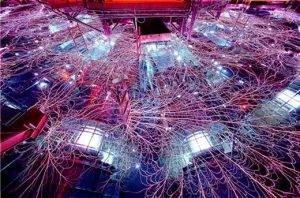
How Sandia’s Z-machine generates heat hotter than a star to generate fusion power
I have to watch it twice. Maybe about 3 times. What exactly is that mess of cables? Although it looks like a bundle of wires, the structure is huge, about the size of a gym. In a lab in New Mexico, the device is acts as a hellish machine. The temperature is over 2 billion degrees. This is definitely world class heat. Even the core of the sun, the hottest star we know, emits only about 16 million degrees of heat. The Z Machine goes much further.
Sandia National Laboratories didn’t build the Z-machine to break Guinness World Records. The goals are realistic. The researchers are testing whether this experimental device could be useful for electricity production in the future. They are pursuing nuclear fusion.
To achieve this, they directed an electrical current of 20 million amperes through the wire and directed it at the plasma particles. These particles are electrically charged and smaller than atoms. For a fraction of a second, the current passing through it corresponds to the output of 10,000 power plant generators. Each generator can light 500,000 light bulbs. The energy density is amazing.
When a large number of accelerated electrons collide with the plasma, the particles are crushed to the size of a pencil tip. The space becomes so small that the particles cannot move freely. They release their energy in the form of heat. Compression creates a plasma state where atoms are stripped of their electrons. This state allows for the release of immense thermal energy.
The researchers themselves were surprised by the temperature reached. The electric bill for this lab could bankrupt the parents if they had to pay the bills. But in a trillionth of a second, the experiment produced four times more energy than scientists initially put into it.
“In a trillionth of a second, this experiment produced four times more energy than scientists originally used.”
This increase in energy is an important milestone. Show that the Z-machine can create the necessary conditions for fusion. Nuclear fusion is the process that powers stars. Lighter atomic nuclei combine to form heavier atomic nuclei. This process releases a large amount of energy. It produces no long-lived radioactive waste. It offers a clean and nearly limitless energy source.
The Z Machine uses a technique called Z-pinch. It compresses plasma using magnetic fields. The magnetic pressure forces the plasma inward. This inward compression increases density and temperature. The goal is to achieve ignition. Ignition means that the fusion reaction can be sustained without external input. The Z Machine has come close. This shows that high energy density physics is possible.
The implications for energy production are profound. If researchers can consistently replicate this result, it could open up new ways to generate electricity. The current technology requires massive amounts of electricity. The Z machine itself also consumes considerable power. But the increase in net energy shows that physics works. The engineering challenge remains. Scaling this up to a commercial power plant is difficult. The materials must withstand extreme heat. The magnets must handle immense currents.
The surprise of energy production highlights how much we still have to learn about plasma. We thought we knew the limits. we were wrong. The plasma behaved better than expected. They bind together long enough to release more energy than they put in. It’s more than just a number. This is a proof of concept.