


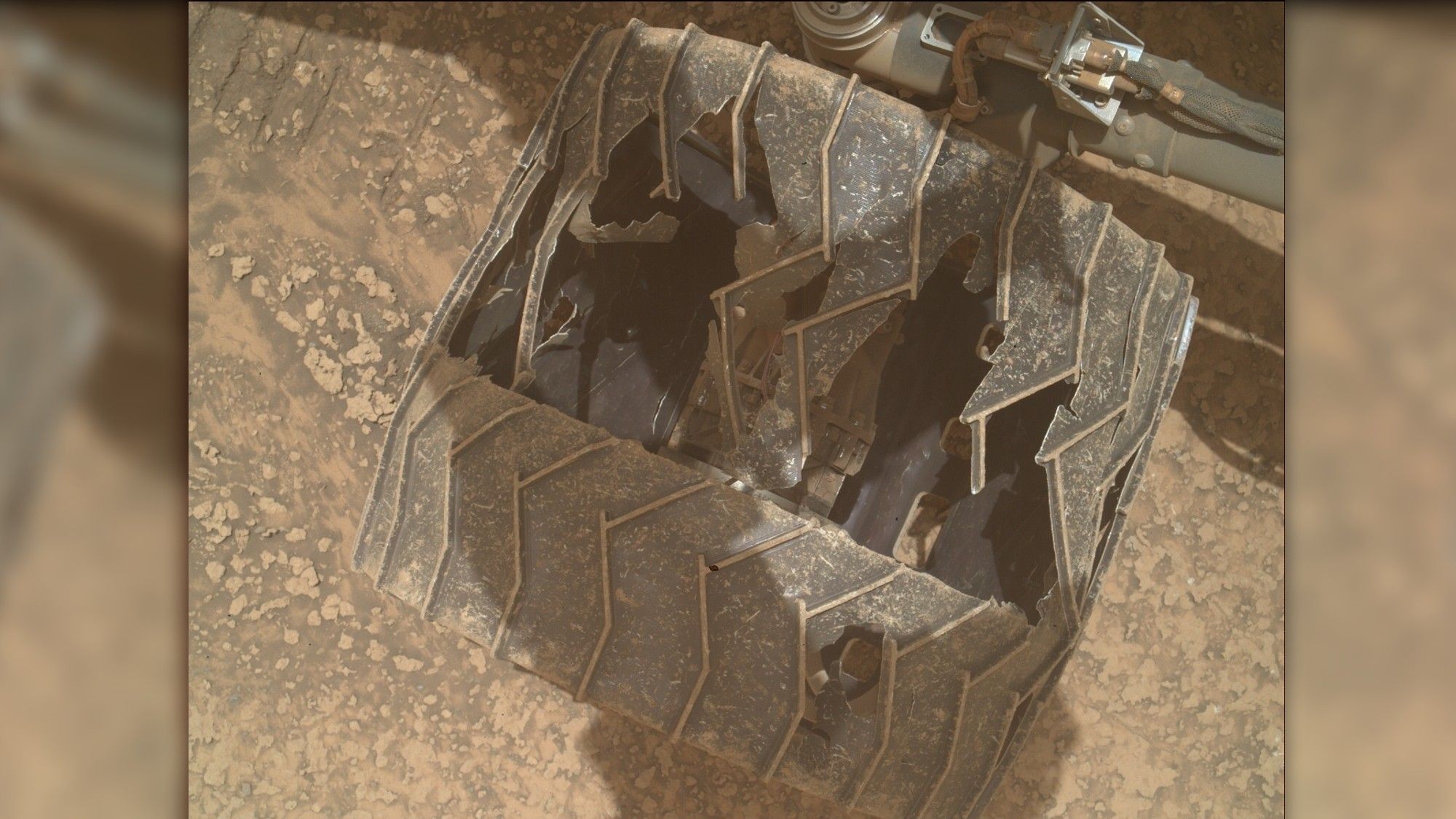
NASA’s Curiosity rover is showing its age. After nearly 14 years traversing the Red Planet’s unforgiving terrain, the vehicle looks it. A raw image released July 27, 206, reveals the truth: the rover’s aluminum wheels are battered. Deep cracks. Sharp holes. It’s not pretty. It’s proof of work.
How did it get here? Curiosity landed in Gale Crater on August 5, 2012. The deployment was a feat in itself — hanging from a sky crane that gently lowered the car-sized robot to the Martian surface. That landing was just the beginning.
Since touchdown, Curiosity has rolled more than 20 miles (32 km) across jagged rocks and abrasive dust. The rover weighs over one ton. Mars is rough. The combination is destructive by design. You cannot drive a heavy machine over sharp, granite-like rocks for 20 miles without damage.
“Holding up well despite taking some of the worst abuse on Mars.”
This isn’t just cosmetic damage. The cracks and punctures are physical evidence of the rover’s persistence. NASA and the Jet Propulsion Laboratory monitor these conditions closely. Despite the holes, the wheels remain functional. The agency’s 2024 assessment was blunt: they are enduring some of the worst treatment any planetary rover has ever taken.
More Than Just Metal Damage
Seeing these photos might make you wince. But consider the alternative.
We take for granted the daily stream of data coming from another planet. Two robotic explorers — Curiosity and Perseverance — beam images back to Earth constantly. It’s mundane now. But a decade ago, this was science fiction. The ability to place a wheeled laboratory on another world and keep it running for over a decade is an engineering miracle.
The cracked wheels represent that miracle. They are scars from the frontier.
These machines are our first interplanetary citizens. They are not human, but they act as proxies. They answer the fundamental question of how other worlds operate. Every mile Curiosity travels brings us closer to understanding Mars’ ancient potential for life.
Why This Matters Now
We aren’t just taking photos of broken aluminum. We are documenting the durability required for future human exploration. The data gathered by Curiosity — the geology, the climate history, the soil composition — lays the groundwork.
If we plan to send humans to Mars, we need to know if the environment can sustain them. We need to know if our equipment can survive. Curiosity is essentially stress-testing the planet for us.
The wheels are failing. Slowly. But they haven’t failed. Yet.
That distinction is everything. As long as Curiosity moves, it learns. It finds organic molecules. It analyzes rocks that tell stories from billions of years ago. The damage to the wheels doesn’t stop the science. It complicates the logistics. But it doesn’t end the mission.
So, look at the cracks. Don’t just see destruction. See persistence. See a robot that has outlasted expectations. It’s been nearly fourteen years on Mars. And it’s still driving.


