


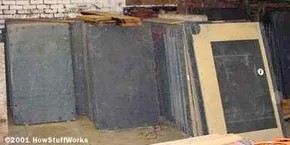
You have probably noticed that a high-end pool table feels immovable. It is not just the heavy wooden frame. The secret lies in the bed. That flat, green (or black) playing surface is not wood. It is a slab of stone. Specifically, slate.
This is not a gimmick. It is geology serving precision.
Slate is a metamorphic rock. It forms when layers of clay sediment are compressed. The result? A rock made of chlorite, mica, and quartz. These minerals arrange themselves in thin, parallel layers. This allows the rock to split cleanly. Professionals call this “cleaving.” You get broad, flat segments without much effort.
That flatness is the entire point.
Grinding that stone into a perfectly level plane is relatively straightforward. Wood warps. Wood expands and contracts with humidity. Slate does not care about the weather. It stays flat. For decades, that stability made it the undisputed king of billiard surfaces.
The Quest for the Perfect Green
Where does this stone come from? Anywhere with the right geology. You can find slate in Brazil, China, India, and many other regions. But not all slate is created equal.
For serious players and collectors, the origin matters. The gold standard is Italian slate.
Specifically, the Ligurian region of northern Italy.
Italian slate is preferred for a quality billiard table.
The stone from Liguria is dense. It is consistent. It takes a polish that others struggle to match. When you buy a top-tier table, you are likely paying for stone shipped from this specific corner of Italy. It is a minor detail to the casual observer, but for anyone who cares about the true roll of the cue ball, it is everything.
The Logistics of Heavy Stone
Here is where the romance of the game meets the brutal reality of logistics.
Slate is heavy. Insanely heavy. A single slab for a standard table is usually three-quarters of an inch to one inch thick. That single piece weighs between 400 and 600 pounds. Moving that much rock is a nightmare for shipping carriers. It is also prone to cracking if the stress isn’t distributed evenly.
So, manufacturers do something clever. They split the slab.
Most tables use three separate pieces of slate. Each slab weighs about 150 to 200 pounds. This makes transport manageable. It also reduces the risk of a catastrophic fracture during shipping. You can stack three smaller slabs more safely than one massive monolith.
But there is a catch.
Three pieces mean two seams. If those seams are even a hair out of alignment, the ball will stutter. It will not roll true. The surface must be matched perfectly. The edges must be planed to be completely flat. The joints must be invisible to the naked eye.
Some manufacturers still produce tables with a single, continuous slab of slate. It is rarer now. It is more expensive to ship. It is harder to install. But for the purists, that single piece offers the most unbroken playing surface in the world.
Most brands stick to the three-slab method. It is the industry standard for a reason. But getting it right? That takes skill. And that skill is what separates a $2,
The foundation of a serious pool table isn’t just about the flat surface you strike balls across. It’s about structural integrity hidden beneath the cloth. Ideally, the slate slab should be oversized. This isn’t a minor detail. It means the stone extends slightly beyond the actual playing bed, reaching underneath the rails. That extra overhang provides critical support to the rail structure, keeping the whole table rigid during heavy play.
Most high-quality tables take this a step further by framing the slate. Builders glue a sturdy wood backing to the underside of the stone. This frame serves a specific mechanical purpose. It anchors the felt cloth that gets stretched over the top. The cloth isn’t just laid down; it’s stapled or tacked directly into that wooden frame. Without this backing, you’d have to glue the fabric directly to the bottom of the slate. That’s messy, difficult, and far less durable.
Precision Cutting for Pockets and Anchors
The manufacturing process doesn’t stop at sizing. The slate is carefully carved around the edges to create the pockets. This isn’t just cutting corners; it requires precise removal of stone to ensure proper ball drop.
Once the pockets are carved, builders drill holes along the perimeter. These aren’t decorative. They’re functional apertures designed for bolts. The slate needs to be bolted securely to the top of the table frame. This anchoring prevents any shifting or warping over time. A loose slate ruins the roll. A bolted, framed, oversized slate ensures the game plays exactly as designed.
Why Your Pool Table Warps (And What It’s Made Of)
Skip the slate. If you are looking at an entry-level pool table, you are likely looking at a lie.
The playing surface isn’t stone. It is a compromise. Manufacturers use non-slate materials to keep costs down. You will see names like Slatron and Permaslate on spec sheets. They sound heavy. They sound professional. They are neither.
These are hard, synthetic sheets. Basically plastic layered over particle board. There is also Honeycomb construction. That is stiff plastic honeycomb sandwiched between two plastic sheets. It sounds structural. It is not.
Then there is Medium Density Fiberboard (MDF). Also called pressed wood. Or particle board. It is flat when it leaves the factory.
The Warp Problem
Here is the reality of non-slate surfaces. They warp. Easily.
You cannot maintain a perfectly flat playing surface for any length of time with these materials. Gravity wins. Humidity wins. Time wins. The durability simply isn’t there. A billiard ball rolls true on slate. It drifts on MDF.
Foundation First
The quality of the cloth or the surface material itself is irrelevant if the foundation is weak. You need a solid base. Without it, nothing else matters.
We will look at the construction of the table itself in the next section.


