New paleontological discoveries in South Australia are providing a rare, detailed glimpse into the evolutionary history of one of nature’s most unusual creatures. Fossils recovered from the Namba Formation reveal that 25 million years ago, an ancestor of the modern platypus—known as Obdurodon insignis —was a much more formidable predator than its contemporary descendant.
A Predator with a Powerful Bite
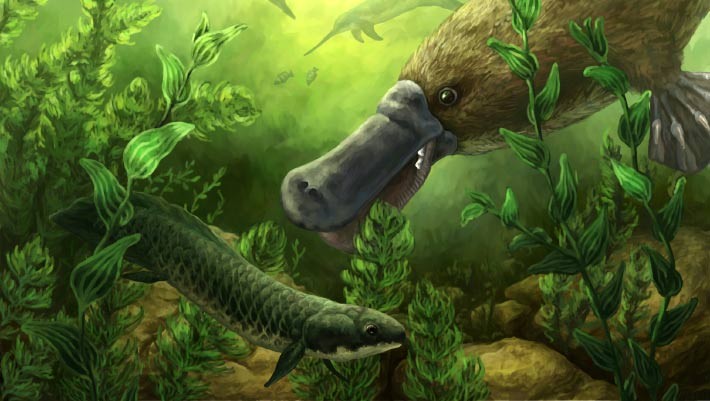
While the modern platypus (Ornithorhynchus anatinus ) is famous for its lack of adult teeth, relying instead on keratinous pads to grind food, its ancestor was built differently. The newly discovered fossils of Obdurodon insignis include a first premolar and robust molars, proving that this ancient species possessed a functional, powerful set of teeth.
According to researchers from Flinders University, these dental features suggest a much more aggressive diet.
– Crushing Capability: The large, pointed front teeth combined with heavy molars allowed Obdurodon to crush hard-shelled prey.
– Dietary Focus: Scientists believe they likely fed on animals with tough exoskeletons or shells, such as yabbies (freshwater crayfish).
This evolutionary shift—from a toothed predator to a toothless gum-user—marks a significant change in how the monotreme lineage interacts with its environment.
Built for the Water
Beyond its mouth, the fossil find includes a partial scapulocoracoid (a bone that supports the front limb). This discovery is crucial because it provides evidence of the animal’s physical capabilities.
The structure of the forelimb is remarkably similar to that of the modern platypus, suggesting that while its diet and size have changed over millions of years, its fundamental ability to swim has remained largely consistent. This indicates that the platypus’s specialized aquatic lifestyle was established very early in its evolutionary journey.
A Lost Freshwater Ecosystem
The fossils do more than just tell the story of a single species; they reconstruct a vibrant, lost world. 25 million years ago, the region was characterized by lush inland lakes, slow-moving rivers, and forested lowlands.
The Namba Formation reveals a highly diverse biological community:
* In the Water: Ancient lakes were home to lungfish, various small fish, and even small freshwater dolphins.
* On the Shores: Waterfowl, cormorants, and flamingos inhabited the lakes, while skinks and frogs lived along the edges.
* In the Forests: The canopy was filled with birds like the giant eagle Archaehierax, while tree-dwelling mammals such as early koalas and possums thrived.
* On the Ground: Large, sheep-sized marsupials browsed through the undergrowth alongside smaller carnivorous mammals.
“Platypuses are extremely rare in the fossil record and are often restricted to teeth, so it’s exciting to find new material and learn more about these unique mammals,” says paleontologist Dr. Aaron Camens.
Why This Matters
The rarity of monotreme fossils makes every find significant. Because these animals have such specialized biology, they often leave behind very little evidence of their existence. This discovery helps bridge the gap between the prehistoric “toothed” versions of the platypus and the specialized, toothless creatures we see today, providing a clearer map of how mammals adapt to changing environments over millions of years.
Conclusion
The discovery of Obdurodon insignis confirms that the ancient platypus was a larger, tooth-bearing predator capable of crushing hard-shelled prey. These findings reconstruct a complex, prehistoric Australian ecosystem and highlight the remarkable evolutionary stability of the platypus’s swimming anatomy.