Astronomers have long struggled to peer into the “nursery” of the universe. Because new stars are born deep within thick, opaque clouds of molecular gas and dust, they remain hidden from traditional optical telescopes. However, a recent breakthrough using radio waves has allowed scientists to “see” through these cosmic veils, weighing newborn stars by observing their orbital dance.
The Challenge of the Cosmic Veil
Stars begin their lives as dense pockets within vast clouds of hydrogen gas. As gravity pulls this material inward, the core heats up, eventually igniting a star. This process is highly dynamic; a young star continues to pull in surrounding gas, growing in mass even as it begins to shine.
The central problem for astronomers is visibility. During these critical first million years of life, stars are shrouded in dark, dusty cocoons that block visible and even much of the infrared light. This makes it incredibly difficult to observe the growth process in real-time.
Understanding this stage is vital because mass is a star’s most fundamental property. A star’s mass dictates:
– Its brightness (luminosity)
– Its surface temperature
– Its entire lifespan
– Its ultimate fate (whether it becomes a white dwarf or a supernova)
Currently, astronomers know that low-mass stars are far more common than high-mass stars—a concept known as the Initial Mass Function —but they lack the observational data to fully explain why this distribution exists.
Using Radio Waves to Track Orbital Motion
To bypass the dust, researchers turned to radio astronomy. Unlike visible light, radio waves can pass through dense gas clouds unhindered.
A research team led by Sergio A. Dzib Quijano of the Max Planck Institute for Radio Astronomy utilized the Very Long Baseline Array (VLBA) —a massive network of radio telescopes across the United States—to study the Orion Molecular Complex. Located roughly 1,300 light-years away, this region is one of the most active star-forming areas in our sky.
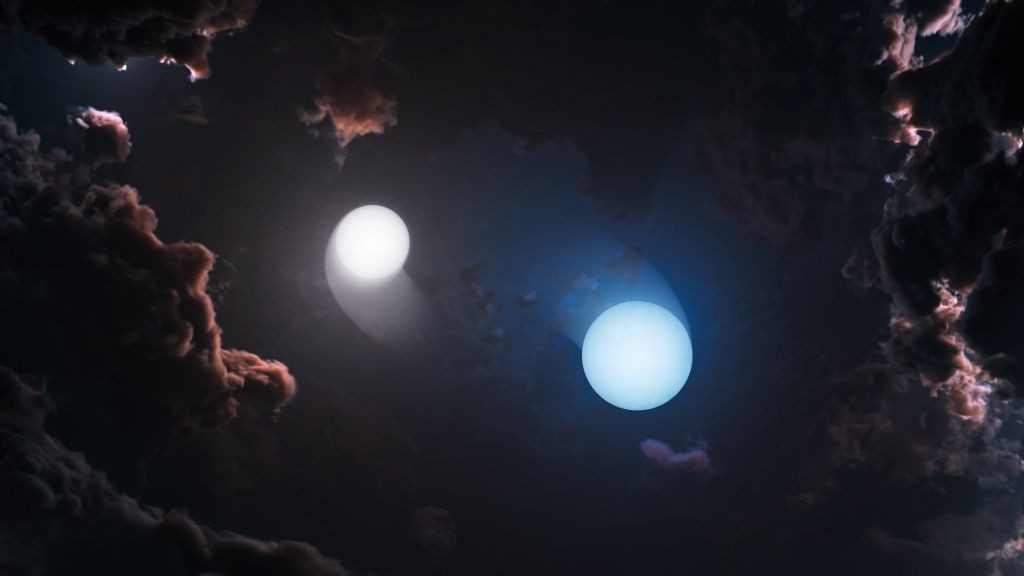
The team focused on binary systems —pairs of stars that orbit a common center of mass. By tracking these orbits, the researchers applied the laws of physics to calculate the stars’ masses:
1. The team observed the orbital period (how long one revolution takes).
2. They measured the velocity (how fast the stars are moving).
3. By analyzing these “dance moves,” they could mathematically derive the exact mass of the stars involved.
Testing the Laws of Stellar Evolution
The precision of the VLBA allowed the team to track 15 binary systems with millisecond accuracy. This high resolution led to several key findings:
- Mass Determination: The team successfully determined the masses for seven of the systems.
- Validation of Theory: In four of these systems, the measurements were so precise they could be calculated from “first principles,” without relying on existing theoretical models.
- Refining the Models: The results showed that most of the measured masses aligned with current theoretical predictions. However, the discrepancies found in some systems suggest that while our current models are largely correct, they require further refinement to account for the complexities of stellar growth.
“These accurate mass measurements now turn Orion into a precision laboratory for testing how young stars form and evolve,” noted Jazmin Ordonez-Toro of the Universidad Nacional Autónoma de México.
Conclusion
By using radio waves to bypass cosmic dust, astronomers have turned the Orion nebula into a testing ground for stellar physics. These precise mass measurements provide the missing data needed to bridge the gap between theoretical models and the actual reality of how stars are born.