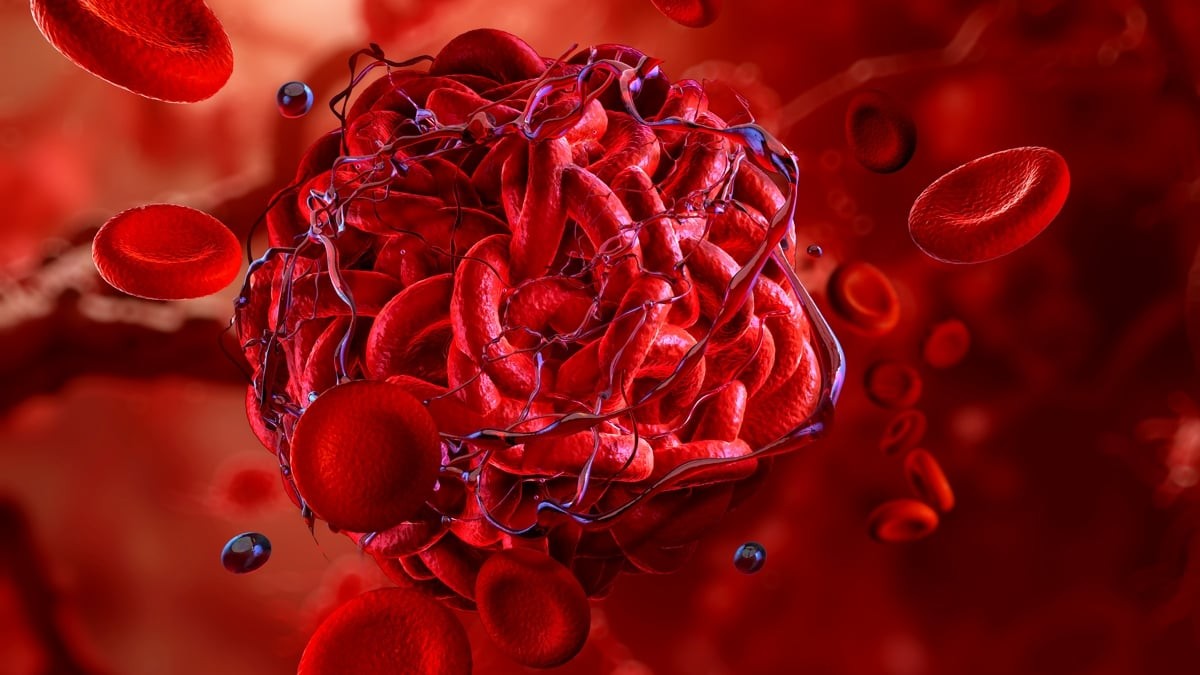
Blood clots are essential for survival, acting as the body’s natural emergency sealant to prevent fatal blood loss. However, natural clots can be slow to form and mechanically fragile, often failing to stop severe hemorrhaging or compromising long-term tissue healing.
A collaborative team of researchers from Canada and the United States has developed a breakthrough solution: Engineered Blood Clots (EBCs). Using a rapid technique called “click clotting,” these synthetic clots form in seconds, are significantly stronger than their natural counterparts, and can be prepared from either a patient’s own blood or donor blood.
The Limitation of Natural Clots
To understand the innovation, it is necessary to look at the composition of a natural blood clot. While fibrin fibers provide structural strength, they make up less than 1% of a clot’s volume. The remaining bulk consists largely of red blood cells.
“Natural blood clots can be slow to form and mechanically fragile, which limits their ability to stop severe bleeding and can compromise healing,” explains Jianyu Li, a mechanical engineer at McGill University.
The problem lies in the red blood cells. Although they provide volume, they are not mechanically robust and can easily fracture under pressure. Previous attempts to improve clotting focused on strengthening the fibrin scaffolding. The new approach takes a different path: reinforcing the red blood cells themselves.
How “Click Clotting” Works
The researchers utilized a bioengineering technique that triggers microscopic chemical reactions to bind red blood cells together into a sturdy, cohesive structure. This process transforms the cells from passive fillers into active, durable building materials.
The resulting product is a gel-like substance known as cytogel. It can be integrated with natural clots to enhance their stability and strength. Key advantages of this method include:
- Speed: The chemical reactions are rapid and safe.
- Preparation Time: The cytogel can be ready in 10 minutes using type-matched donor blood (allogeneic) or 20 minutes using the patient’s own blood (autologous).
- Safety: Tests showed no signs of toxic reactions or dangerous immune responses.
Superior Performance in Testing
In laboratory settings and animal trials involving rats, the engineered blood clots demonstrated remarkable improvements over natural clots:
- 13 times more resistant to fracturing.
- 4 times more adhesive to tissue surfaces.
In a critical test, the cytogel successfully repaired an injured rat liver without causing adverse immune reactions. This suggests that EBCs could serve as effective emergency patches for surgeries and traumatic accidents, particularly for patients with clotting disorders who struggle to form stable natural clots.
Broader Clinical Implications
While the primary focus is on stopping external bleeding, this technology has implications for internal health as well. Patients on blood thinners to prevent dangerous clots in the brain or lungs often suffer from reduced ability to form beneficial clots when injured. The cytogel could restore clot strength and stability for these individuals, bridging the gap between safety from thrombosis and protection from hemorrhage.
Challenges and Future Steps
Despite the promising results, significant hurdles remain before widespread clinical use. The “click clotting” technique has only been tested in rat models so far. Human trials are necessary to confirm safety and efficacy in real-world scenarios.
Furthermore, the technology requires fine-tuning for specific medical contexts. Currently, the cytogel is not strong enough to stop high-pressure arterial bleeding. Researchers aim to adjust the material’s properties to handle diverse scenarios, from delicate organ repair to major trauma.
Conclusion
Engineered blood clots represent a significant leap forward in emergency medicine and wound care. By transforming red blood cells into robust structural materials, scientists have created a faster, stronger alternative to natural clotting that could save lives in critical situations. While further development is needed, this innovation offers a promising pathway to enhancing the body’s innate healing mechanisms.