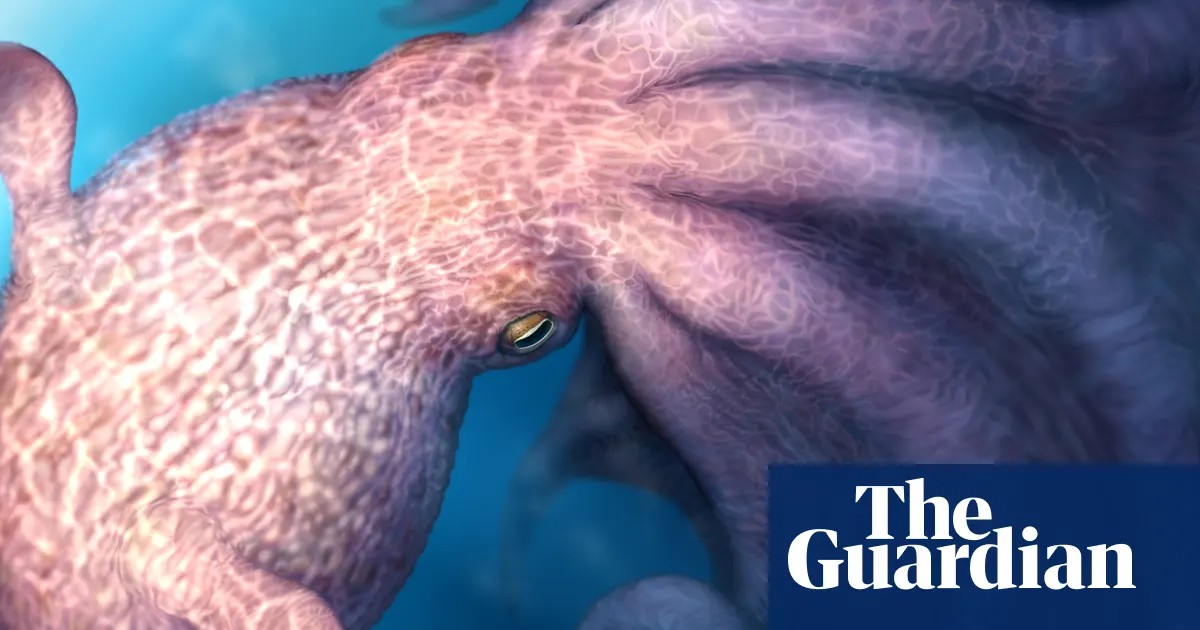
New paleontological research has revealed that the oceans of the Cretaceous period were home to much more than just massive dinosaurs and marine reptiles. Evidence suggests that giant, “kraken-like” octopuses were among the most formidable apex predators of their era, capable of crushing bones and shells with ease.
Rethinking the Marine Food Web
For a long time, the prevailing view of Cretaceous seas was that they were dominated almost exclusively by large vertebrate predators, such as mosasaurs and plesiosaurs. However, a study led by Dr. Yasuhiro Iba of Hokkaido University challenges this narrative.
By analyzing fossilized beaks—the only hard part of an octopus’s otherwise soft body—researchers have discovered that these ancient cephalopods were not merely larger versions of modern octopuses. Instead, they were top-tier predators that occupied a massive niche in the marine food web.
Massive Scale and Bone-Crushing Power
The research focused on a group of ancient octopus relatives known as Nanaimoteuthis. Through digital imaging and re-examination of existing fossils, the team identified several significant findings:
- Unprecedented Size: One species, Nanaimoteuthis haggarti, possessed a beak larger than that of the modern giant squid. By comparing jaw size to the body length of modern finned octopuses, scientists estimate N. haggarti reached lengths of 7 to 19 meters. This would make it the largest invertebrate ever recorded.
- Specialized Predation: The fossilized beaks showed distinct wear patterns—blunted edges, chips, and scratches—that are not found in juveniles. This suggests these giants used their powerful jaws to routinely crunch through hard prey, such as bony fish and shelled animals.
- Hunting Apex Predators: Given their massive size, these octopuses may have even preyed upon large marine reptiles, effectively turning the hunter into the hunted.
Sophisticated Behavior and “Handedness”
Beyond their sheer size, the fossils suggest these creatures were highly intelligent and behaviorally complex. The researchers noted that the beaks were more worn on one side than the other, a phenomenon known as lateralized behavior.
This indicates that these ancient octopuses may have exhibited a form of “handedness,” similar to modern octopuses, where certain arms are preferred for specific tasks like exploration or feeding. This level of behavioral sophistication suggests a highly evolved predator that used its limbs to subdue prey before dismantling it with its beak.
“It is quite nice to imagine an octopus eating a large vertebrate for once. As a cephalopod researcher, I am very excited to see invertebrates that may have rivaled vertebrates.”
— Dr. Thomas Clements, Palaeobiologist at the University of Reading
Why This Matters
The discovery of such massive invertebrates fills a significant gap in our understanding of prehistoric life. Because soft-bodied animals like octopuses rarely leave fossils, our view of ancient ecosystems has often been biased toward vertebrates. This research proves that invertebrates played a much more dominant and aggressive role in prehistoric oceans than previously believed.
Conclusion
The discovery of Nanaimoteuthis reveals a lost world where giant, highly intelligent octopuses reigned supreme, proving that the Cretaceous oceans were a much more diverse and terrifying landscape than we once imagined.