


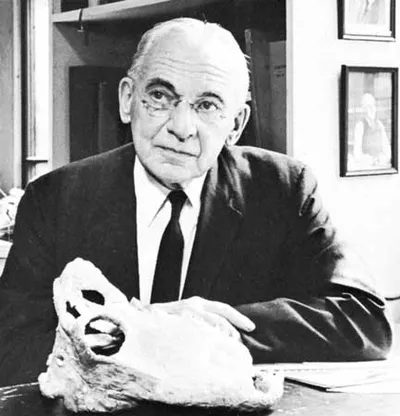
Alfred Sherwood Romer did not want to become the architect of our understanding of vertebrate evolution. He was born in White Plains, New York, in 1894, the son of a journalist whose regular moves made his early years marked by instability. The family was poor. It wasn’t until 1909, when he moved in with his grandmother, that a more consistent rhythm emerged. He was a shy boy. Adapting was difficult. But in high school, he found his footing. That’s when a defining feature emerged: the compulsive need to participate and improve things.
The path to paleontology was anything but linear.
Romer dropped out of high school for a year to work odd jobs and save every penny for college. Against his family’s wishes and their traditions, he enrolled at Amherst College in 1913. He financed himself through scholarships, menial labor, and student union loans. His majors were history and German literature. He took other courses and delved into areas that seemed far removed from the natural sciences.
The change happened in New York.
He visited the American Museum of Natural History. The dinosaur exhibits stopped him cold. Something clicked. Later, while taking the required evolution course under Frederic B. Loomis, the ambiguity disappeared. He knew exactly what he wanted to do.
Graduation took place in 1917, in the middle of the First World War. Restless, Romer joined the American Field Service in France. In the fall, he joined the US Army. The war ended for him in 1919. He returned home and immediately attended graduate school at Columbia University, where he worked under William K. Gregory.
Gregory was a force.
Romer completed his Ph.D. in just two years. His dissertation became a classic of comparative myology – the study of muscle structure. But graduation was just the beginning. He was part of the Columbia cohort that Gregory shaped. Romer helped spread these ideas and founded a school of thought that prioritized comparative anatomy, functional anatomy, and evolutionary biology. This framework is still dominant in this field.
Why comparative anatomy is important in fossil research
The core of Romer’s contribution was not only the fossils he studied, but also the way he studied them. He specifically used comparative anatomy and embryology to interpret the history of vertebrates. This approach changed the game.
Before that, paleontology could be a game of identification. Find the bone. Name the bone. Move forward. Romer demanded context. How does the muscle attach? How did the joint move? What does the development of the embryo say about the adult form?
Using this method, researchers were able to reconstruct the evolutionary history of vertebrates with unprecedented precision. It wasn’t enough to say that the fossil looked like a modern animal. Romer’s work required an explanation of the activity and lineage. This is why his insights into vertebrate evolution are still so central. They provided the tools to ask the right questions about ancient life.
Legacy of a Non-Traditional Path
Romer’s journey illuminates an often overlooked truth in science: specialization rarely comes early. He studied literature. He served in the war. He did manual work. Then, after one visit to the museum and the required course, he changed completely.
His influence extended beyond his own research. By helping to spread Gregory’s ideas, Romer established a method that valued mechanical function and developmental biology in paleontology. This is still how we understand the transition from water to land, the rise of reptiles, and the origin of mammals.
Fossils have been preserved. The bones are still on the ground. But the lens through which we view them is sharpened by Romer’s insistence on anatomy. He turned
Chicago to Cambridge
By 1934, Alfred Romer had traded the humidity of New York for the academic rigor of Cambridge. He entered Harvard University as a professor of biology and leaving behind an 11-year stint at the University of Chicago. The previous chapter was not perfect. He spent years trying to convince geology departments to take biology really seriously, a frustration that probably fueled his efforts to do things differently at Harvard.
He married Ruth Hibbard early in Chicago. She wasn’t just a wife; He was a field partner. They had three children and she traveled with him to dig up the past. Around that time, he published Vertebrate Paleontology in 1933. It wasn’t just a book. It became the Bible of the field. Three editions later, it continued to define how students and professors thought about life in the ancient world.
Progress at Harvard was rapid. From 1945 he headed biological laboratories. A year later, he took charge of the Museum of Comparative Zoology. The museum not only survived under his watch; it flourished.
Shaping the Discipline
Romer’s work was relentless during these years. He didn’t just publish; he defined the vocabulary. Review of the Pelycosauria (1940) and The Osteology of the Reptiles (1956) dealt with the messy details of reptile evolution. But it was “The Vertebrate Body” (1949) that changed classrooms across the country. It became the standard text for comparative anatomy, and was used from small colleges to Ivy League institutions.
He collected honors like other men collected stamps. Honorary degrees. Medals. Memberships in foreign societies. But things were quieter around the awards that were really close to his heart. He helped found the Society of Vertebrate Paleontology and served as its first president when it was formally established in 1940. He also advocated the creation of a Section of Vertebrate Morphology within the American Society of Zoologists.
His influence spread around the world. He accepted the presidency of the XIV International Zoological Congress in Washington in 1963. By then he was already a member of the National Academy of Sciences, speaking to his peers’ respect of his colleagues.
Traveling was part of the job. Trips to South Africa and Argentina in 1929 and 1956 revealed fossils that supported his theories for decades. Still, despite the heavy burden of teaching, administration and international travel, he remained surprisingly approachable. He spoke with quiet humor. He was attractive. His lectures were informal, often colloquial, and masking the rigorous, deep knowledge underneath.
Conservative evolutionist
Romer retired from Harvard in 1965. He did not slow down. He used his freedom to travel more around the world, collect more fossils, and give more lectures. He kept writing papers that furthered the understanding of the evolution of lower vertebrates.
His scientific approach was fundamentally conservative. He did not approve of rapid, sudden evolutionary leaps. Instead, he focused on form and function. How did the structure interact with the environment? That interaction, he argued, was the key to progress, he argued. His studies of extinct fish, amphibians and reptiles revealed a slow, steady flow through time. It was a Darwinian view, documented with anatomical precision.
He spent his life tracing the transition from water to land. He dug up Permian Period fossils from Texas deposits. He looked for adaptations. How did the fish survive on land? How did this lead to amphibians, reptiles and finally mammals? He mapped these structural and functional changes. He didn’t just find bones. He found the story of how they fit together in a changing world.


