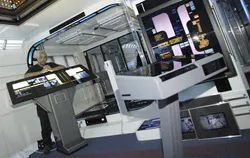
“Beam me up, Scotty.” It’s the line that defined a generation of sci-fi fans. The transporter is the ultimate fantasy in Star Trek. It breaks down your body into atoms, scatters them across space, and rebuilds you elsewhere. Not a single cell lost in transit.
Sounds like magic. It’s also physically impossible.
Forget teleportation. No one has cracked that code. But the show didn’t get everything wrong. When Star Trek debuted in 1966, a lot of its tech seemed like pure fiction. Today? We’re living in the future it predicted. Here are the top technologies from the franchise that actually made it to reality.
10: Transparent Aluminum Armor
You know the scene. Star Trek IV: The Voyage Home. The crew crashes a Klingon Bird of Prey into the San Francisco Bay. They miss the Golden Gate Bridge by inches, thanks to blind flying in a storm.
But there’s another detail buried in the chaos. Scotty needs materials to build a tank for the humpback whales, George and Gracie. He trades a future formula matrix for sheets of plexiglass. His pitch? Replace six inches of thick plexiglass with just one inch of “transparent aluminum.”
It sounded like nonsense in 1986. It’s real now.
The material is called aluminum oxynitride, or ALON. It starts as a powder. Heat and pressure turn it into a crystalline solid. Think of it as glass’s tougher older brother.
ALON can withstand bullets. It’s lighter than bulletproof glass and significantly stronger. The U.S. Air Force has tested it for aircraft windows and canopies. Less weight. More protection. That’s the trade-off Scotty promised.
9: Communicators
The handheld device that started it all. A flip-phone before cell phones existed. Before you knew what a cell phone was.
In the original series, officers pulled out a bulky device to contact the ship or other stations. It seemed like a stretch for the 1960s. Yet, the basic concept of a portable, two-way radio that fits in your pocket is the foundation of every smartphone today.
We went from clunky, antenna-heavy bricks to devices that map the globe and stream 4K video in our pockets. The Star Trek vision of instant, wireless communication wasn’t just accurate. It was conservative. We achieved the goal, then added a camera, a gallery, and a keyboard to it.
The spirit of the communicator lives on in every pocket.

8: Hypospray
Let’s be honest. The idea of injecting medication through the skin without a needle sounds like pure science fiction. But in the world of Star Trek, it’s just another Tuesday for the crew of the Enterprise. When Captain Kirk was out on the planet surface, surrounded by hostile aliens or exotic diseases, he didn’t need a hospital. He needed Bones. Dr. McCoy had a solution for almost every medical emergency, and the tool of choice was the hypospray.
It’s a sleek, pistol-shaped device that fires a tiny dart containing a dose of medicine directly into the bloodstream. No needles. No needles. No needles.
Sound familiar?
It’s essentially an early concept of the needle-free injector. Today, we have devices that use high-pressure air or a spring mechanism to push liquid medication through the skin without breaking it. It’s used for vaccines, insulin, and even pain management. The hypospray was ahead of its time, predicting a future where medical intervention is quick, clean, and barely noticeable.
Think about the next time you need a flu shot. The dread. The wince. The arm you can’t lift for two days. Now imagine a quick spray. Done. The hypospray wasn’t just a prop; it was a glimpse into a less painful medical future. And while we don’t have phasers or warp drive, we’re getting closer to that pain-free, no-needle reality. The needle-free injector is real. It’s here. It’s just not as cool as a starship doctor’s sidearm.
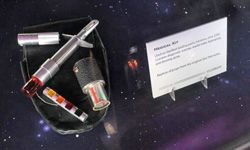
Remember the medical bay on the Enterprise? Dr. Leonard “Bones” McCoy didn’t just nurse patients back to health; he spent half his screen time firing a hypospray at people. It wasn’t just a cool prop. The device solved a real problem we still face today.
Most of us dread the flu shot. The needle. The pinch. The wait.
In the show, McCoy used high-pressure air to force medication under the skin. No needle required. The liquid shoots deep enough for subcutaneous absorption. Real-world scientists already figured this out. They call it a jet injector.
Jet injectors aren’t new. They predate Star Trek. Originally designed for mass vaccination campaigns, they offer two distinct advantages. Speed. Safety.
No needles means no risk of passing along infectious diseases through contaminated sharps. The device looks like an automotive paint gun. It uses a larger reservoir for the vaccine. Medical personnel can inoculate crowds faster and more efficiently.
“Jet injecting is safer and faster in administering vaccines.”
The concept is simple. High pressure. No penetration. Just force.
7: Tractor Beams
Space repairs are a nightmare. Take the Hubble Space Telescope. Astronauts had to train for years. They had to endure extravehicular activity. Thick gloves limited their dexterity. The risk was constant.
Wouldn’t it be easier to just pull the telescope inside?
Science fiction ships like the Enterprise use tractor beams to snatch objects. Large vessels can trap smaller ones. They override gravitational forces. Is this plausible?
Sort of.
On Earth, we have optical tweezers. They are the closest thing to a legitimate tractor beam we possess. Scientists use focused lasers to create an optical trap.
Microscopic particles get suspended. Manipulated. Moved with precision.
These beams aren’t strong enough to dock the Space Shuttle to the ISS. You can’t beam up a car. But for science? They are invaluable.
Researchers use optical tweezers to trap bacteria. They sort cells. They study the physical properties of DNA. It is a start. A small one.
But the principle holds. Light can exert force. And if light can move a molecule, maybe one day it can move a ship.
6: Phasers
We stopped at the weapons. Phasers.
The show described them as adjustable. You could stun a person. Or obliterate a planet. The range of effect depended on the power setting.
Real-world physics doesn’t quite work that way. We have lasers. High-powered lasers can cut through steel. We have microwave emitters. We have directed energy weapons in development.
But a single hand-held device that switches from a stun to a star-destroying blast? That’s not just engineering. That’s magic.
The closest we have come is the High Energy Laser Mobile Vehicle Unit. It’s big. It’s heavy. It requires a massive power source. It can disable drones. It can blind satellites.
It doesn’t fit in a holster.
The dream of a portable, adjustable energy weapon remains exactly that. A dream. But the tech is catching up. Slowly.
We can cut metal. We can burn targets. We just can’t turn it off and on like a dimmer switch. Not yet.
The gap between fiction and reality is closing. But for now, Bones’ hypospray is the only tech that actually works exactly as advertised.
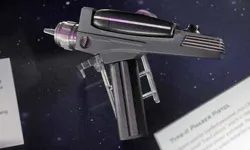
The command “Set phasers to stun” is iconic, but the reality of non-lethal force is a bit less sci-fi and more grounded in 20th-century invention. While the phaser could theoretically kill or incapacitate, real-world stun tech focuses on the latter. Electricity wasn’t new to punishment or livestock control; it dates back to the 1880s. The modern stun gun, however, truly arrived in 1969 with Jack Cover’s invention of the Taser.
Unlike the fictional phaser, the Taser doesn’t kill. It delivers an electrical punch that disorients or completely incapacitates the target. The delivery method is where fiction and reality diverge. Real tasers fire two electrodes connected by wires, ensuring skin contact from a distance. Stationary contact probes exist too, but they are less practical because you have to be within arm’s length to use them.
Is a true phaser on the horizon? Applied Energetic is developing Laser Guided Energy and Laser Induced Plasma Energy technologies. These systems aim to transmit high-voltage bursts through the air. If successful, they could stun targets while minimizing collateral damage. A real-life phaser might be closer than we think.
How Universal Translators Work Today
Imagine visiting a foreign country and understanding every word spoken. Now imagine hopping planets with Captain Kirk and crew. They had a universal translator. In Star Trek, characters spoke into a small device, and it converted their words into English for the listeners.
Real-world tech exists for this. Devices allow you to speak in English and get the phrase back in a specified language. The catch? These tools only work for predetermined languages. A true Star Trek -style universal translator that can handle any language on the fly isn’t here yet.
Voice recognition has advanced significantly. However, computers still cannot “learn” languages in the human sense. They rely on data. To build a translation system, someone must invest time and money to compile the necessary linguistic data. This is why current devices focus on popular, widely spoken languages rather than every dialect on Earth.
Geordi’s VISOR: Seeing Without Eyes
Geordi La Forge, the chief engineer of the USS Enterprise-D, wore the VISOR (Visual Imaging Sensor and Optical Receiver). This device replaced his blind eyes, allowing him to see across the entire electromagnetic spectrum. He could detect invisible energy signatures, see through walls, and perceive details far beyond human capability.
Does technology that mimics the VISOR exist? Not exactly. We don’t have cybernetic implants that grant superhuman sight. However, thermal imaging and night vision technologies are the closest real-world equivalents.
Thermal cameras detect heat signatures, allowing users to “see” in the dark or through smoke. This is crucial for military operations, search and rescue, and even home inspections. Night vision devices amplify available light, making it easier to see in low-light conditions.
While these tools don’t offer the full-spectrum vision of the VISOR, they provide similar advantages in specific scenarios. Geordi could see radio waves and ultraviolet light, something our current tech can’t do in a wearable form. But the core concept—enhancing human perception through technology—is very real.
Why These Technologies Matter
The line between sci-fi and reality is blurring. We have stun guns that project energy, translators that break language barriers, and sensors that enhance human sight. Each of these technologies started as a fictional concept and evolved into practical tools.
The Taser revolutionized law enforcement by providing a non-lethal option. It has saved countless lives by incapacitating suspects without causing permanent harm. Universal translators, while limited, are changing how we communicate globally. They make travel easier and business interactions smoother. VISOR-like technologies are improving safety and efficiency in industries ranging from construction to healthcare.
These advancements aren’t just about convenience. They’re about solving real problems. Non-lethal force reduces violence. Language barriers prevent misunderstandings. Enhanced vision saves lives in emergencies. The Star Trek crew had it easy with their futuristic tech, but we’re making progress too.
Will we ever have a true phaser? Maybe. Applied Energetic’s research suggests it’s possible. Will we have a universal translator that works with any language? Likely, as AI and data collection improve. And will we have a wearable VISOR? Probably not in the near future. The science required to detect and display the entire electromagnetic spectrum in a small device is still beyond our reach.
But that doesn’t mean we stop trying. The same curiosity that drove Gene Roddenberry to create Star Trek is driving engineers and scientists today. We’re building the future, one invention at a time. The crew of the Enterprise explored the galaxy. We’re exploring the possibilities of our own technology. And the journey is just beginning.
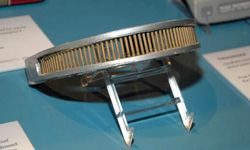
Geordi LaForge wasn’t just the Enterprise-D’s favorite engineer. He was a cultural reset. When Star Trek: The Next Generation dragged the franchise out of the dusty archives and shoved it back into the mainstream spotlight, the cast changed. The snarky Bones McCoy and the logic-bound Mr. Spock were gone. In their place stood a new breed of Starfleet officer. And none were more fascinating than the blind man with the glowing visor.
Geordi’s eyewear—the VISOR (Visual Instrument and Sensory Organ Replacement)—wasn’t just a prop. It was a sleek, futuristic piece of gear that let him see across the electromagnetic spectrum. It seemed like pure sci-fi fluff.
It wasn’t.
Bionic Eyes: Real Science Behind the VISOR
The VISOR looked like science fiction. The reality? It’s closer than you think.
In 2005, Stanford University scientists pulled off something that feels stolen from a Trek script. They implanted a tiny chip behind the retina of blind rats. The rats didn’t just wiggle. They passed vision recognition tests.
Here is how bionic eye technology works. It mirrors the logic of Geordi’s VISOR almost perfectly.
- The Implant: A chip is placed behind the retina.
- The Glasses: The patient wears special glasses equipped with a video camera.
- The Process: Light hits the camera. A small wireless computer processes that image.
- The Transmission: The computer broadcasts the image as infrared LED lights on the inside of the glasses.
- The Feedback: Those infrared images bounce off the retina. The chip stimulates photodiodes.
- The Result: The photodiodes mimic lost retinal cells. They turn light into electrical signals. Those signals fire nerve pulses to the brain.
The outcome? A person with 20/400 vision (legally blind from conditions like retinitis pigmentosa) can theoretically upgrade to 20/80 vision.
Is it 20/20? No. You still won’t pass a driving test. But you can read a billboard. You can navigate a room without a seeing-eye dog. It’s not full sight. It’s functional independence. And that’s massive.
The Photon Torpedo Coffin
Before he was a legend, Spock was a corpse.
In the second Star Trek movie, the Enterprise crew faced a grim choice. To save the ship, they had to fire Spock’s body out of the torpedo bay. He was encased in a coffin shaped exactly like a photon torpedo.
It looked cool. It looked tragic. It looked like merchandise waiting to happen.
And it did.
Eternal Image designed a real-life Star Trek photon torpedo coffin. The company announced it would be available in early 2009. As of the last check, it’s still not on the market. The price? Unknown.
If you prefer ashes to a full burial, they were planning a matching Star Trek urn. The United Federation of Planets doesn’t officially approve these (the UFP doesn’t exist). But for fans who want one last ride in a photon torpedo, the option is theoretically out there.
Telepresence: More Than Just Zoom
Imagine talking to someone across the galaxy. Not a grainy hologram. Not a delayed video call. You feel like they’re in the room.
That’s telepresence technology.
In 1966, interacting across the void of space felt as impossible as space travel itself. Telepresence bridges that gap. It’s not video conferencing. The difference is immersion. If the illusion isn’t convincing, you’re just looking at a screen. If it is convincing, you’re there.
AT&T and Cisco changed the game in 2008. They launched the first industry-standard telepresence experience.
How? By mirroring the room.
The system combines high-definition video, spatial audio, and ambient lighting. The goal is to trick your brain. If you’re in Boardroom A and someone is in Boardroom B, the lighting in both rooms matches. The background scenery aligns. It feels like the person is sitting across the table.
Star Trek showed us the dream. Cisco and AT&T built the prototype. The tech is ahead of the show’s graphics. But the inspiration? That’s pure Trek.
The Tricorder Revolution
We’ve covered the eyes. We’ve covered the body. And we’ve covered the connection. But the most useful tool on the Enterprise wasn’t a weapon. It wasn’t a ship.
It was the tricorder.
The device that scanned, analyzed, and diagnosed everything in seconds. No more waiting for a lab result. No more guessing if the red substance was toxic or just spicy.
Today, that handheld analyzer exists. It’s just called a smartphone.
But the dedicated tricorder technology is making a comeback in industrial and medical fields. Handheld spectrometers can detect toxins in water. Medical scanners can map tissue density without invasive surgery.
The dream of a single device that does it all? We’re close. Not quite 24th-century sleek. But close enough to make Geodi proud.
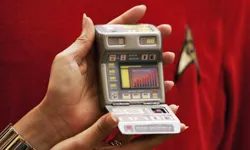
Remember that iconic shot? Spock, phaser in hand, a bulky device slung over his shoulder, scanning a new world for Captain Kirk. That wasn’t just set dressing. It was a tricorder.
We’ve all seen them. Medical tricorders. Engineering tricorders. Scientific tricorders. They measured oxygen. They spotted diseases. They gave an instant read on an alien ecosystem. In the 23rd century, it was routine.
But here’s the kicker. That fictional tech isn’t stuck in Hollywood anymore. It’s creeping into our labs. And it’s changing how we handle health, space, and diagnostics.
NASA’s Tricorder on the ISS
NASA didn’t just copy the look. They copied the function.
Meet LOCAD. It’s not a glowing green slab. It’s a handheld device. But it does the same job. It scans for unwanted microorganisms. Think E. coli. Fungi. Salmonella. All aboard the International Space Station.
Space is dirty. Or it can be. LOCAD is the first line of defense. It keeps the crew safe by detecting biological threats before they become outbreaks. It’s the real-world tie-in to Spock’s scanner.
The Next Generation of Handheld Scanners
The tricorder is evolving. Fast.
Two major developments are coming out of prestigious institutions. They’re small. They’re handheld. And they’re powerful.
Loughborough University in England is working on photoplethysmography. You don’t need to know the jargon. Just know this: it monitors heart function. Non-invasively. Handheld. No hooks. No wires. Just a device you can hold and get instant data.
Then there’s Harvard Medical School. They’re looking at nuclear magnetic resonance imaging. But miniaturized. The goal is a device sensitive enough to detect as few as 10 infectious bacteria.
Let that sink in.
Ten bacteria.
Current medical lab equipment misses that easily. This new tech is 800 times more sensitive.
“This kind of sensitivity could revolutionize the way doctors diagnose disease.”
Why This Matters
It’s not just about cool gadgets. It’s about speed.
In a pandemic. In a contaminated space station. In a rural clinic without a full lab. Having a scanner that works like a tricorder changes the equation. It moves diagnosis from “wait for results” to “know now.”
We’ve stopped asking if sci-fi concepts can work. We’re asking how fast they can be built.
The tricorder is no longer a prop. It’s a prototype. And the prototypes are getting better.
What will the next version do? Detect alien DNA? No. But it might detect a tumor before you even feel symptoms.
The future isn’t coming. It’s already in our hands. Just less shiny.