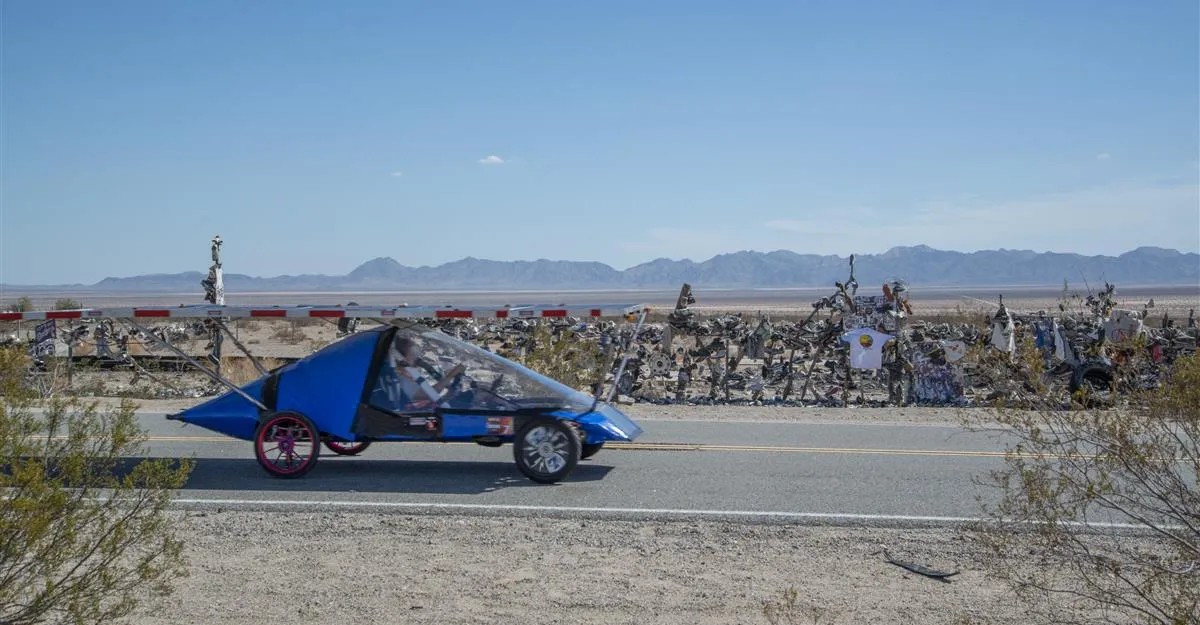
On July 19th, a fleet of strange, sleek machines will roll out of Fort Worth. They won’t be roaring down Interstate 20. Their only fuel is sunlight. These aren’t prototype test mules from major automakers. They’re high school race cars.
Dozens of student teams are about to start a five-day, 630-mile solar car race across Texas. Their destination? Fort Stockton, far out in the desert scrublands of the west. The winner? Not necessarily the fastest in a sprint. It’s the team that logs the most driven miles while using nothing but the sun’s power.
It’s 630 miles of heat, tension, and welding. And it marks 30 years of an experiment in engineering education that has outlived its original skeptics.
Born From a Classroom Frustration
Dr. Lehman Marks didn’t start the annual solar car challenge for high school students because he wanted to invent the next Tesla. He started it because he was annoyed.
Marks, a Texas educator, watched kids in the late 80s check out. Textbooks failed them. Abstract formulas didn’t spark interest. But then he took them to the University of North Texas. He let them see a collegiate solar car—a creature of carbon fiber and solar panels that hummed with potential.
“They kept yelling, ‘Doc, please let us build one,’” Marks recalled.
So they built one. Or tried to. The result? Humility.
High schoolers lacked the budget. They lacked the shop space. They were crushed by university teams with lab grants. So Marks made a pivot in 1993. He created a parallel universe for teenagers. The Solar Car Challenge was born. The first national competition launched two years later in 1995, and it’s still going strong.
More Than Just Fast Cars
Most people see a solar car and think of a science fair project. But this isn’t just about physics. It’s a crash course in reality.
Participants learn budgeting. Fundraising. Project management. And if that vehicle breaks down—because it will—they learn patience.
“We’re preaching this hard to the kids: put 500 miles into it first,” Marks says. “You need to know will it break. If it does, let it break in the parking lot. So you can fix it here.”
That’s the brutal logic of the cross-country solar car race in Texas. Teams don’t just design on a computer. They have to survive the road. Residents along the route, from Palestine to San Angelo, often wave, cheer, and offer support. The Texas solar car race has become a traveling festival for STEM enthusiasts.
To date, the program has touched over 85,00 students in 39 states. International teams from Singapore to Costa Rica have joined the fray. It is massive.
A New Shape for the Future
Traditionally, solar-powered race cars looked like flat pancakes with wings. Low profile. Minimalist. Efficient to the fault. You crawled into one like it was an airplane cockpit.
Critics scoffed. “Cool car,” they said. “Useless in real life.”
Enter the Cruiser class. A new division this year.
Now, students must build four-seaters. They need trunks. They need doors. The solar array must integrate into the body panels, not just sit on top as an add-on. Marks wanted proof that solar passenger vehicles could look like actual cars, not just aerodynamic experiments.
“People would say, ‘Oh this is really neat but it’s not reality. Now we can show them what it could. I think that’s a step down.”
— Lehman Marks, founder of the Solar Car Challenge
It’s a design constraint with a purpose. By forcing realism, the competition pushes engineering toward mass-market viability. It asks a harder question: How do we make efficient solar transportation that looks like something your parents would buy?
Behind the Welding Sparks
Meet Blake Wood. Seventeen years old. Rising senior from Benbrook. Captain of the Old Rip Racing team.
His team isn’t tied to a single high school. It’s a coalition from three different schools across the Fort Worth suburbs. Wood says that collaboration is their edge. Students who’d never met are now arguing over torque curves and battery discharge rates.
Planning starts a year out. Paper sketches give way to complex CAD models. It’s not just coding or building; it’s an education in digital fabrication.
“It looks nice, I think,” Wood admits, looking at a partially assembled prototype. “But we rarely see it all together. We’re always taking parts off. ‘Oh no, we have to weld there.’ We dismantle the electrical component again. It’s endless repair.”
This cycle of build, break, repair, repeat is where the actual learning happens. Battery-electric cars are everywhere now. But fully integrated solar electric vehicles? Still experimental. Startups have pivoted. Others failed. Yet teams like Wood’s persist.
Building the Workforce
So, who actually wins?
Traditionally, races have Classic, Advanced, and Electric-Solar (where cars draw from stationary panels) categories. Now there’s the Cruiser. Winning depends on consistency, endurance, and reliability. Speed is secondary. Mileage is king.
But Marks insists this isn’t about commercial success for these specific cars. Aptera exists. Tesla exists. Solar cars aren’t going to take over the world by next Christmas.
The real output of the Solar Car Challenge is people.
“I’m not trying to build a better solar car. I’m trying to build students who know commitment. I’m trying to build engineers who know how to work in teams. That’s the goal. Build the workforce.”
Marks has been doing this for three decades. Wood will be doing this professionally one day. Maybe for Aptera. Maybe for someone else entirely. But they’ll know the intricacies of solar vehicle design in a way textbook definitions can never convey.
The race begins in five days. The sun will set. The roads are long. And for half a million kids, it’s the closest thing to flying.
You watch them drive off, looking less like racers and more like survivors. Ready to see who can make the solar cell last the longest. Who knows how to fix the unfixable. And who realizes, halfway to Fort Stockton, that this isn’t a contest.
It’s a test drive for their futures.