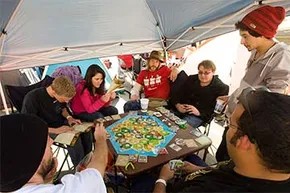
It’s Friday night. The family is gathered. Someone pulls out a box that looks like it belongs in a European café, not a suburban living room. You might assume it’s a drinking game because of the aesthetic, but think again. These are German-style board games. Also called designer games or Euro board games. They are family-friendly, surprisingly deep, and designed for people who hate waiting.
The vibe is completely different from what we grew up with. Think Risk. Think Monopoly. Think rolling dice and shouting “Go to Jail.” German-style games reject that chaos. They follow strict guidelines that prioritize strategy over luck. There is no rolling dice here. Randomness is the enemy. Instead, you rely on careful planning and indirect competition.
Why Speed Matters
Most of these games run for about an hour. This duration is no accident. It keeps the energy high. It appeals to short attention spans. But the real secret is the downtime. In traditional games, you watch three other people make their moves for twenty minutes. You sit there. You check your phone. You get bored.
German-style games eliminate this lag. The time between turns is minimal. Players interact constantly. You might be bidding against your neighbor or blocking their path. Everyone stays engaged until the very last second. No one is eliminated early. You play until the game ends. It’s a race where the track is shared.
Strategy Over Conflict
These games have been compared to a multi-player game of solitaire.
The core mechanic is economic, not military. You aren’t trying to conquer your friends. You are trying to optimize your own position. The best-known example in the United States is Settlers of Catan. It changed the landscape of hobby gaming overnight. Before Catan, mainstream board games were often about luck or direct conflict. After Catan, strategy became king.
This style originated in Germany, a country that treats board games as a serious pastime. However, you don’t need to be German to make one. The term “designer game” comes from the fact that the creator’s name is printed prominently on the box. Reiner Knizia is a prime example. He’s from Germany and has published more than 300 games. His name is a selling point.
Visuals and Components
Don’t let the strategy fool you. These games are beautiful. Art is an essential component of the experience. You’ll find intricate illustrations and high-quality components. Wooden pieces are common. Three-dimensional aspects pop up often. The physical act of placing a token or building a structure feels tangible. It’s not just paper and cardboard. It’s craft.
The themes vary wildly. You might be building a plantation. You might be designing a landscape. You could be managing electricity grids or developing ancient architecture. The setting doesn’t matter as much as the mechanics. But the art draws you in first.
Popular Titles to Try
If you want to move away from dice-rolling and luck-based outcomes, start with these titles. They define the genre.
- Puerto Rico : A complex economic engine builder.
- Carcassonne : Tile placement that feels like a collaborative puzzle with a competitive edge.
- Tigris & Euphrates : A game of cultural influence and river management.
- Caylus : A worker placement game set in medieval France.
- Power Grid : A tense auction game about building an electrical network.
Is It Right for Your Group?
These games often require three or more players. The interactions are subtle. You aren’t attacking anyone. You are trying to outmaneuver them through resource acquisition and efficient planning. It’s like playing chess with a deck of cards.
Some critics call them boring because there is no “kingmaking” or direct aggression. They say it’s too quiet. But for players who dislike the frustration of being eliminated early or ruined by bad luck, this is heaven. It’s a race where everyone finishes.
The genre has spread far beyond Germany now. While the roots are there, the innovation is global. If your family is looking for a fast-moving game with lots of player interaction