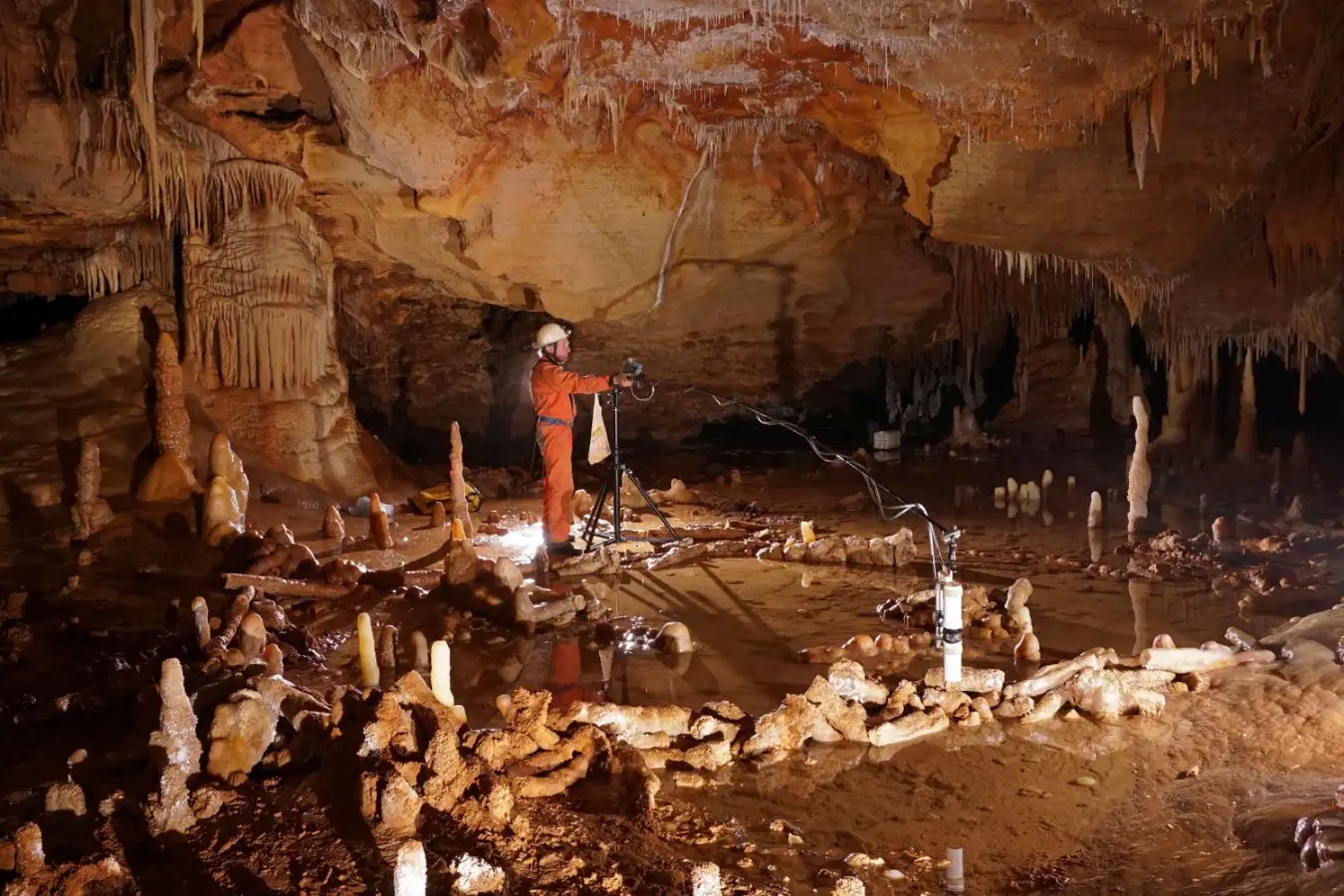
Deep within the limestone walls of Bruniquel Cave in southwestern France, a silent mystery has persisted for over 175,000 years. While archaeologists have long been fascinated by circular structures built from broken stalagmites in this pitch-black cavern, a new discovery offers a rare, intimate glimpse into the individuals who created them: a possible kneeprint of a Neanderthal.
This impression, preserved in clay and sealed under layers of calcium carbonate, suggests that these ancient humans did not just pass through the cave—they knelt, worked, and perhaps engaged in complex behaviors far from the light of day.
The Mystery of the Stalagmite Circles
The Bruniquel Cave discoveries date back to the 1990s, but it wasn’t until a 2016 study that the full scale of the Neanderthal engineering became clear. The cave floor features two large circular structures made from broken stalagmites. The largest circle has a diameter of roughly 7 meters, constructed using stone pillars that are more than 20 centimeters thick at the base.
These structures are located more than 300 meters inside the cave, in total darkness. This depth challenges conventional assumptions about Neanderthal behavior. To build these circles, they would have had to carry heavy stones deep into the earth, likely using torches or other light sources, as traces of fire have been found nearby.
A Rare Footprint in Time
While ancient footprints are relatively common in the archaeological record, kneeprints are virtually unknown. Sophie Verheyden, a researcher at the Royal Belgian Institute of Natural Sciences, notes that this specific impression is the first of its kind to be investigated.
The print is undeniably ancient. It was preserved by a thin layer of calcite—the same mineral that forms stalagmites—shielding it from erosion. A bear specialist confirmed that the impression does not match any known bear tracks, ruling out the most common cave-dwelling animal of the era.
“It’s just a hypothesis,” Verheyden cautions. “To be sure of that, we need a lot of imprints of knees to compare it to.”
To validate the finding, researchers are now conducting experiments where modern humans kneel in various types of clay to create a reference library of impressions. This comparative analysis will help determine if the cave mark truly matches the biomechanics of a human knee.
Why This Matters: Ritual vs. Survival
The location and construction of the circles raise profound questions about Neanderthal cognition and culture. The most straightforward explanation is that the circles served as the bases for shelters. However, their position 300 meters underground, in absolute darkness, makes this unlikely for daily living.
This has led many scientists to speculate that the structures had a cultural or religious purpose.
- Effort and Intent: Breaking stalagmites that are 20 cm thick requires significant force and planning. Recent dating of the broken bases confirms they were snapped off at the same time the circles were built, ruling out accidental breakage by animals or natural collapse.
- Symbolic Value: Verheyden draws parallels with later civilizations, such as the Maya, who collected stalagmites from deep within caves for use in fertility amulets. If Neanderthals similarly valued stones from specific, hard-to-reach locations, it suggests a symbolic or ritualistic motivation.
The Neanderthal Connection
Could Homo sapiens have built these structures? Unlikely. Around 175,000 years ago, modern humans had not yet arrived in Europe. Furthermore, the cave entrance collapsed at least 140,000 years ago, sealing the interior until its rediscovery by cavers in 1990. This timeline ensures that all artifacts inside are of Neanderthal origin.
Future Directions: DNA and Mineral Fingerprinting
The discovery of the kneeprint is just the beginning. Researchers are exploring advanced techniques to unlock more secrets from the cave floor:
- DNA Extraction: Mareike Stahlschmidt of the University of Vienna has demonstrated that DNA can diffuse into and be preserved by calcite. If skin cells, hair, or blood were present in the kneeprint when it was mineralized, Neanderthal DNA might still be recoverable.
- Mineral Fingerprinting: By analyzing the chemical composition of the broken stalagmites, scientists hope to trace their origins. Did the Neanderthals break stones nearby, or did they transport them from other parts of the cave system? This could reveal the extent of their planning and the significance they placed on specific locations.
Conclusion
The potential Neanderthal kneeprint in Bruniquel Cave is more than a fossilized footprint; it is a testament to the complexity of early human behavior. It suggests that Neanderthals were capable of organized labor, symbolic thought, and perhaps ritual practices long before the arrival of modern humans. As researchers continue to peel back the layers of calcite, each new discovery brings us closer to understanding the minds and motivations of our ancient cousins.