A new study has subjected Isaac Newton’s Law of Universal Gravitation to its most rigorous test to date, probing the forces at work across hundreds of millions of light-years. The results are clear: gravity behaves exactly as Newton predicted in the 17th century and as Einstein refined in the 20th.
This finding is significant not just for historical curiosity, but because it addresses one of the most profound mysteries in modern cosmology. By confirming that gravity follows the inverse-square law even on cosmic scales, the research strengthens the argument that dark matter —invisible, undetected mass—exists. Conversely, it casts doubt on alternative theories suggesting that our understanding of gravity itself needs revision.
The Cosmic Discrepancy
When astronomers map the visible universe, they encounter a puzzling mismatch. The amount of “normal” matter—stars, planets, gas, dust, and everything composed of atoms known as baryonic matter—is insufficient to explain the motions we observe.
- Galaxies rotate too fast to be held together by their visible mass alone.
- Galaxy clusters remain bound despite having enough kinetic energy to fly apart.
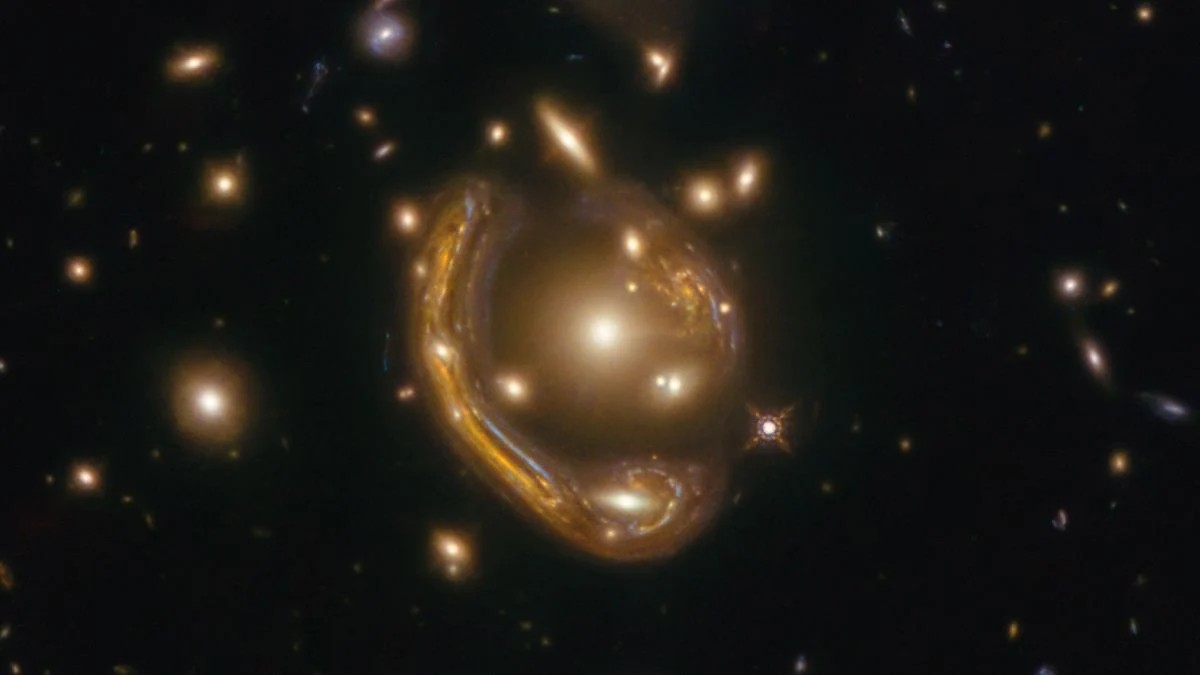
- Light bends more sharply around massive objects than visible matter can account for.
These anomalies suggest that roughly 85% of the matter in the universe is invisible. This unseen component is what scientists call dark matter. However, there is another possibility: perhaps dark matter does not exist, and instead, gravity behaves differently on large scales than it does in our solar system. This concept, known as Modified Newtonian Dynamics (MOND) or other modified gravity theories, suggests that gravity weakens more slowly over vast distances.
Testing Gravity at the Edge of the Observable Universe
To distinguish between these two explanations, cosmologist Patricio Gallardo of the University of Pennsylvania and his team conducted a large-scale observational study. They focused on a volume of space located 5 to 7 billion light-years away, analyzing the movements of approximately 686,000 galaxies grouped into clusters.
The researchers utilized a sophisticated technique called the kinematic Sunyaev-Zeldovich (kSZ) effect to measure the velocities of these galaxy clusters. Here is how it works:
- Cosmic Microwave Background (CMB): The CMB is the afterglow of the Big Bang, a faint radiation field that permeates the entire universe.
- Interaction with Gas: As CMB photons travel toward Earth, they pass through hot clouds of gas surrounding galaxy clusters.
- Velocity Measurement: If a cluster is moving toward or away from us, the CMB photons scatter off free electrons in the gas, causing a slight shift in the signal’s temperature. By measuring this shift, scientists can determine the cluster’s velocity relative to the CMB rest frame.
By comparing the velocities of pairs of clusters moving toward each other, the team could calculate the gravitational forces acting between them. If gravity weakened more slowly than Newton’s law predicts (as modified gravity theories suggest), the clusters would be pulled together more strongly at large distances.
The Verdict: Newton Was Right
The data revealed that the gravitational pull between distant clusters fades rapidly with distance, consistent with the inverse-square law. This means that gravity does not change its fundamental behavior on cosmic scales.
“It is remarkable that the law of the inverse of the squares – proposed by Newton in the 17th century and then incorporated by Einstein’s theory of general relativity – is still holding its ground in the 21st century,” says Gallardo.
This outcome effectively rules out many modified gravity models that attempt to explain cosmic phenomena without dark matter. Instead, it points back to the existence of a substantial amount of unseen mass providing the extra gravitational glue needed to hold the universe together.
What Remains Unknown
While this study provides strong evidence against modified gravity and in favor of dark matter, it does not solve the mystery of what dark matter actually is. The findings confirm that dark matter exists as a gravitational component, but its physical nature remains elusive. It does not emit, absorb, or reflect light, interacting with the rest of the universe almost exclusively through gravity.
As Gallardo notes, “This study strengthens the evidence that the Universe contains a component of dark matter, but we still do not know what that component is made of.”
Conclusion:
By confirming that Newton’s laws of gravity hold true even billions of light-years away, this research eliminates modified gravity as a primary explanation for cosmic anomalies. This leaves dark matter as the leading candidate for the invisible mass shaping our universe, driving further efforts to identify its fundamental particles.