Astronomers have detected a remarkable event: the collision of two black holes accompanied by an unexpected burst of light. This observation, confirmed in November 2024, challenges the prevailing understanding that black hole mergers are inherently “dark” events, and suggests that under specific conditions, these cosmic collisions can be visible across billions of light-years.
The Unusual Detection
The event began with the detection of gravitational waves by the LIGO-Virgo-KAGRA collaboration – ripples in spacetime caused by the merging of two black holes approximately 4.2 billion light-years away. Just eleven seconds later, X-ray and gamma-ray observatories registered a powerful flash of light originating from the same region of the sky. The statistical improbability of this being a coincidence is extremely low, estimated at one in 30 years of observations.
The key question isn’t just that light was observed, but why. Black holes, by definition, trap light, making them invisible. This detection forces scientists to reconsider the environments in which these mergers occur.
The Role of Active Galactic Nuclei
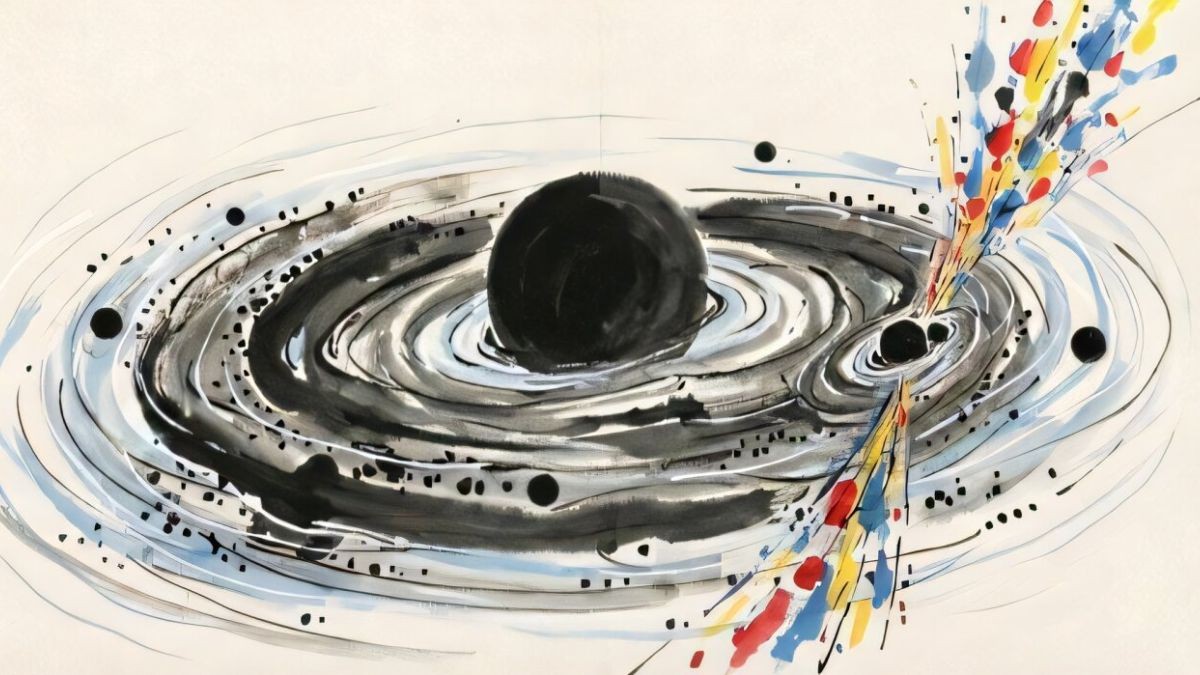
The leading hypothesis points to an active galactic nucleus (AGN) – the bright core of a galaxy powered by a supermassive black hole. Researchers led by Shu-Rui Zhang propose the black hole collision took place within the swirling disk of gas and dust surrounding this central behemoth. The merger, involving black holes with a combined mass roughly 150 times that of our Sun, triggered a surge of energy as the newly formed black hole plunged into the accretion disk.
This collision would have imparted a “natal kick” to the merged black hole, sending it careening through the dense material. The resulting disruption caused rapid accretion, superheating the surrounding gas and launching powerful jets of radiation. This is not the first time such an event has been theorized; however, this is the clearest observational evidence to date.
Implications for Understanding Black Holes
The discovery has broad implications. Most black hole mergers detected via gravitational waves have remained silent, confirming that light emission is not a typical outcome. The rarity of this event suggests the required conditions – a merger within an active accretion disk – are highly specific.
- The event highlights the chaotic environments found in galactic centers, where smaller black holes frequently spiral toward the supermassive core.
- It provides a new tool for studying black hole mergers, linking gravitational wave signals to electromagnetic observations.
- It underscores the complexity of black hole behavior and the need for more detailed simulations to understand how these events shape the cosmos.
Further research, including deeper observations of the host galaxy and refinement of simulation models, will be critical to confirm the team’s hypothesis. However, the detection of light from this black hole collision marks a significant step toward unraveling the mysteries of these enigmatic objects and the extreme environments they inhabit.
This rare event confirms that even in the darkest corners of the universe, there are still surprises waiting to be discovered.