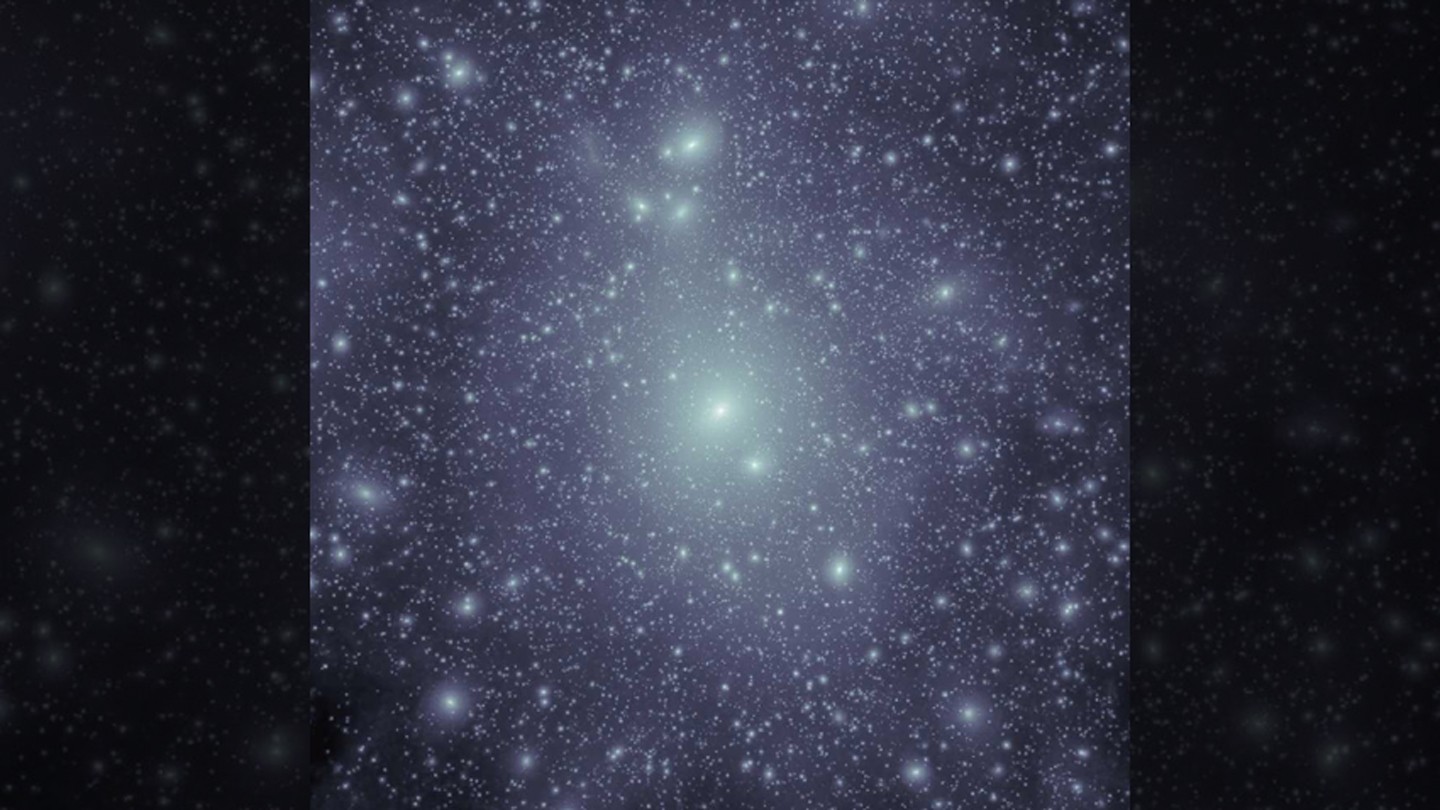
A significant concentration of dark matter, estimated to be 10 million times the mass of our sun, may reside just 3,260 light-years from Earth. This discovery, reported January 29 in Physical Review Letters, offers a rare opportunity to study the elusive substance that makes up most of the universe’s mass.
The Invisible Universe
Dark matter is one of cosmology’s greatest mysteries. We can’t see it, but we know it exists because of its gravitational effects on visible matter, like stars and galaxies. The Milky Way is thought to be embedded in a vast halo of dark matter, with smaller clumps – called subhalos – scattered throughout. Finding one so close is unexpected and important.
How It Was Found
The team detected the dark matter clump not by looking for light (since it doesn’t emit any), but by observing how gravity subtly affects pulsars. Pulsars are the rapidly spinning remnants of dead stars, which emit precise bursts of radio waves. By meticulously tracking these pulses from 53 pulsars, the researchers noticed an anomaly: two neighboring pulsars showed a slight shift in their timing, suggesting they were being pulled by something massive.
Eliminating Other Explanations
The team expanded their analysis to include 19 pulsars in the area to confirm the gravity anomaly. Critically, there were no visible stars, gas clouds, or other known objects nearby that could account for the observed gravitational distortion. This left dark matter as the most probable explanation.
Why This Matters
Mapping these dark matter subhalos could help us understand the fundamental nature of dark matter itself. Different theories predict different distributions of these clumps. If we can precisely locate them throughout the Milky Way, scientists may be able to narrow down the possibilities and finally identify what dark matter is made of. As astrophysicist Sukanya Chakrabarti puts it, “That’s the final goal. That’s what we’re after.”
This discovery represents a major step toward unraveling one of the most pressing questions in modern physics. The proximity of this dark matter clump means it can be studied in detail, potentially providing unprecedented insights into the invisible universe that shapes our own.