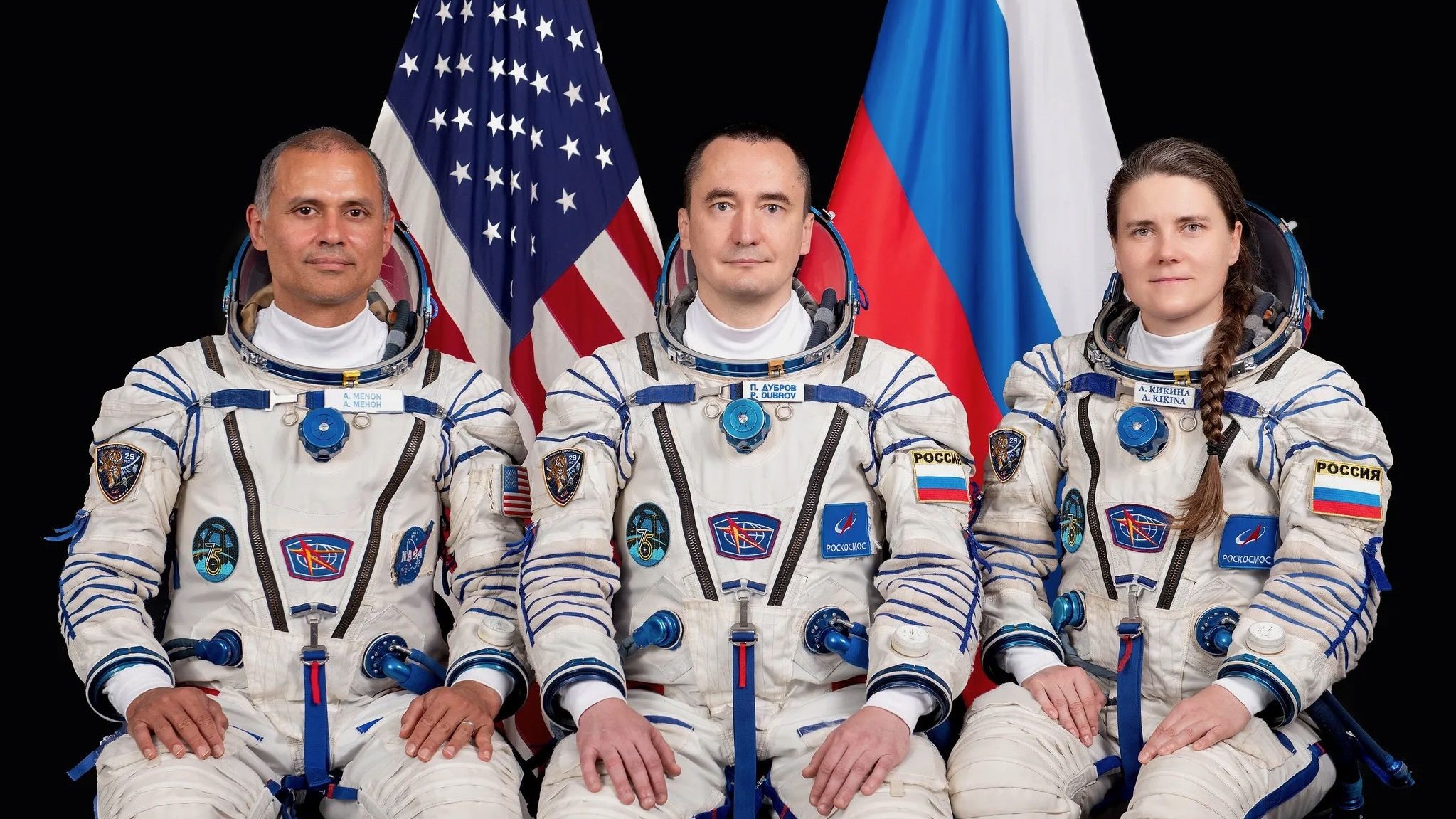
Three people. Tuesday, July 14. Head for orbit.
You can watch the Soyuz MS-29 launch live from Baikonur Cosdomome in Kazakhstan. The window is tight: lift off scheduled for 10:47 a.m. EDT. That is 7:47 p.m. local. NASA is streaming the pre-coverage at 9:45 a.m. on YouTube and Space.com. Don’t miss it.
The crew is Anil Menon, Pyotr Dubrov, Anna Kikina. Russian rocket, Russian land.
They hit the station fast. Two orbits only. Docking around 1:56 p.m. EDT. Watch that part too. Stream starts at 1:10 p.m., breaks for docking, resumes at 3:30 p.m. before the hatches open. Expect air flow by 3:55 p.m.
“Hatches open. New crew inside.”
It makes the ISS a crowded house. Nine souls up there after the handshake. Seven already aboard: Jessica Meir, Jack Hathaway (Chris Williams, Sophie Adenot and the trio of Kud-Sverchkov (Sergei Mikaev (Andrey Fedyaev (Roscosmos).
This is big for Menon. First time in space for him. He got selected by NASA in late 2021 (Group 23). His wife is Anna Menon. She got picked in 2025 (Group 24).
She has already flown. But not for NASA.
In 2024. SpaceX’s Polaris Dawn mission. Private money, private rocket. She was part of Jared Isaacman’s team. The mission did two big things. It reached an altitude of 870 mi (1,400 km)—higher than anyone else. And they did a spacewalk. The first commercial one ever.
Anil wasn’t far behind. He worked as the first flight surgeon for SpaceX before he got his astronaut wings.
His crewmates? Veterans. Both flying again. Dubrov was up from April 2020 to March 202. Kikina too. October 22. Five months out there.
Kikina carries weight. She is the only woman in the Russian corps right now. Remember 202? She flew home on a SpaceX Crew Dragon (Crew-5). Big moment. First Russian on a U.S. commercial ride since the Shuttle days ended back in 201. It had been two decades. Since Treshchov and Korzun landed in 200.
Now they lock back in. Eight months together. Menon will keep busy. No sleeping around. He’s doing semiconductor crystal work. For chips. AI. Med-tech.
Also medicine. AI-guided ultrasound.
Why bother? Maybe we don’t need doctors down on Earth telling them what to do in zero-g. Maybe they can do it themselves. Who knows how well that works up there? We will see.