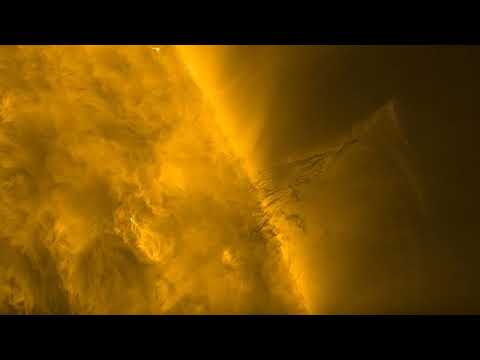
The European Space Agency’s (ESA) Solar Orbiter has captured a stunning image of a dark, arching solar prominence rising from the sun’s edge. The event, observed earlier this year using the spacecraft’s Extreme Ultraviolet Imager (EUI), showcases the powerful and dynamic nature of our star.
What are Solar Prominences?
Solar prominences are vast structures of electrically charged gas – plasma – held in place by the sun’s complex magnetic fields. Despite the sun’s scorching atmosphere, which often exceeds one million degrees, the plasma within these prominences remains relatively cool at around 18,000 degrees Fahrenheit (10,000 Celsius). This lower temperature makes them appear darker when viewed against the brighter solar corona.
When these structures are visible against the darkness of space, they’re called prominences; when stretched across the sun’s disk, they are known as filaments. Both can extend for tens of thousands of miles, dwarfing the size of Earth many times over.
Where was this Image Taken?
The observation was made from approximately 39 million miles (63 million kilometers) from the sun – roughly the same distance as Mercury’s orbit. This close proximity allows Solar Orbiter to gather detailed data about the sun’s activity.
Why Does This Matter?
This observation is crucial for understanding the sun’s magnetic behavior, the origin of solar wind, and energetic processes that affect space weather around Earth. The sun is approaching the peak of its 11-year activity cycle, meaning events like prominences, filaments, and coronal mass ejections will likely become more frequent.
“Being able to observe these phenomena allows scientists to understand the magnetic dynamics at play in the sun’s atmosphere,” ESA scientists stated.
Solar Orbiter, a collaboration between ESA and NASA, carries ten instruments designed to study the sun from multiple angles. The Extreme Ultraviolet Imager, led by the Royal Observatory of Belgium, is essential for visualizing the solar atmosphere in high resolution.
The mission launched in 2020 and continues to provide valuable data about our star’s behavior, helping improve our ability to predict and mitigate the impact of solar events on Earth’s technology and environment.
The sun’s magnetic dynamics are critical to understanding not only space weather but also the broader interplay between stars and their orbiting planets. These observations represent a significant step towards unraveling these complex relationships.