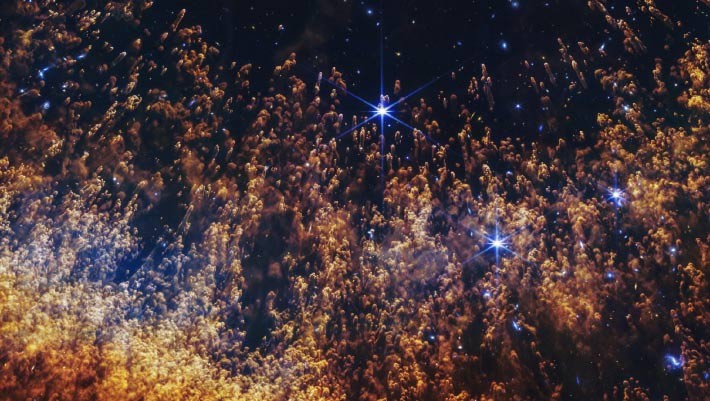
The James Webb Space Telescope has delivered a striking new infrared image of the Helix Nebula, a planetary nebula 655 light-years away in the constellation Aquarius. This latest view isn’t just another pretty picture of space; it offers crucial insights into how stars die and how their remnants could seed future planetary systems.
The Nebula’s History and Significance
First observed in the early 1800s, the Helix Nebula has long captivated astronomers. Its proximity to Earth and striking, ring-like appearance make it a popular target for both amateur and professional observation. Planetary nebulae are formed when dying stars shed their outer layers of gas and dust. This process is key to understanding stellar evolution, and the Helix Nebula provides a detailed example of this transformation.
Webb’s Infrared View: Uncovering Hidden Structures
The new image from Webb’s Near-Infrared Camera (NIRCam) reveals previously unseen details in the nebula’s structure. Pillars of gas and dust, resembling comets with extended tails, encircle the inner region. These features are the result of violent collisions between hot gas expelled by the dying star and cooler gas and dust shed earlier in its life.
This interaction isn’t just visually stunning; it’s also scientifically important. The extreme temperatures and chemical compositions revealed by Webb’s infrared sensors paint a vivid picture of the nebula’s evolution.
Temperature and Chemical Gradients
The image demonstrates a clear temperature gradient:
- Blue hues indicate the hottest gas, energized by intense ultraviolet light from the central white dwarf.
- Yellow regions show cooler gas where hydrogen atoms bond into molecules.
- Reddish tones trace the outermost, coolest material where gas thins and dust begins to form.
This distribution of temperature and chemistry is vital because it showcases how the dying star’s energy is shaping the nebula’s environment.
The White Dwarf at the Heart of the Matter
At the center of the Helix Nebula lies WD 2226-210, a blazing white dwarf that isn’t visible in this particular image. The white dwarf’s intense radiation ignites the surrounding gas, creating a vibrant display of ionized elements and protective pockets where complex molecules can form within dust clouds.
This process is crucial: the ejected material from dying stars contains the raw ingredients for future planet formation. The Helix Nebula isn’t just a beautiful celestial object; it’s a stellar nursery in reverse, providing the building blocks for new worlds.
The Webb telescope’s observations continue to redefine our understanding of the cosmos, and this new image of the Helix Nebula is a powerful reminder of the constant cycle of birth, death, and renewal in the universe.