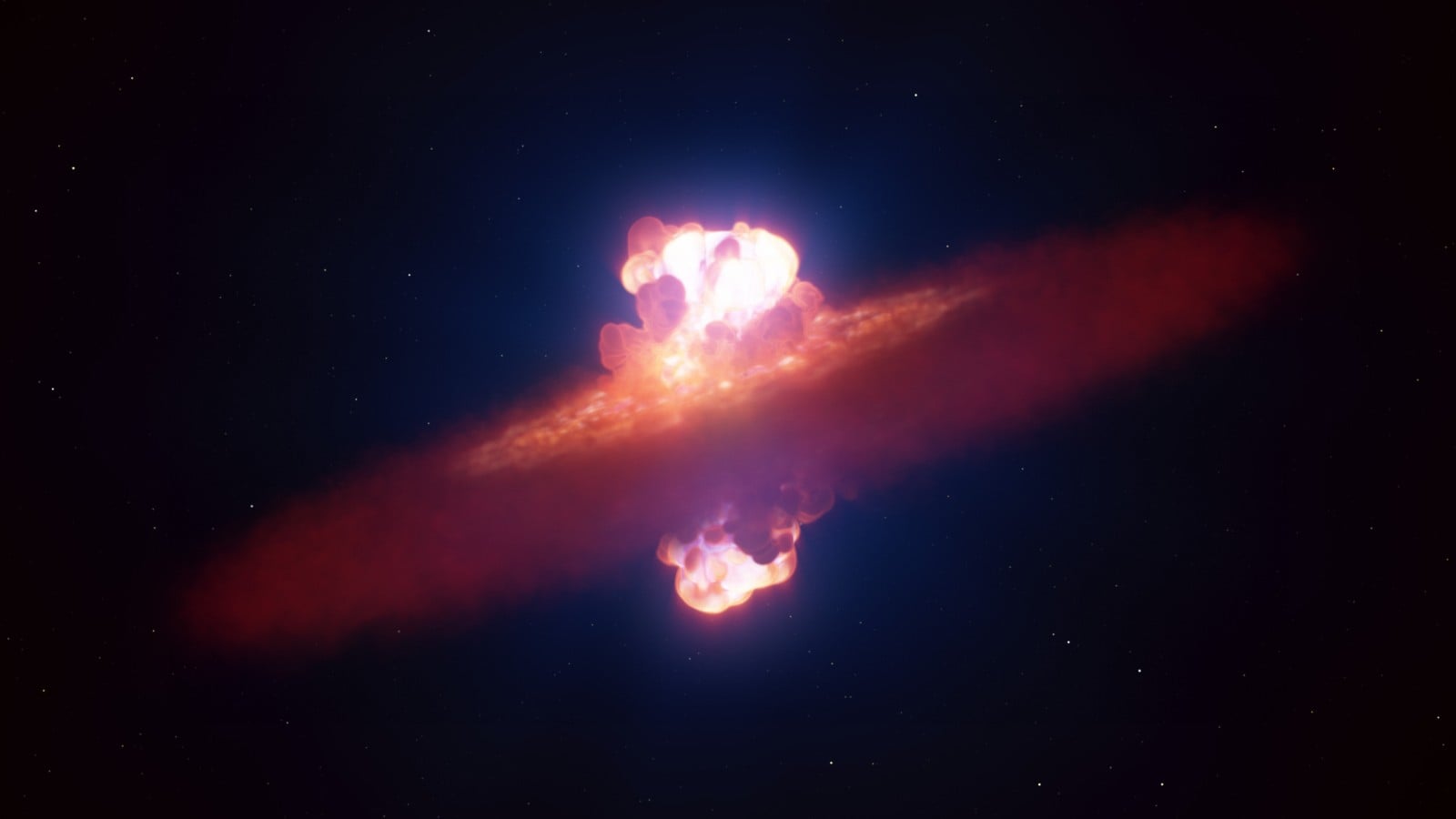
For the first time, scientists have mapped the early shape of a supernova explosion, revealing that these stellar deaths aren’t the symmetrical events previously assumed. The discovery, made possible by rapid observations using the Very Large Telescope (VLT) in Chile, challenges existing models of how massive stars die and provides key insights into the physics of these cataclysmic events.
Initial Detection and Rapid Response
On April 10, 2024, the Asteroid Terrestrial-impact Last Alert System (ATLAS) detected the first light from a supernova – the explosion of a star 12 to 15 times the mass of our sun. Within 26 hours, astronomers focused the VLT on the event, designated SN 2024ggi, located approximately 22 million light-years away in the galaxy NGC 3621. This speed was crucial; the initial shape of the explosion would have been obscured within a day as the shockwave interacted with surrounding gas.
The Unexpected Shape
The data obtained using a technique called spectropolarimetry revealed that the initial shockwave wasn’t spherical. Instead, it was stretched along one axis, resembling an olive. This means that the energy wasn’t released equally in all directions, defying the conventional understanding of stellar collapse.
This finding is significant because it implies a directional mechanism at play during the explosion, something previous models didn’t account for. The early asymmetry suggests that the physics governing supernova breakouts are more complex than previously thought.
How Stellar Death Works: A Brief Explanation
Massive stars maintain their shape through a constant battle between gravity pulling inward and the outward pressure from nuclear fusion. When fusion stops, gravity wins, causing the star to collapse. This collapse generates a shockwave that rips the star apart, releasing immense energy.
Traditionally, astronomers believed this shockwave would expand spherically. However, SN 2024ggi shows that the initial breakout wasn’t uniform, indicating a bias in the explosion’s direction. Even 10 days later, the hydrogen-rich outer layers of the star were aligned with the same axis, proving that the directional shape wasn’t just an early anomaly.
Implications for Supernova Models
The VLT’s FORS2 instrument, uniquely positioned in the Southern Hemisphere to make this measurement, provided critical data. The observations have already ruled out some existing supernova models while supporting others, giving scientists a better understanding of how these explosions occur.
“This is a fundamental question in astrophysics: how do massive stars end their lives? This discovery provides a new constraint on models and could lead to a better understanding of the processes that shape the universe.”
The study, published in Science Advances on November 12, 2024, marks a turning point in supernova research. By capturing the initial shape of a supernova for the first time, astronomers have opened a new window into the violent deaths of stars and the underlying physics that drive them. This breakthrough will undoubtedly reshape our understanding of how heavy elements are created and dispersed throughout the cosmos.