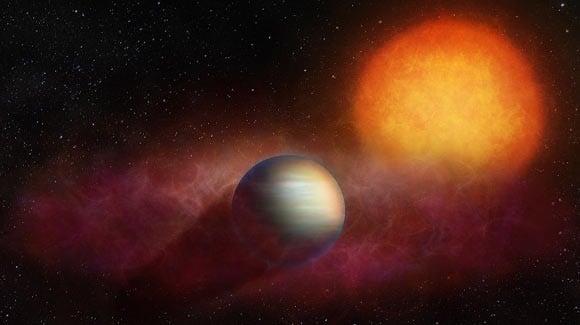
Astronomers using the James Webb Space Telescope (JWST) have observed significant helium gas escaping from WASP-107b, a unique exoplanet located 212 light-years away in the Virgo constellation. This finding provides key insights into how planets lose their atmospheres—a process critical to understanding planetary habitability and evolution.
Discovery of Atmospheric Escape
The JWST’s Near Infrared Imager and Slitless Spectrograph (NIRISS) detected a massive helium cloud surrounding WASP-107b. This “super-puff” or “cotton-candy” planet, first identified in 2017, is exceptionally low in density and orbits its star at a distance of less than 16 times the Earth-Sun distance. Its orbit takes just 5.7 days.
The escaping helium isn’t a minor trickle; it forms a cloud so large it partially obscures the star’s light before the planet passes in front of it. Models suggest this cloud extends to ten times the planet’s radius in the direction of its orbit.
Why This Matters
Atmospheric escape is a fundamental process shaping planetary evolution. On Earth, we lose roughly 3 kg of atmosphere per second, mostly hydrogen. For planets closer to their stars—like WASP-107b—this effect is dramatically amplified. The high temperatures (around 500°C or 932°F) caused by tidal heating (from a slightly elliptical orbit) accelerate this loss.
“It is therefore essential to fully understand the mechanisms at work in this phenomenon, which could erode the atmosphere of certain rocky exoplanets,” explains University of Geneva astronomer Vincent Bourrier.
The loss of atmosphere can determine whether a planet retains liquid water or becomes barren, like Venus. This research helps scientists assess which exoplanets might be habitable, and why others aren’t.
Clues About Planet Formation
In addition to helium, the JWST data confirmed the presence of water, carbon monoxide, carbon dioxide, and ammonia in WASP-107b’s atmosphere. These compounds provide clues about the planet’s formation and migration history. Scientists believe WASP-107b likely formed further from its star and then moved inward, leading to its inflated atmosphere and ongoing gas loss.
Key Findings
- Significant Helium Leakage: JWST detected a massive helium cloud escaping WASP-107b.
- Low Density: The planet is exceptionally low in density, resembling a “cotton-candy” world.
- Atmospheric Erosion: The findings highlight how atmospheric escape can strip planets of their atmospheres.
- Migration History: The planet likely formed further out and then migrated closer to its star.
The research, published in Nature Astronomy, underscores the power of the JWST to probe exoplanetary atmospheres and unravel the mysteries of planetary evolution. Understanding these processes is critical for assessing the potential habitability of exoplanets and charting the future of planetary science.