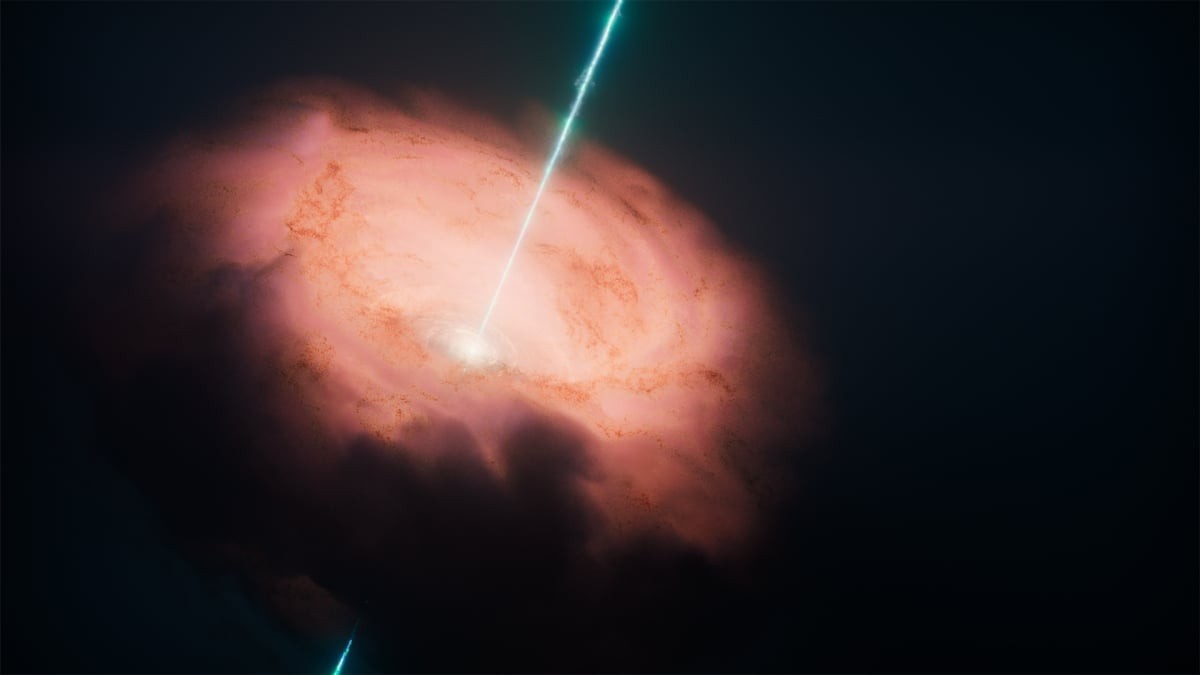
Astronomers using the James Webb Space Telescope have made a key observation about how supermassive black holes consume matter. The study, focused on the Circinus galaxy 13 million light-years away, shows that nearly all the dust and gas fueling the black hole is concentrated in a dense ring, rather than scattered by outflows as previously assumed. This discovery challenges decades of models and provides a clearer picture of how galaxies emit infrared light.
The Unexpected Structure of a Black Hole’s Fuel Supply
For years, scientists believed that the brightest infrared emissions from active galaxies were primarily produced by streams of hot gas pushed out by black holes. However, Webb’s high-resolution imaging reveals the opposite: approximately 87% of the glowing dust resides in a compact disk feeding the black hole, with less than 1% ejected as exhaust. This structure, known as a “torus,” acts as both a funnel and a regulator – directing material inward while controlling how energy escapes.
“Since the ’90s, it has not been possible to explain excess infrared emissions… the models only take into account either the torus or the outflows, but cannot explain that excess.” – Enrique Lopez-Rodriguez, University of South Carolina
Why This Matters: Refining Our Understanding of Galaxies
The new findings are significant because they force a reassessment of how galactic energy is produced. Black holes are central engines in many galaxies, and accurately modeling their behavior is crucial for understanding galactic evolution. The old models were incomplete. The discrepancy between predicted and observed infrared light has puzzled astronomers for decades, and this research finally provides a strong explanation: the fuel source is far more focused than previously thought.
How the Discovery Was Made
The team achieved this breakthrough using Webb’s Aperture Masking Interferometer, an advanced tool that effectively doubles the telescope’s resolution by combining light from multiple small openings. This technique allowed researchers to reconstruct sharp images of the Circinus galaxy’s center, revealing the previously hidden details of the black hole’s feeding zone. This marks the first time a space-based infrared interferometer has been used to study an object outside our Milky Way, opening the door for similar observations of other black holes.
The Future of Black Hole Research
To confirm whether Circinus is an outlier or representative of other black holes, scientists plan to expand their sample size. A statistical study of a dozen or two dozen black holes will be needed to determine the common patterns of accretion disks and outflows. This refined data will allow for more accurate models of galactic energy production and a deeper understanding of these mysterious cosmic engines.
The discovery underscores the power of new technologies like Webb in overturning long-held assumptions and providing a clearer view of the universe’s most extreme phenomena.