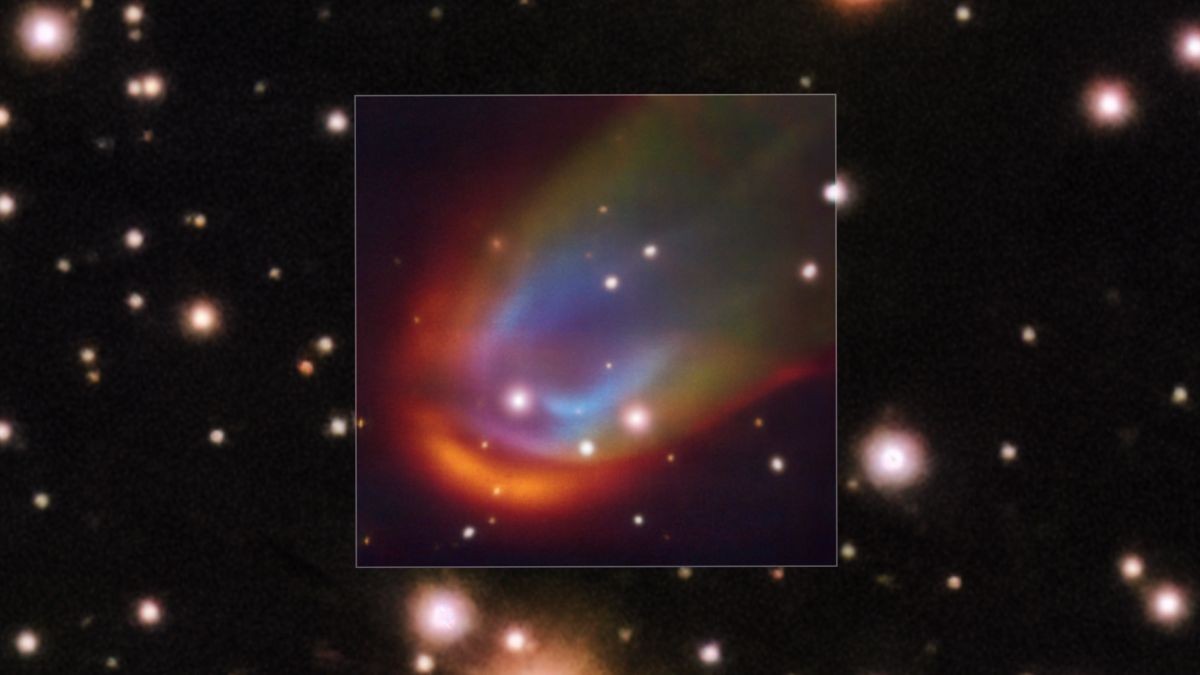
Astronomers are puzzled by a vibrant, multi-colored nebula surrounding a nearby white dwarf star, RXJ0528+2838, located 731 light-years from Earth. The glowing structure, known as a bow shock, appears to be driven by an unexplained outflow of energy from the dead star.
The Anomaly Explained
White dwarfs are the dense remnants of stars like our Sun after they have exhausted their fuel. Though small – roughly Earth-sized – they pack the mass of up to 1.4 suns. Typically, such stars either exist in solitary silence or siphon material from a companion star, forming a swirling disk that often leads to energetic outbursts.
RXJ0528+2838 breaks this pattern. It has a low-mass companion, but no disk has been observed. Yet, the bow shock around it is powerful enough to have been emitting energy for roughly 1,000 years, a duration that doesn’t align with the short-lived explosions usually associated with white dwarf interactions.
What Makes This Unusual?
Bow shocks form when stellar outflows collide with surrounding interstellar gas. In most cases, these outflows are driven by material from a disk circling the white dwarf. The absence of a disk suggests an alternative mechanism is at play.
The research team believes the star’s intense magnetic field may be diverting material directly from the companion star, bypassing the usual disk formation. This would funnel energy onto the white dwarf and create the observed outflow without the typical intermediary step.
“Our observations reveal a powerful outflow that, according to our current understanding, shouldn’t be there,” explains astronomer Krystian Ilkiewicz of the Nicolaus Copernicus Astronomical Center.
Why This Matters
This discovery challenges existing models of how matter behaves in extreme binary star systems. If confirmed, it means white dwarfs can generate powerful outflows even without a disk, opening new questions about the physics governing these interactions. The finding underscores that our understanding of stellar evolution and magnetic field dynamics is still incomplete.
The unexpected presence of a persistent, high-energy outflow from a diskless white dwarf system raises fundamental questions about how matter moves and interacts in extreme environments. Further study will be crucial to unraveling the underlying mechanism and refining our models of stellar evolution.