Archaeological discoveries suggest that humans were using mathematical concepts thousands of years earlier than previously thought. New research indicates that ancient potters in Mesopotamia, dating back nearly 8,000 years, embedded mathematical patterns in their artwork. These findings challenge the long-held belief that structured mathematical thinking emerged with the Sumerian civilization around 3000 B.C.
The Halafian Culture and Their Pottery
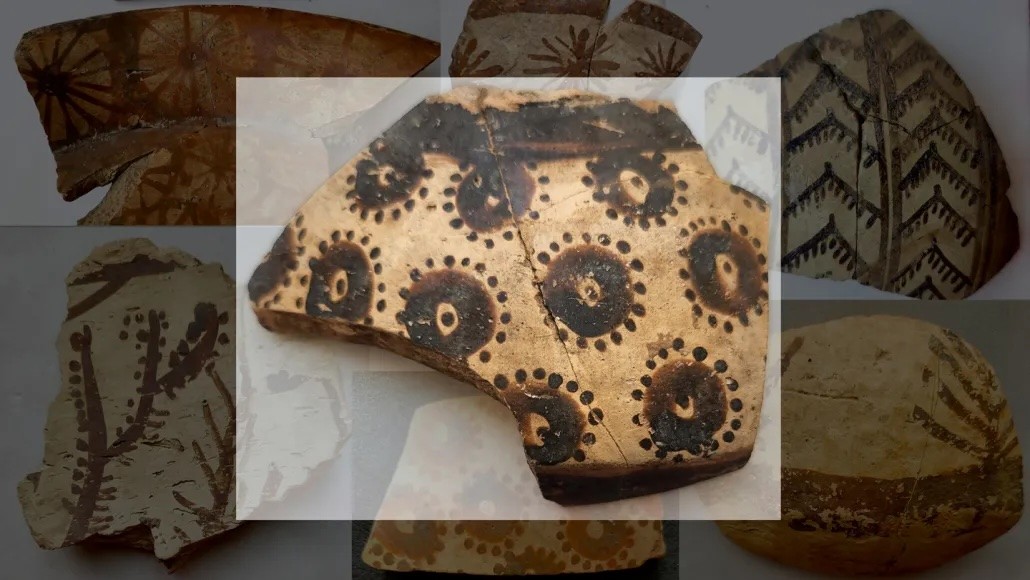
Between 6200 B.C. and 5500 B.C., the Halafian people thrived in Mesopotamia, the region encompassing modern-day Iraq. They were skilled artisans, particularly known for their intricate pottery decorated with floral designs. For decades, archaeologists have admired these designs; now, a new study published in the December 2025 Journal of World Prehistory reveals that these patterns aren’t merely decorative—they’re a form of early mathematical expression.
Decoding the Floral Patterns
Researchers Yosef Garfinkel and Sarah Krulwich from the Hebrew University of Jerusalem meticulously cataloged thousands of pottery fragments excavated since the 1930s. Out of 375 fragments featuring floral motifs, an astonishing pattern emerged: the flowers almost universally displayed petals in powers of two—4, 8, 16, 32, or 64.
This isn’t random. The consistent use of doubling numbers suggests that the Halafians possessed a sophisticated understanding of mathematical progression. This predates the earliest known written mathematical records by thousands of years.
Implications and Broader Context
While the Sumerians are credited with developing a base-60 system that underpins our modern timekeeping, the Halafian pottery suggests that mathematical concepts were being explored much earlier. The Halafians lived during the Neolithic period when communities were transitioning from nomadic lifestyles to settled agriculture. This new evidence implies that math wasn’t solely a product of complex civilizations but may have originated from practical needs in early farming societies.
The researchers suggest that this early mathematical thinking could have been used for land division, crop allocation, or even simple trade.
“This is evidence of [math] knowledge that we are not aware of from any other source,” Garfinkel notes.
The discovery raises questions about how early human societies conceptualized and applied math before the advent of formal writing systems. It reinforces the idea that mathematical thinking isn’t just a cultural invention, but a fundamental cognitive ability that developed alongside human settlement and agriculture.
This finding adds a new layer to our understanding of early human intelligence and its role in shaping the first civilizations.