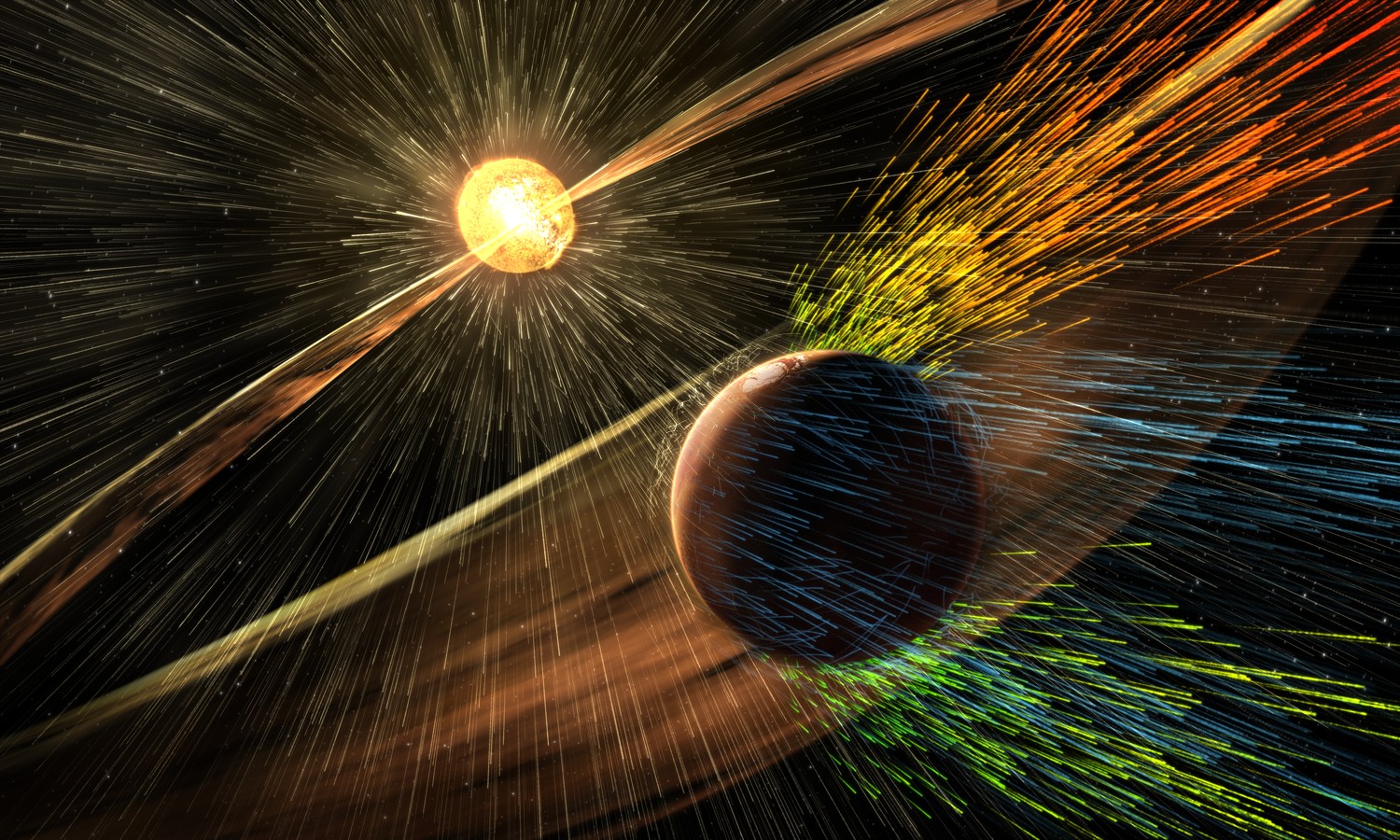
A recent solar superstorm, the largest in over two decades, simultaneously impacted Earth and Mars, triggering dramatic atmospheric changes on the Red Planet. European Space Agency orbiters – Mars Express and the ExoMars Trace Gas Orbiter – recorded unprecedented surges in atmospheric electrons, providing vital data on how planetary atmospheres respond to extreme space weather. This event underscores the risks space weather poses to technology and highlights the stark differences between Earth’s shielded environment and Mars’ exposed conditions.
The Storm’s Impact on Mars
The solar storm, which reached Earth on May 11, 2024, delivered approximately 200 days’ worth of radiation to Mars in just 64 hours. This caused a substantial increase in electron density within the Martian upper atmosphere: a 45% rise at 68 miles (110 kilometers) and an astonishing 278% increase at 81 miles (130 kilometers) above the surface. These are the highest electron counts ever observed in the Martian atmosphere, according to ESA researchers.
The storm also caused temporary glitches in both orbiters’ systems – a typical hazard of energetic space particles. However, the spacecraft were engineered with radiation-resistant components and error-correction protocols, allowing them to recover quickly.
Pioneering Measurement Technique
Scientists utilized a technique called radio occultation to analyze the storm’s effects. This involves transmitting a radio signal from one orbiter (Mars Express) through the Martian atmosphere to another (ExoMars TGO) as it dips below the horizon. The signal’s refraction reveals atmospheric details, similar to how ocean waves bend around objects.
“This technique has been used for decades in the solar system, but only recently have we applied it between two spacecraft at Mars,” explains Colin Wilson, ESA project scientist. The timing of the observation – just 10 minutes after a major solar flare hit – was remarkably fortunate, given that observations are currently conducted only twice a week.
Earth vs. Mars: A Tale of Two Atmospheres
The study highlights a fundamental difference between Earth and Mars. Earth’s magnetosphere deflects much of the solar wind, mitigating its impact on the atmosphere. Mars, lacking a global magnetic field, is directly exposed to solar radiation.
The event revealed that Earth and Mars react very differently to charged particles from the sun. The planet’s magnetic field protects Earth while Mars remains vulnerable.
Implications for Planetary Evolution and Future Missions
This research could shed light on how Mars lost much of its atmosphere and water over billions of years. The continuous influx of solar particles strips away atmospheric gases, contributing to the planet’s current arid state. Understanding this process is crucial for assessing the long-term habitability of planets.
The electron surge also has practical implications for future missions. Denser electron populations can interfere with radar signals used to study the Martian surface, potentially hindering exploration efforts. The team’s findings will help refine mission planning and improve our ability to navigate and investigate other worlds.
This study reinforces the importance of space weather prediction and the need for robust spacecraft design. The solar superstorm served as a stark reminder of the unpredictable forces at play in our solar system, and how vulnerable even our most advanced technology can be.