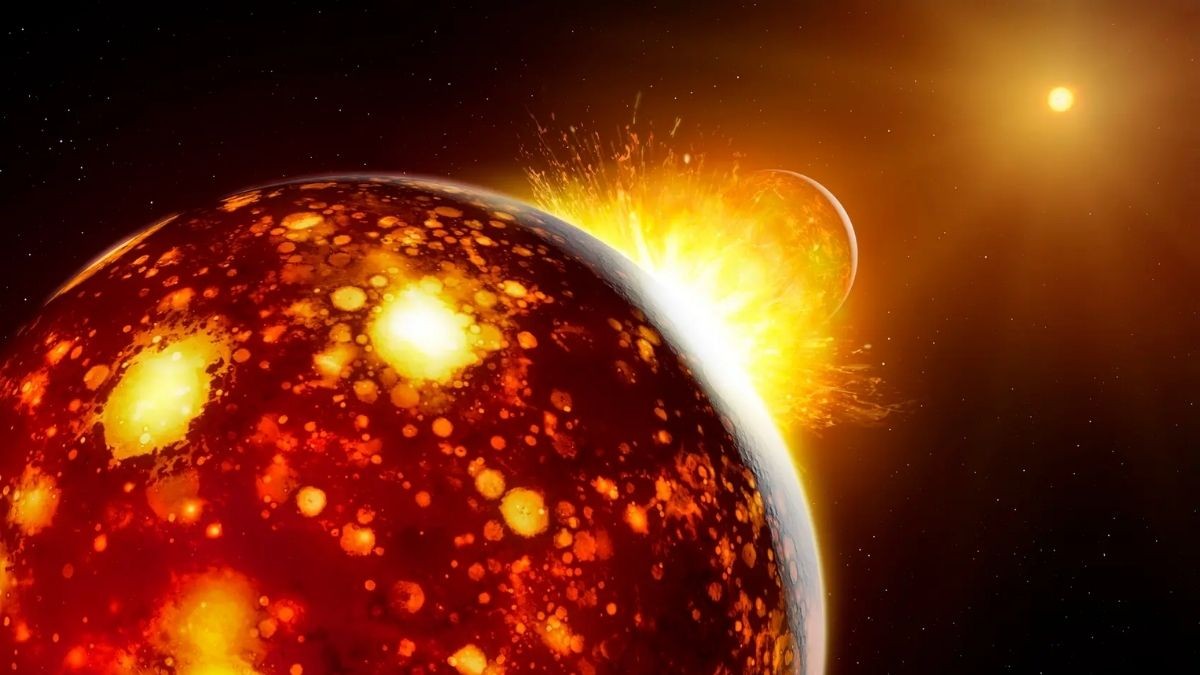
For billions of years, scientists have pieced together the story of our Moon’s formation: a cataclysmic collision between early Earth and a Mars-sized object called Theia. Now, new research confirms where this planet-altering impactor came from – the warmer, inner regions of our solar system.
The Collision That Changed Everything
Roughly 4.5 billion years ago, Theia slammed into proto-Earth, vaporizing much of both bodies. The resulting debris eventually coalesced, forming the Earth we know today, alongside its lunar companion. But the mystery remained: what was Theia’s birthplace? The answer lies in the chemical fingerprints preserved in Earth’s mantle, the Moon, and ancient meteorites.
Isotope Ratios as Cosmic Fingerprints
Researchers from the Max Planck Institute and the University of Chicago analyzed isotope ratios – variations in the number of neutrons within elements – found in Earth, lunar samples, and meteorites. These ratios act as a unique identifier, revealing where a celestial body formed. Just like a poorly mixed cake batter, different regions of the early solar system had distinct chemical compositions.
The key finding? The Earth’s mantle contains iron that likely arrived after the planet’s initial formation, delivered by Theia. But Theia’s isotopic signature doesn’t match any known building blocks of our planet. This suggests it wasn’t a random wanderer from the outer solar system. Instead, the evidence points to a neighbor from the inner disk, closer to the Sun than Earth itself.
Inner Solar System Origins Confirmed
Meteorites serve as cosmic time capsules, categorizing by origin. Non-carbonaceous (NC) meteorites come from the inner solar system, baked by the Sun’s heat. Carbonaceous chondrites (CC) formed in colder regions, retaining carbon and water. The Earth’s mantle isotope ratios align with NC meteorites, but Theia’s signature remains distinct.
“The most convincing scenario is that most of the building blocks of Earth and Theia originated in the inner Solar System,” explains Timo Hopp, lead author of the study. This means Earth and Theia were likely neighbors in the early solar system, sharing a common origin before their violent encounter.
The aftermath of this collision gave us our Moon, which continues to drift away from Earth at a glacial pace of 1.5 inches per year. The discovery of Theia’s origins not only clarifies the Moon’s formation but also deepens our understanding of the chaotic early stages of our solar system.